
On World Solar Day, India stands at the cusp of a dual revolution: one in its fields and one in its energy grids. The concept of agriphotovoltaics (Agri-PV)—integrating solar energy generation with agricultural production—is transforming the landscape, promising a future where farmers are not just growers of food but also producers of clean power .
The Promise of Agriphotovoltaics
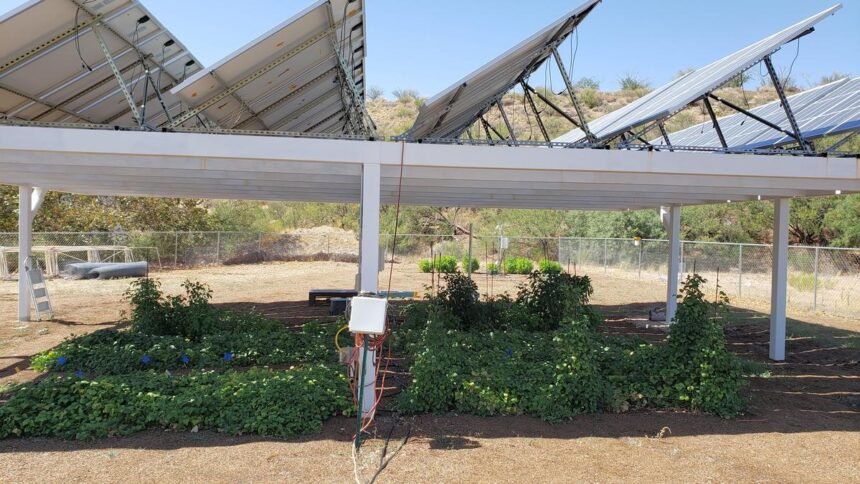
Agri-PV offers a model that maximizes land-use efficiency. By elevating solar modules about 2 metres above the ground, crops can grow underneath, allowing for a “dual harvest” of food and energy . This approach, pioneered by German scientists in 1981, is proving particularly relevant for India, which faces the challenge of feeding a growing population while meeting ambitious renewable energy targets .
The benefits are tangible. In Najafgarh, Delhi, a farmer leasing land to a solar company saw his income triple—from ₹41,000 per acre a year to ₹1 lakh in rent, plus additional earnings from continuing to farm high-value shade-loving crops like turmeric and ginger .
Record Growth in Solar Capacity
India’s commitment to solar energy is evident in its staggering growth figures. As of March 2026, India’s total solar capacity has reached 150 gigawatts (GW), a 53-fold increase from just 2.82 GW in 2014 . The last 50 GW were added in just 15 months—the fastest growth in the nation’s history . Currently, nearly 50% of India’s installed power capacity now comes from non-fossil fuel sources .
A recent study mapping Agri-PV potential across India identified over 200,000 square kilometres of cropland as highly suitable for deployment, with states like Rajasthan, Gujarat, Punjab, and Haryana leading the way .
Solarising Agriculture: PM-KUSUM and Beyond
The government’s flagship Pradhan Mantri Kisan Urja Suraksha evam Utthaan Mahabhiyan (PM-KUSUM) scheme is central to this transition. As of mid-2025, the scheme has facilitated the installation of over 840,000 off-grid solar pumps and over 5 GW of off-grid solar capacity . States like Haryana and Maharashtra are scaling up rapidly, offering substantial subsidies to farmers to replace diesel pumps and solarise agricultural feeders .
However, challenges persist. The high capital expenditure for Agri-PV systems—about 11% more than standard ground-mounted solar plants—requires strong economic incentives and farmer-centric policy frameworks . Small farmers often lack the risk appetite and capital to own these systems, pointing to the need for innovative financing and institutional support through Farmer Producer Organisations (FPOs) .
Solar-Powered Cold Storage: A Game Changer
Beyond irrigation, solar energy is also tackling post-harvest losses. Innovations like the Pusa-Farm SunFridge—a battery-less, grid-independent cold storage system—are empowering farmers to preserve perishable produce at one-tenth the cost of traditional systems . These solar absorption cold storage systems, developed in collaboration with international partners, are proving to be a sustainable solution, particularly in remote and underserved regions .
The Road Ahead
As India marks World Solar Day, the message is clear: the future of Indian agriculture is intertwined with solar energy. By scaling Agri-PV, expanding solar irrigation, and fostering innovations like solar cold storage, India is not just cultivating crops—it is cultivating a sustainable, self-reliant, and prosperous future for its farmers. The country’s clean energy journey is now being powered by the sun, one field at a time .