
From the air, the spring landscape of Nebraska is a vast expanse of brown farmland stretching out below, ready for farmers to dig in and plant their corn and soybeans, the state’s two top crops. But what flying above Nebraska doesn’t show is the vast network of aquifers and groundwater that supplies those millions of farm acres, a resource that has been threatened in recent years by drought and nitrogen fertilizer contamination.
On the ground at the University of Nebraska-Lincoln, faculty and researchers are working on solutions to these problems, while concurrently preparing students for the future of agriculture. The university’s fledgling major, agricultural systems technology, blends hard science, data science, engineering and management.
It’s designed to prepare students for what’s known as precision agriculture, which uses high-tech approaches to farming that can improve both efficiency and environmental impacts. Along with traditional training, this agriculture degree requires an understanding of data science to enable analysis of information from satellite imagery and myriad sensors that collect details on soil health, crop growth and water usage.
The Challenge of Adoption
If farmers could take advantage of the new technology, experts say, it might help enable farms to stay in business with less manpower. But many farmers, especially older ones, have been reluctant to adopt the new practices because they didn’t have the education necessary to interpret the data, according to a 2024 Government Accountability Office report on precision agriculture.
“There’s growing numbers of data available, but it’s hard to make use of all that data,” said Derek Heeren, a professor in the biological systems engineering department at Nebraska-Lincoln, whose research focuses on precision irrigation. “So a lot of what we do is that tech piece, collecting data, logging data, analyzing data.”
The New Curriculum
Teaching this to undergraduates is a relatively new phenomenon. Among the dozens of colleges and universities that offer agriculture-related degrees, only six have a full major in agricultural systems technology: Nebraska-Lincoln, Iowa State, Oklahoma State, the University of Missouri, South Dakota State and Utah State.
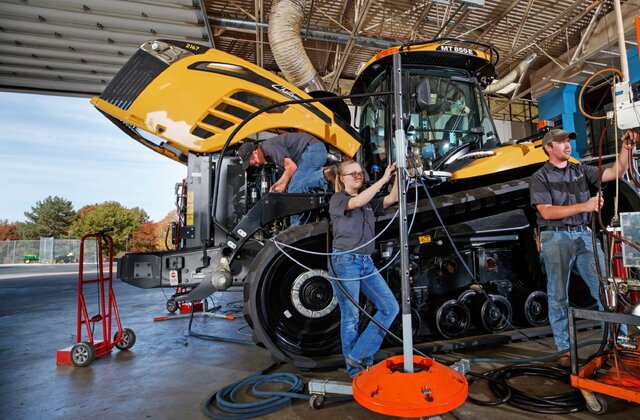
Along with data analytics, the agricultural systems technology students at Nebraska-Lincoln take courses in hydraulics, electrical systems, entrepreneurship and more. They learn how to use drones for tasks like spraying pesticides in small and targeted quantities and surveying land, and how to operate autonomous tractors remotely.
Outside the classroom, they can intern at on-campus labs like the Machine Automation & Agricultural Robotics Lab, the Agricultural Intelligence Lab and the Nebraska Tractor Test Lab—the only one of its kind in the country. Students also participate in clubs like the quarter-scale tractor team, where they build a small tractor and enter a year-end nationwide competition.
The Labor Shortage
Labor shortages have plagued agriculture for years because of the aging farmer population. Nationally, the average farmer’s age has crept upward, from 53 in 2002 to 58 in 2022, according to the U.S. Department of Agriculture’s 2022 Census of Agriculture. The hired farmworker population is also aging; it rose from 36 in 2006 to just under 40 in 2022.
Even as farming methods become less labor-intensive and more tech-driven, the number of students ready to fill the new kinds of jobs remains relatively low. A joint Purdue University and USDA report projects that nearly 20,000 jobs in food production will open annually between 2025 and 2030, but that colleges with agriculture-related programs will only graduate 58.7 percent of the graduates needed to fill those jobs.
“We can’t graduate enough students in any of these programs right now because there’s just such a demand across the state,” said Joe Luck, interim department chair of the biological systems engineering department at Nebraska-Lincoln.
Concerns About the Future
Bruce Erickson, a professor of digital agriculture at Purdue University, said that the lower number of students majoring in the field could be related to turmoil within the agriculture industry. “Agriculture has lots of problems right now,” he said, including high fertilizer prices, fluctuating crop prices and concern about environmental impacts.
“The typical farmer is viewed somewhat suspiciously,” he said, “out there with their humongous sprayer putting on pesticides.” He believes this perception has influenced some students to reject studying agriculture.
The AI Question
As the field changes, concerns about job prospects are on the minds of parents. Luck said that parents who tour the college with their children have begun asking if a degree from the program will be AI-proof. “Who would’ve thought five years ago you’d be answering questions like that in a recruitment visit?” said Luck.
But many agriculture professors at Nebraska-Lincoln are bullish on AI. “We’ve changed from how can we keep students from using AI to how can we encourage them to use AI appropriately and when is it appropriate and when is it not?” said Rick Stowell, a biological systems engineering professor at UNL.
Luck said students will use AI in the next generation of agriculture jobs, but he doesn’t think it will replace them. “I’m not concerned about that threat to them yet because we still interface with the real world,” he said. “Our programs are really geared towards, ‘How do we interface with water, soil, plants, animals and humans.'”