
Indigenous soil and water management practices are sustaining the centuries-old terrace farming model of the Angami community in Nagaland, according to a new study by a team from Nagaland University .
The research, published in a SAGE journal, moves beyond the technical aspects of terrace cultivation to examine the broader social, cultural, and ecological knowledge systems that underpin its long-term success . The authors, Ketekhoto Neihu and Dr. Srikanth Yamsani of the university’s Tribal Research Centre, argue that the farming practices of the Angami Nagas are not only ecologically adaptive but also culturally resilient, contributing significantly to food production and environmental stewardship .
A Sophisticated System of Terrace Cultivation
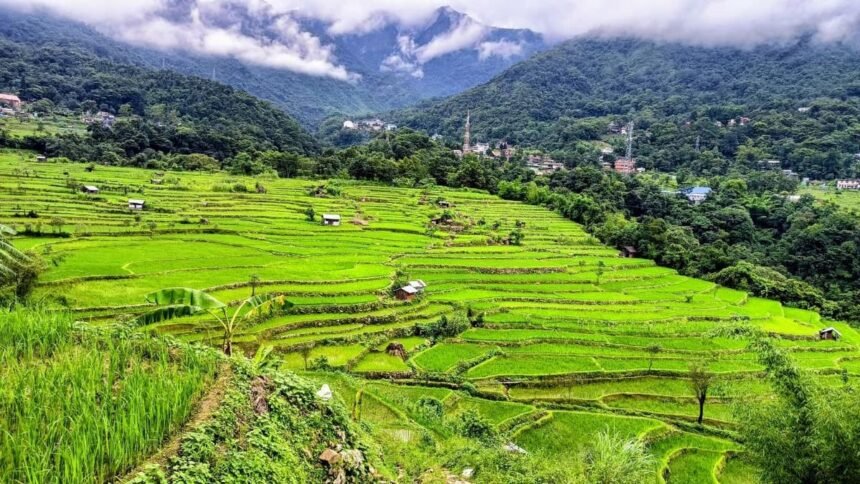
While shifting cultivation, or jhum, remains the predominant agricultural method across Nagaland’s rugged terrain, the Angami community has maintained a distinct and ancient tradition of constructing bench terraces for paddy cultivation on steep slopes . This system, known locally as panikheti or wet cultivation, is a testament to their sophisticated engineering and ecological understanding .
“The terrace farms are built using traditional construction methods, which reduce soil erosion and enable proper utilisation of water,” the paper notes . The irrigation channels are intricately constructed according to the slope of the terraces, allowing water to flow freely to all fields without causing overflow . This efficient water management is complemented by a continued reliance on organic inputs, reflecting a deep-seated commitment to protecting both the environment and human health .
Farming in Harmony with Nature
A key finding of the study is how the Angami people continue to practice agriculture in close association with natural cycles and environmental cues . Farmers make critical decisions about planting, transplanting, and harvesting based on keen observations of nature, including clues like plant bloom times, bird habits, and insect activity . This indicates a profound, living knowledge of the local ecosystem refined over generations.
A Living System for a Sustainable Future
Nagaland University Vice-Chancellor Prof. Jagadish Kumar Patnaik emphasised the study’s significance, stating that the research “demonstrates how traditional wisdom continues to support agricultural productivity, ecological balance, and community resilience in the hill landscapes of Nagaland” . He added that the findings underscore the importance of documenting and preserving indigenous knowledge systems as the world seeks climate-resilient agricultural solutions .
The research highlights that agriculture among the Angami is deeply rooted in community life, culture, and social cooperation, rather than being purely an economic activity . However, the study also points to emerging challenges, such as changing rainfall patterns and climate variability, which are putting these traditional systems under new pressure .
The findings are expected to help guide development policies and projects, ensuring they do not inadvertently undermine indigenous agricultural methods that have proven sustainable for centuries . As Dr. Yamsani noted, the adaptive capacity embedded within these indigenous knowledge systems will be critical for maintaining agricultural resilience in the face of future challenges .