
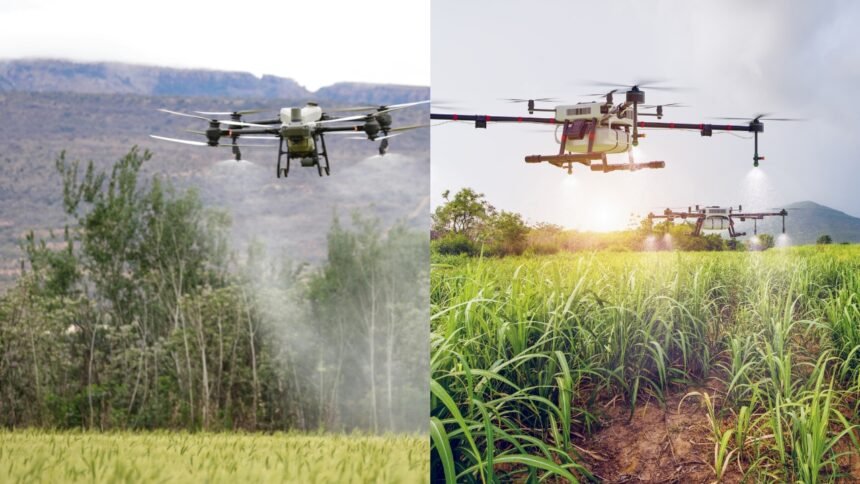
Spray drones are rapidly evolving from a novelty into a real competitive advantage on farms across the country – and for good reason. As growers search for smarter, more efficient ways to apply crop inputs, drone technology is proving to be a valuable tool.
| Drone Advantage | Benefit |
|---|---|
| Application precision | Targeted product placement |
| Reduced soil compaction | No heavy equipment in fields |
| Access to difficult areas | Wet spots, tall crops, irregular fields |
| Timely applications | Works during tight weather windows |
However, adopting this technology involves more than just adding a new piece of equipment. Farmers must navigate FAA regulations, state compliance requirements, pilot training, insurance, and day-to-day operational management.
Here is what farmers need to know to evaluate spray drones effectively and take the right steps to get started.
Determine Your Objectives
Before investing in spray drone technology, it is important to identify the specific challenges you are trying to address.
Common Objectives
| Objective | Description |
|---|---|
| Wet soil applications | Make sprays when ground equipment can’t operate |
| Tall crop access | Apply products later in the season |
| Reduce compaction | Eliminate heavy equipment traffic |
| Targeted applications | Spot-treat sensitive or irregular areas |
| Supplement capacity | Add spraying during peak windows |
Clear objectives will help determine whether owning a drone, hiring a custom spray drone operator, or cooperating with neighboring farms is the most appropriate option.
Consider Regulatory Requirements
Spray drone operations are regulated at both the federal and state level. Farmers should be aware of the following requirements before operating.
Federal Requirements
| Certification | Requirement |
|---|---|
| FAA Part 107 Remote Pilot Certificate | Required for commercial drone operation; involves written knowledge test covering airspace, weather, and operational rules |
| FAA Part 137 Certification | Required for any aerial application of pesticides, including drones |
Iowa State Requirements (Example)
| Requirement | Details |
|---|---|
| IDALS licensing | All aerial applicators must hold appropriate state licensing |
| Iowa DOT aircraft registration | Required within 30 days of purchase or arrival in Iowa |
| Pesticide label compliance | Only products labeled for aerial application may be used |
Note: Rules and regulations change frequently. Always check for updates.
Obtain Insurance and Practice Risk Management
Most standard farm liability policies do not automatically cover aerial pesticide application or aircraft-related risks. Farmers should consult with their insurance provider to obtain coverage specific to agricultural drone operations.
Common Insurance Components
| Coverage Type | Protects Against |
|---|---|
| Chemical liability | Off-target movement or drift-related claims |
| General liability | Bodily injury or property damage not related to pesticides |
| Hull/physical damage | Repair or replacement of drone and equipment |
Insurance providers typically require documentation of FAA Part 137 certification before issuing chemical liability coverage.
Select Equipment Based on Your Needs
Spray drones vary widely in size, capacity, and features. When comparing systems, consider:
| Feature | What to Evaluate |
|---|---|
| Tank capacity | Size and refill frequency |
| Battery life | Flight time, charging time, replacement cost |
| Nozzle/atomizer | Droplet size control options |
| GPS guidance | RTK technology, mapping, automation |
| Local support | Dealer availability, training, repair services |
Producers unfamiliar with the technology may benefit from observing demonstrations or working with a custom applicator before making a purchase decision.
Prioritize Training and Safe Operation
Proper training is essential for effective and safe spray drone use.
Recommended Practices
| Practice | Purpose |
|---|---|
| Empty tank flights | Gain experience without spraying |
| Calibration checks | Verify coverage using water |
| Weather monitoring | Check wind speed and temperature inversions |
| Routine maintenance | Nozzle inspection, battery management |
Swath Width Setup
Correct swath width setup is critical for consistent spray performance. Each spray drone model has a defined effective swath that depends on:
- Nozzle or atomizer configuration
- Flight height
- Operating speed
Using a swath width that is too wide or too narrow increases the risk of over-application, under-application, and visible striping.
Adopt the Practice Gradually
Farmers new to spray drones are encouraged to start on a limited scale.
Steps for Gradual Adoption
| Step | Action |
|---|---|
| 1 | Begin with small acreage or trial fields |
| 2 | Compare results with conventional methods |
| 3 | Develop efficient procedures for mixing, refilling, and battery exchange |
Dry Product Uses (Where Permitted)
In addition to liquid applications, producers may cautiously evaluate spray drones for:
- Cover crop seeding
- Limited spot fertilizer placement in difficult-to-access areas
These applications should be approached conservatively, with attention to equipment capability, material flow consistency, and regulatory guidance.
Pay Attention to Future Developments
Spray drone technology continues to evolve, with ongoing improvements in:
| Development Area | What’s Changing |
|---|---|
| Payload capacity | Larger tanks, heavier lifts |
| Flight automation | More autonomous operation |
| Navigation | Better obstacle avoidance |
| Battery performance | Longer life, faster charging |
| Data integration | Connection with precision ag systems |
Continued evaluation of these advancements will help determine the long-term role of spray drones in crop production systems.
Additional Resources
The following websites offer more information on agricultural drones and licensing:
| Organization | Resource |
|---|---|
| Iowa Department of Agriculture | Licensed UAV pesticide applicator guidance |
| Iowa State University | Research to Rows – agriculture drones |
| Federal Aviation Administration | General drone information |
| Iowa DOT | Registration for aerial applicators |
| National Agricultural Aviation Association | Hiring a spray drone operator |
Engaging with these resources can help reduce learning curves and improve compliance.
A Thoughtful Approach to Drone Adoption
Spray drones represent an emerging application tool that may complement existing ground and aerial spraying systems. Successful use depends on:
| Key Factor | Why It Matters |
|---|---|
| Clear objectives | Determines if drones fit your operation |
| Regulatory compliance | Avoids legal issues and fines |
| Adequate insurance | Protects against liability |
| Proper training | Ensures safe, effective operation |
| Thoughtful integration | Maximizes return on investment |
Farmers considering spray drones are encouraged to evaluate the technology carefully, utilize available educational resources, and adopt at a pace appropriate for their operation.
As one specialist noted: “Spray drones can give your farm a competitive edge. Still, they involve more than just the purchase.”
With the right preparation – from FAA certification to insurance to gradual field testing – drones can become a valuable tool in your precision agriculture toolkit.