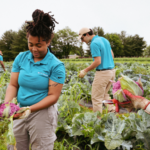

The Chennai Urban Farming Initiative (CUFI) is working to promote gardening on rooftops and vacant urban spaces across Chennai, India. Their aim is ambitious: to build a sustainable and local food system, make healthy food more accessible, cool the city, and create jobs for vulnerable populations.
In a city that regularly experiences temperatures close to 40 degrees Celsius, rooftop gardens are not just about food — they are about survival, comfort, and dignity.
Gardens in Daycares and Schools: Teaching Children Where Food Comes From
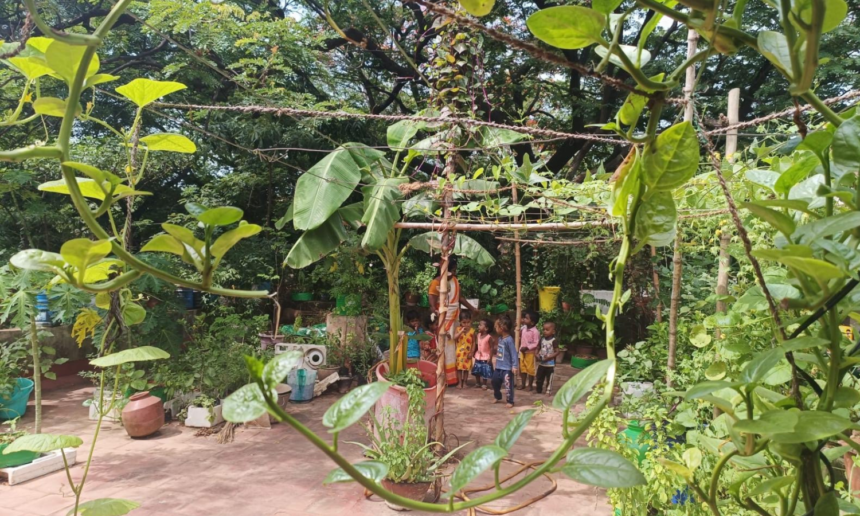
One aspect of CUFI’s programming involves partnering with day care centers and schools to build organic, edible gardens. These gardens are not just decorative — they are classrooms.
Students learn about food systems, organic farming practices, botany, and composting. Children as young as two years old learn about colors, shapes, and identifying vegetables.
The produce that students help grow is then incorporated into their school meals. This creates a direct connection between the work of their hands and the food on their plates.
“The children seem to love the taste of the spinach they grow — they normally hate spinach,” Krishna Mohan, Chief Resilience Officer of Chennai, tells Food Tank.
From School Gardens to Home Gardens
The gardens are designed to improve the health of the whole community — not just the children.
Mothers can visit the spaces when they pick their children up from school and are often inspired to start their own gardens at home, where they grow medicinal plants and herbs.
What begins as a school project becomes a household movement, spreading from one family to the next.
Mobile Vegetable Garden Kits: Gardening for Everyone
CUFI also distributes Mobile Vegetable Garden Kits to families across Chennai, ensuring that women-led and other vulnerable households receive priority.
These kits contain all the necessary materials for people to start their own gardens: soil, seeds, containers, and instructions. The goal is to encourage a broader cultural shift toward urban farming — making gardening accessible to anyone, regardless of income or experience.
Beginner gardeners can join a supervised WhatsApp group for advice, guidance, and to build relationships with other gardeners across the city. This creates a virtual community of urban farmers, sharing tips, celebrating harvests, and troubleshooting problems together.
Women’s Empowerment: A Dignified Livelihood
In addition to improving health and facilitating food systems education, urban farming can have positive impacts on women and other marginalized groups, according to researchers from Johns Hopkins Bloomberg School of Public Health.
CUFI partners with women’s self-help groups, training women in vegetable gardening and putting them in contact with people who need help creating gardens and will pay for their services.
“For women, urban farming presents an opportunity to earn a dignified livelihood, contributing to women’s agency and their empowerment,” Mohan tells Food Tank.
This is not charity — it is economic opportunity. Women who would otherwise struggle to find formal employment can become gardening consultants, earning income while helping their neighbors grow food.
Mental Health Benefits: More Than Just Food
CUFI’s projects can also improve mental health and well-being.
“Urban farming improves mental health and well-being not just for people engaged in the farms but also for those seeing or visiting it on a regular basis,” according to Mohan.
Researchers at MacEwan University found that spending time at urban gardens improves mental wellness, fostering feelings of altruism, serenity, and connection with nature.
In a fast-paced, crowded city like Chennai, a rooftop garden can become a refuge — a green space that offers not just vegetables but peace.
Cooling the City: 7 Degrees Celsius Cooler
Perhaps one of the most tangible benefits of rooftop gardens is their ability to cool buildings and cities.
Mohan tells Food Tank that rooftop gardens can reduce the temperature of rooms by up to 7 degrees Celsius. This temperature drop can reduce the need for air conditioning — which saves money, reduces energy consumption, and lowers carbon emissions.
In Chennai’s affordable housing schemes, where most people cannot afford air conditioning, a seven-degree drop is “a huge blessing,” says Mohan.
On a city-wide scale, widespread rooftop gardens could help mitigate the urban heat island effect — the phenomenon where cities are significantly warmer than surrounding rural areas due to concrete, asphalt, and lack of vegetation.
The Challenge: Scaling Up and Policy Change
Creating a more sustainable city and benefiting the community is not without challenges.
While CUFI is funded by the Adrienne Arsht-Rockefeller Foundation Resilience Centre and has government support, Mohan tells Food Tank that the project must increase in scale to ensure its continued existence.
The key constraint is policy. To make urban farming flourish, Chennai needs policy changes that provide incentives — tax breaks, building code modifications, subsidies, or other support mechanisms.
But policy change requires data. And more data requires funding that allows CUFI to run for another two years.
It is a classic challenge for social enterprises: you need results to get funding, but you need funding to produce results.
The Dream: Every Rooftop in Chennai
“We have a dream,” Mohan shares with Food Tank. “To ensure that every rooftop in Chennai has an edible rooftop garden. “
It is an audacious goal. Chennai is a massive metropolis with millions of residents and countless buildings. But the dream is not impossible.
If every rooftop garden could reduce indoor temperatures by 7 degrees Celsius, the cumulative impact on energy consumption, heat-related illness, and quality of life would be staggering.
If every school garden could teach children to love spinach, to understand where food comes from, to care for the soil — the impact on public health and environmental literacy would be equally profound.
The Urban Heat Island Effect in Chennai
Chennai, like many Indian cities, suffers from severe heat. With temperatures regularly approaching 40 degrees Celsius, the city’s residents — particularly those in affordable housing without air conditioning — face significant health risks.
The urban heat island effect exacerbates this problem. Concrete buildings absorb heat during the day and release it at night, preventing the city from cooling down. Dark roofs, asphalt roads, and lack of vegetation all contribute to higher temperatures.
Rooftop gardens address multiple problems at once. They provide insulation, reducing heat gain through the roof. They provide evaporative cooling as water transpires through plant leaves. And they convert a heat-absorbing dark surface into a heat-reflecting green surface.
The Food Security Context in Chennai
Chennai faces significant food security challenges. Supply chains are long, and fresh produce often travels hundreds of kilometers before reaching city markets. By the time vegetables arrive, they are days old and have lost significant nutritional value.
Urban farming shortens those supply chains dramatically. When food is grown on the rooftop of a school or apartment building, it can be harvested and eaten within hours. Nutritional density is preserved. Transportation emissions are eliminated. And families have direct control over what they grow and eat.
The Global Context: Urban Farming Movements
Chennai is not alone in its urban farming ambitions. Cities around the world — from Singapore to Detroit to Paris — are investing in urban agriculture as a strategy for food security, climate resilience, and community development.
What makes CUFI distinctive is its focus on equity. By prioritizing women-led and vulnerable households for Mobile Vegetable Garden Kits, by training women’s self-help groups to become gardening consultants, by placing gardens in daycare centers and schools, CUFI ensures that the benefits of urban farming reach those who need them most.