
On October 18, 2021, residents of Chittur-Thathamangalam, a small town in Kerala’s Palakkad district, received something the town had never had before: a Draft Master Plan 2031.
It proposed extensive road widening, four bypasses and ring roads, two lorry terminals, a new bus stand, and a terminal market. But when the town’s newly elected municipal council and roughly 32,000 residents examined the proposals, many were alarmed.
They concluded that the infrastructure projects could wipe out nearly 80% of the town’s retail economy, while requiring the demolition of hundreds of homes, community buildings and acres of agricultural fields.
An alternative vision
Instead of accepting the state’s blueprint, the town decided to challenge it. Rather than go to court, the municipality began work on its own alternative – a participatory planning process that would ultimately produce the Chittur-Thathamangalam Master Plan 2042.
Over 33 months, the municipality worked with planners, volunteers, local residents and academic experts to create what supporters say is India’s first municipality-led participatory master plan.
“We believed that the best way to counter the draft plan was to develop a better one,” says urban planner Jayaraj Sundaresan, who was part of the expert committee.
Rediscovering the ancient water system
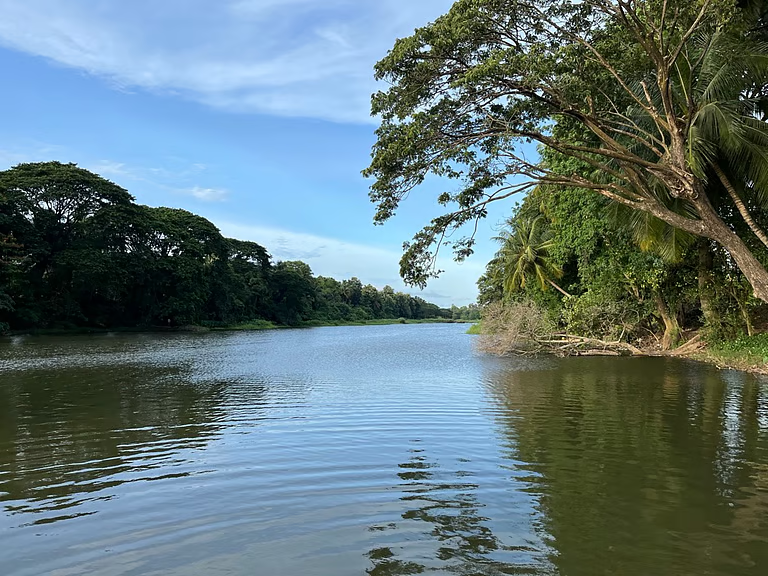
One of the most significant issues overlooked by the original draft plan was the town’s centuries-old water management system. The town contains 171 human-made ponds – known locally as kulams – connected by canals and natural streams flowing through cascading paddy fields.
“These water-channelling systems have evolved over roughly 1,500 years,” Sundaresan explains. “They support groundwater percolation, agriculture, livestock, drinking water supply and flood mitigation.”
Yet the Draft Master Plan 2031 did not recognise this network.
Building a plan together
The participatory process unfolded in three stages. First, residents were educated about the draft plan. Second, focus group discussions captured residents’ aspirations – from 50 schoolchildren to 550 participants across 20 groups covering 32 themes. Third, a three-day workshop allowed local residents to work alongside planning experts to translate findings into concrete proposals.
Many controversial proposals were removed. Large-scale road-widening was eliminated. Instead, the new plan focuses on pedestrian walkways and cycle tracks.
Climate resilience and heritage
To address flooding, the People’s Plan introduces an Ecological Protection Zone covering the town’s interconnected water bodies and cascading paddy fields. A Flood and Riverine Buffer Zone along the Sokanasini river aims to reduce flood vulnerability while creating public space.
The plan also documents urban commons: banyan trees with circular gathering platforms, chumaduthangis (stone supports for travellers to rest their loads), festival grounds, school playgrounds and weavers’ working areas.
A culture of collective action
For Sudeesh Yezhuvath, a member of the municipal special committee, the success reflects a long tradition of collective action in the town – from religious festivals lasting over two weeks to the annual Konganpada temple festival, a historic war re-enactment.
The People’s Master Plan 2042 officially replaced the Draft Master Plan 2031 in July 2024. It is now awaiting formal state notification. As a Malayalam proverb says: oruma undengil olakka melum kidakkam – with unity, even the most difficult challenges can be overcome.