
What if California, the world’s fourth largest economy, could transform its extractive agricultural system into one that regenerates the land while strengthening communities?
That is the question driving Regenerative California, a nonprofit working to build a regenerative economy that uplifts communities, advances sustainability, and strengthens the state’s food and agriculture system.
Listening to communities first
When Regenerative California began its work, the team chose Monterey County as their pilot location – a region described as “California’s most wealthy and also poorest county in the state,” and home to the Salinas Valley, nicknamed the salad bowl of the world.
Rather than imposing solutions, the organization started by interviewing community members to understand the challenges and opportunities they faced. Two main themes emerged: the transition to regenerative organic agriculture and the revitalization of the blue economy.
The demonstration farm: Regenerate 68! Farm
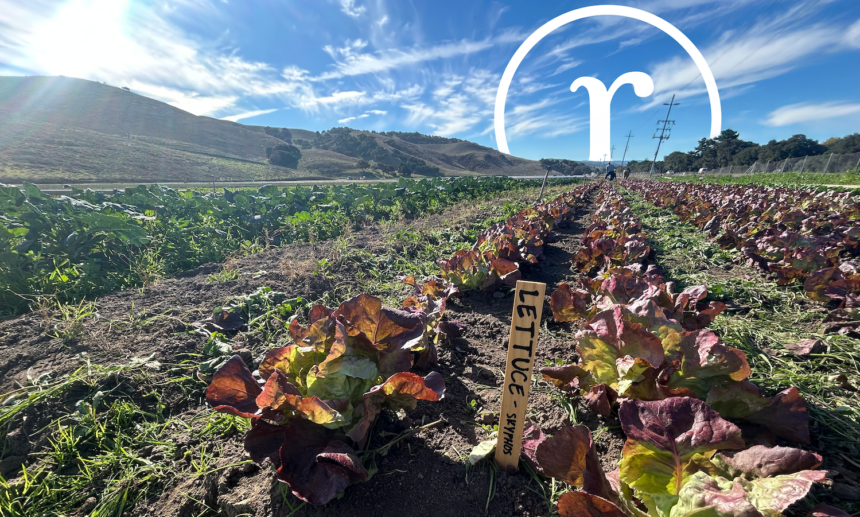
From these conversations, Regenerative California developed a 70-acre demonstration farm called Regenerate 68! Farm, located just off Highway 68 in Monterey County.
“Obviously, 70 acres is not going to change the entire system of agriculture in California, but we’re really using it as sort of a Petri dish,” Kristin Coates, Co-Founder and CEO of Regenerative California, told Food Tank.
The farm serves as a demonstration site for regenerative organic agriculture training, where farmers can learn to grow nutrient-rich crops. The land is also part of a much larger ranch stewarded by the Big Sur Land Trust, proving that regenerative farming can integrate seamlessly with broader conservation efforts.
State investment in soil health
Regenerative California’s vision aligns with significant state investment. The California Department of Food and Agriculture’s Healthy Soils Program has awarded $162.8 million through 2,340 projects since its launch in 2017.
These projects have sequestered 1.6 million metric tons of CO₂e – equivalent to removing 370,000 cars from the road for a year – across more than 190,000 acres of California farmland and ranchland.
The passage of Proposition 4, the 10billionClimateResilienceBond,inNovember2024hasfurtherstrengthenedthiscommitment.Thebondallocates65 million for soil health and carbon sequestration through the Healthy Soils Program, and $40 million for the State Water Efficiency and Enhancement Program (SWEEP).
Scaling impact across the state
What works on one farm may not work on another, but Regenerative California believes in scaling impact through shared lessons.
“We can create a flywheel,” Coates says. “And we really, genuinely believe that California can lead that work”.
The model is gaining attention. A dozen other regions have expressed interest in joining the movement, wanting to apply the same process of listening, engaging, and creating community momentum.
Scientific research supports the transition
University researchers are actively studying the economic viability of regenerative practices. A study published in the American Journal of Enology and Viticulture evaluated the financial outcomes of implementing regenerative agriculture practices in Sonoma County vineyards.
The study found that conventional and regenerative practices result in comparable profitability over a 30-year time horizon, with regenerative averaging only 5% lower in net present value. While regenerative practices involve higher initial costs, they provide long-term benefits including lower operational expenses, improved soil health, and additional revenue from integrated practices like sheep grazing.
The COAR project: connecting research to policy
The California Organic, Agroecological, and Regenerative Transitions (COAR) project, a collaboration across University of California campuses, is working to directly connect agroecology research with state policy.
The project brings together researchers from UC Berkeley, UC Davis, UC Merced, UC Santa Cruz, UC Riverside, and UC Agriculture and Natural Resources, while maintaining direct communication with state agencies to ensure research aligns with California’s climate and agriculture priorities.
Economic growth through soil health
Regenerative California’s vision treats soil health not as an environmental goal but as an economic strategy. Healthier soils require fewer inputs, retain more water, and produce more resilient crops – all of which improve farm profitability over time.
By demonstrating that regenerative practices work at scale, providing technical assistance to farmers, and connecting them with markets that value sustainable products, the initiative is building an economy where agriculture and ecology thrive together.