

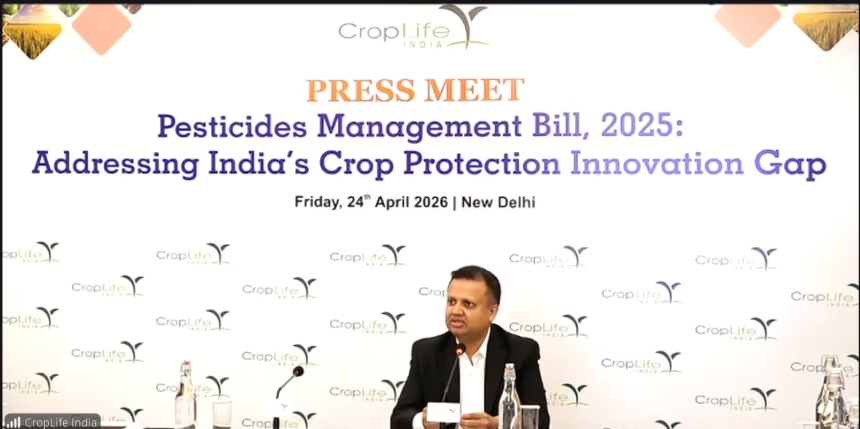
The proposed Pesticides Management Bill, intended to replace the six-decade-old Insecticides Act of 1968, must address India’s growing innovation lag if farmers are to benefit from modern crop protection technologies, industry body CropLife India said on Thursday.
Speaking at a national conference on agricultural inputs, CropLife India representatives argued that the current draft focuses heavily on regulation and compliance but falls short on enabling faster access to safer, more effective, and environmentally sustainable molecules.
What is the Pesticides Management Bill?
The draft Pesticides Management Bill, currently under inter-ministerial consideration, aims to modernize India’s pesticide regulatory framework. Key proposed changes include:
- A centralized registration system with defined timelines
- Provisions for data protection and intellectual property rights
- Stricter penalties for spurious and substandard pesticides
- Enhanced focus on human and environmental safety
However, industry stakeholders say the draft remains tilted toward restriction rather than facilitation.
The innovation lag problem
India currently lags the global agrochemical industry by approximately 10-12 years in bringing new crop protection molecules to farmers. According to CropLife India, a new molecule registered in the European Union or United States takes on average 10 years to receive approval in India.
This delay has real consequences. Indian farmers continue to use older molecules – some with known resistance issues or higher toxicity profiles – while their counterparts in other countries access safer, lower-dose, more targeted products.
“While the world moves towards biologicals, precision application, and low-chemical solutions, Indian farmers are still waiting for approvals on technologies that were standard elsewhere a decade ago,” said a CropLife India representative.
Key industry demands
CropLife India has submitted a detailed representation to the Ministry of Agriculture and Farmers Welfare, proposing five amendments to the draft Bill:
1. Deemed approval mechanism – If the regulatory authority fails to decide on an application within 24 months, the product should be deemed approved. This would prevent indefinite delays.
2. Data protection provisions – Innovator companies need assurance that the safety and efficacy data they generate will not be immediately used by generic competitors. The draft currently lacks clear intellectual property safeguards.
3. Recognition of global approvals – Products already registered in US, EU, Japan, Australia, or Brazil should face a fast-tracked review process in India, avoiding duplicative testing.
4. Separate category for biopesticides – Biological crop protection products require different safety and efficacy standards than chemical pesticides. The draft Bill treats both under the same framework.
5. Streamlined state-level implementation – While registration is centralized, actual market access involves 28 state governments. The Bill should mandate time-bound state concurrence.
The farmer impact
For small and marginal farmers – who constitute 86% of India’s agricultural landholders – innovation lag directly affects income.
Older pesticides require higher dosages, increasing input costs. Resistance means multiple applications, raising labour expenses. And restricted product choices mean farmers cannot adopt more sustainable practices like integrated pest management (IPM) that rely on precise, low-toxicity options.
“When a vegetable farmer cannot access a newer, safer molecule, he either overuses an older one – harming his soil and his health – or loses his crop to pest resistance. Neither is acceptable,” said an agricultural economist at the conference.
Balancing safety and access
Critics of the industry position argue that faster approvals could compromise safety. India’s regulatory apparatus has been historically understaffed and under-resourced, making rigorous review of new molecules challenging.
CropLife India counters that the same molecules have already been evaluated by stringent regulatory authorities in developed countries. “We are not asking for rubber-stamp approvals. We are asking for mutual recognition of scientific assessments conducted by peer agencies,” the representative clarified.
The draft Bill does include provisions for recognizing approvals from “designated countries,” but industry wants this to be mandatory rather than discretionary.
The data protection debate
The most contentious issue is data protection. Generic manufacturers argue that data exclusivity would delay cheaper products from reaching farmers, keeping input prices artificially high.
Innovators counter that without data protection, no company will invest in developing newer, safer molecules specifically for the Indian market. “Why would we spend crores on local efficacy trials if our competitor can use our data to launch a generic version immediately after our patent expires?” a senior industry executive asked.
The way forward
The Ministry of Agriculture has indicated that a revised draft of the Bill will be circulated for inter-ministerial consultation by August 2026. Industry stakeholders have urged the inclusion of a separate chapter on innovation facilitation alongside the existing focus on regulation.
For India’s farmers – facing climate volatility, pest resistance, and rising input costs – the Pesticides Management Bill represents an opportunity to access 21st-century crop protection. Whether the final version enables that access or delays it further remains to be seen.