

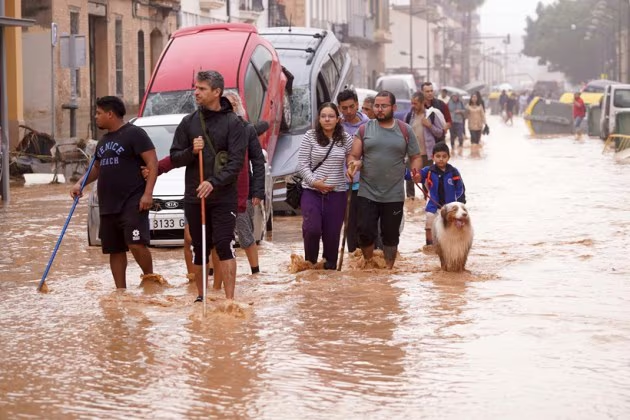
Spain has been grappling with one of the deadliest flooding disasters in its modern history throughout 2026, with successive storms leaving over 220 people dead, thousands displaced, and widespread destruction across infrastructure and agricultural lands.
The hardest-hit regions include Valencia, Andalusia, Extremadura, and Castilla-La Mancha, where torrential rains, overflowing rivers, and mudslides have devastated entire communities.
The October 29 Valencia catastrophe
The single deadliest event occurred on October 29, when a powerful Mediterranean storm unleashed surging torrents of muddy water across the eastern Valencia region. The disaster claimed 216 lives in Valencia alone and 224 nationwide.
Around 17,000 security force and emergency services personnel worked around the clock in Spain’s largest peacetime deployment of its armed forces, repairing damaged infrastructure, distributing aid, and searching for bodies. Firefighters painstakingly combed through piles of damaged vehicles and pumped water from inundated garages and parking garages where more victims were feared.
The town of Paiporta near Valencia became the symbolic “ground zero” of the tragedy, with many streets remaining inaccessible for days and residents struggling to get phone signals. Maribel Albalat, mayor of Paiporta, told public broadcaster TVE they were doing “better, but not well.”
Prime Minister Pedro Sanchez declared the stricken regions “gravely affected” to facilitate more aid, with five working groups created between the national government and the conservative-run regional authority to coordinate recovery efforts.
Government admits mistakes
Carlos Mazon, head of the Valencia regional government, publicly admitted to “mistakes” in handling the disaster before the regional parliament. “I’m not going to deny mistakes,” Mazon said, adding that he was “not going to shirk any responsibility.” He apologized to those who “felt that the aid did not arrive or was not enough.”
Critics had questioned the efficiency of the Valencia region’s alert system, noting that in some cases residents were only contacted by telephone when floodwater was already gushing through towns. The perceived mismanagement triggered mass protests, with 130,000 people demonstrating in Valencia city.
Almost half of those killed in Valencia were 70 years old or older, and 26 were foreigners, including two Britons.
Storms Leonardo and Marta: Widespread destruction
Earlier in the year, back-to-back storms Leonardo and Marta wreaked havoc across southern and central Spain.
Storm Leonardo (February 2026) – In Granada province, the storm caused the death of dozens of animals, with farmhouses buried under mud. “We went over the hills to get the animals that were in the farms. Fourteen hens drowned in one of them,” said a resident of Quéntar. “More than 20 farmhouses have been lost. It’s a catastrophe, whichever way you look at it.”
Emergency response deployment – The government opened 18 comprehensive care offices across Andalusia and Extremadura to assist affected citizens, reinforcing staff with 50 interim officials to expedite aid processing.
Agricultural devastation
Spain’s agricultural sector has suffered catastrophic losses:
- In February alone, Storm Nils destroyed 14,000 hectares of farmland and reduced agricultural production by an estimated 20%.
- Farmers reported thousands of hectares of broccoli, carrots, and cauliflower under water. “We have a real natural catastrophe,” Miguel Angel Perez of the farmers’ organization COAG told Spanish television.
- Portugal’s agriculture ministry placed preliminary storm-related losses at approximately €750 million.
The government approved a comprehensive aid package worth over €7 billion, including:
- Direct aid of €150 per person per day for evacuees
- Quadrupled compensation for death and disability
- Over €2.8 billion for the primary sector
- €2 billion in direct transfers to municipalities for infrastructure reconstruction
Freak weather phenomena
The violent storms brought unusual weather phenomena, including waterspouts (marine tornadoes) off the coast of Murcia’s La Manga region. Witnesses reported seeing at least three waterspouts forming over the Mediterranean, with winds capable of reaching up to 250 km/h.
Spain’s state weather agency Aemet maintained red and orange weather alerts across multiple regions, warning of rainfall up to 40mm per hour.
Climate context
Spain experienced an exceptionally wet start to 2026. According to the State Meteorological Agency, it was the most rainy January since 2001 and the lowest sunshine January in 30 years. Including Storm Nils, Spain had already been hit by nine major storms in 2026 by February alone.
This pattern of increasingly severe and frequent storms aligns with scientific warnings about the intensification of extreme weather events due to climate change.
Ongoing recovery
As Spain continues to count the cost of a year marked by unprecedented flooding, recovery efforts remain underway across affected regions. The disaster stands as the second deadliest flood in Europe this century, according to Prime Minister Sanchez.
For the thousands of families displaced, the farmers who lost their livelihoods, and the communities buried under mud, the road to recovery will be measured in years, not months.