
Precision Planting’s ArrowTube uses basic physics to orient every kernel tip-down and sideways, ensuring more uniform emergence and better light interception
Precision Planting’s new ArrowTube isn’t just any seed delivery system; it’s a highly engineered marvel. Available to order next year, the system relies on basic physics to uniformly space every kernel tip down and sideways at the right depth so more corn seedlings emerge simultaneously.
The added bonus? The seed tube helps the seed “stick the landing,” so upon emergence, a plant has more leaves between the rows rather than within the rows, increasing light interception, especially early in the season.
How It Works
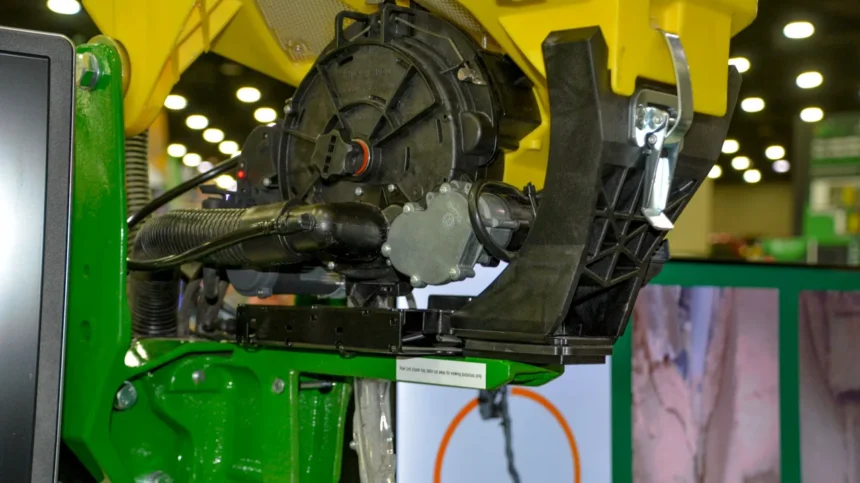
It took engineers five years to perfect the ArrowTube system; yet, it’s simple in function, consisting of three main components: an accelerator that integrates with the brand’s vSet 2 meter, a twisted straw-like tube, and a tungsten carbide knife that sits 5/8 inches below the disc opener.
“Every seed has a center of gravity [closer to the seed’s base than its tip]. By sliding seeds along surfaces and applying friction strategically, the system creates differential forces that rotate seeds into the preferred tip-down orientation,” explained Ryan Baker, a mechanical engineer at Precision Planting.
Orientation begins at the two-wheel accelerator, which spins at 3,000 to 5,000 rpms. The seed is pushed around a precisely frictioned “racetrack” and into the ArrowTube’s helical seed tube, which is reminiscent of a waterslide. Centrifugal force and gravity stabilize the seed’s orientation as it’s propelled downward around the engineered pathway. At the bottom, the kernel is wedged tip down into a slot cut into the furrow by the knife.
The Science Behind It
Precision Planting wasn’t the first to look at the concept of comparing kernels planted tip down with the embryo oriented a certain way versus random distribution of kernels in the row. In “Effects of Seed Orientation at Planting on Corn Growth,” published in January 2023, Dan Emmert and Mark Jeschke, both Pioneer agronomy managers, noted that work on the concept traced back decades. That work involved painstaking hand-planting, comparing rows with kernels placed tip down and oriented correctly versus rows with seeds planted at random.
When seeds were planted tip down with the germ oriented perpendicular to the row, leaves tended to grow across the row, providing quicker canopy closure. Those seeds planted tip down also germinated and emerged about 20 growing degree days faster compared to if kernel tips pointed up. That amounts to roughly one day quicker emergence.
Yield Benefits
In comprehensive field trials, Baker said the ArrowTube correctly planted seeds with the tip facing down 62% of the time. Conventional seed tubes did so 12% of the time. Correct orientation is vital because uniform emergence depends on correct seed positioning, not just precise spacing.
“By planting them with the tip down, you’re giving that mesocotyl the shortest distance from where it is planted to the [surface] so it can transition to photosynthesis,” Baker said.
If emergence happens 36 hours late, yield decreases 30%. At 48 hours late, it drops 60%. Beyond that, the loss is about 75%. According to Baker, seeds planted by the ArrowTube were either tip down or sideways 87% of the time. Plots planted by the ArrowTube saw an average 6.4-bushel advantage across 52 different scenarios.
Precision Spacing
Because each kernel is fired into the slot, the ArrowTube’s seed spacing is extremely precise. “With conventional systems, the seeds will roll and move after they land in the furrow. They might tumble a half-inch,” Baker said. “When it lands in the ground with the ArrowTube, the seed does not move. The seed is thumped into the soil. That is one of the things that’s allowing us to have such good spacing.”
With over four years of field trials across four states—after digging and analyzing 7,000 plants representing about 75 hybrids—Baker said the ArrowTube system produced better yield in head-to-head comparisons with various conventional seed tubes 75% of the time.
Availability
The system requires a Precision Planting vSet 2 meter. Compatible row units include John Deere’s XP or ME5 planters, and Precision Planting’s CornerStone row unit. Additional brand compatibility is planned in the future, as is seed compatibility. Developers are testing the system with crops including sugarbeets, cotton and sunflowers, among others.
“We’re still in beta testing this year,” said Bryce Baker, a spokesperson for Precision Planting. “Some dealers will have a few row units for farmers to test. If things go as planned, they will be available for farmers to buy for 2027.”