
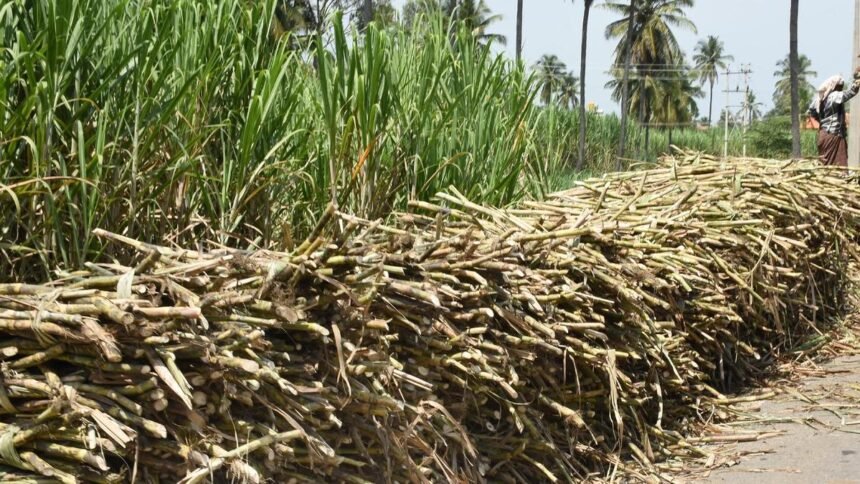
The Union Cabinet, chaired by Prime Minister Narendra Modi, has approved a hike of ₹10 per quintal in the Fair and Remunerative Price (FRP) of sugarcane for the 2026-27 sugar season, setting the minimum price that mills must pay farmers at ₹365 per quintal .
The approved FRP, applicable for the sugar season beginning October 1, 2026, is 2.81% higher than the current season’s rate of ₹355 per quintal . The decision is based on a basic recovery rate of 10.25% and follows recommendations from the Commission for Agricultural Costs and Prices (CACP) after consultations with state governments and stakeholders .
Key features of the FRP structure
For every 0.1% increase in sugar recovery above 10.25%, farmers will receive a premium of ₹3.56 per quintal, incentivizing higher recovery rates. Conversely, the FRP will be reduced by ₹3.56 per quintal for every 0.1% decline in recovery .
However, in a protective measure, the government has ensured that there will be no deduction for sugar mills where recovery falls below 9.5%. Farmers supplying to such mills will receive a minimum guaranteed price of ₹338.3 per quintal .
Economic impact
The government has pegged the cost of sugarcane production (A2+FL) for 2026-27 at ₹182 per quintal. The approved FRP of ₹365 per quintal is 100.5% higher than this production cost .
Union Minister Ashwini Vaishnaw told reporters after the Cabinet Committee on Economic Affairs meeting that farmers are expected to receive more than ₹1 lakh crore from cane sales in the upcoming season .
The Indian Sugar and Bio-energy Manufacturers Association (ISMA) estimates that the FRP increase will result in an additional income of over ₹15,000-20,000 crore for farmers, taking total cane payments to approximately ₹1.3 lakh crore in the 2026-27 season .
Farmer and industry reactions
While the sugar industry has welcomed the move, farmer organizations have called the hike inadequate . Swabhimani Shetkari Sanghatana president Raju Shetti has demanded the FRP be raised to ₹385 per quintal, citing rising fertilizer and fuel costs exacerbated by the West Asia conflict .
“Actual production expenditure incurred by farmers in sugarcane cultivation is higher amid the uncertainty over higher fertiliser costs, coupled with climatic challenges,” Shetti said .
The Bharatiya Kisan Union has also criticized the hike, calling it a “mere formality” and demanding pricing based on the total cost of production (C2 cost) plus a 50% profit margin .
ISMA, while supporting the FRP increase, has reiterated its long-pending demand to raise the Minimum Selling Price (MSP) of sugar, noting that higher raw material costs for mills need to be offset to maintain operational stability and ensure timely cane payments to farmers .
Cane dues clearance
The government highlighted improvements in cane dues clearance. In the 2024-25 sugar season, about 99.5% of total payable dues of ₹1,02,687 crore have been cleared as of April 20. For the ongoing 2025-26 season, approximately 88.6% of the ₹1,12,740 crore dues have been paid .
The sugar sector supports the livelihoods of about five crore sugarcane farmers and their dependents, along with around five lakh workers directly employed in sugar mills .