

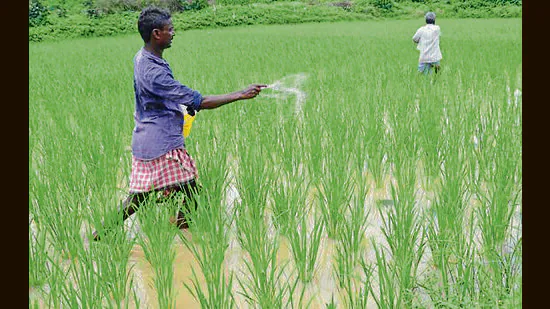
As tensions continue to escalate in West Asia, experts at Punjab Agricultural University (PAU) have warned that India’s heavy dependence on imported fertiliser raw materials could create significant supply stress ahead of the critical Kharif sowing season, posing a direct challenge for Punjab’s agricultural heartland .
With paddy cultivation set to commence across nearly 31.68 lakh hectares in the state, requiring an estimated 7.3 lakh tonnes of urea, any disruption in availability could have severe repercussions for crop productivity and farmers’ input costs .
The Vulnerability of Supply Chains
India remains significantly reliant on imported liquefied natural gas (LNG), urea, di-ammonium phosphate (DAP), and muriate of potash (MOP). The fertiliser sector consumes close to 30 per cent of India’s natural gas, most of which is imported as LNG . With the Middle East accounting for roughly 60-65 per cent of India’s LNG imports and 75-80 per cent of ammonia imports, the region’s instability poses an existential threat to domestic manufacturing .
Dr Rajeev Sikka, head of soil science, and Dr AS Dhatt, director of research, highlighted that disruptions in the Strait of Hormuz and attacks on energy infrastructure are already constraining supply lines. “Any disruption in fertiliser availability could directly affect crop productivity and increase input costs for farmers,” they warned .
Government Reassurances vs. Ground Reality
While the central government has maintained that current stock positions are comfortable—with officials stating that domestic production has reached 95 lakh tonnes and imports have added another 22.60 lakh tonnes—experts argue that long-term sustainability remains questionable .
A senior government official has warned that the fertiliser subsidy bill could cross Rs 3 lakh crore this fiscal if the crisis persists, far exceeding the budgeted Rs 1.71 lakh crore . The sharp fall of the rupee against the dollar has further compounded the burden.
Imbalanced Fertiliser Use: A Preexisting Problem
The experts highlighted that even before the crisis, fertiliser use in India was heavily skewed towards nitrogen, particularly urea. Farmers in Punjab often apply three to four bags of urea per acre for rice against the university’s recommendation of two bags, leading to lower efficiency and long-term damage to soil health .
Alternatives and Immediate Measures
To mitigate the potential shortage, PAU scientists are urging farmers to adopt balanced and need-based nutrient management and diversify crops.
Biofertilizers as a Stopgap: Dr AS Dhatt suggested the use of biofertilizers in case chemical fertilizers go out of stock. PAU has developed and recommended biofertilizers for 30 crops, which act as a booster for enhanced crop productivity and soil health .
Green Manuring: Crops such as dhaincha and sunnhemp can meet up to 50% of nitrogen requirements while improving soil organic carbon and microbial activity .
Crop Diversification: Experts have urged farmers to consider alternatives such as summer moong, mash, and pulses, which require less nitrogen and naturally enrich the soil. Soybean was suggested as a suitable option for water-stressed areas .
Soil Testing: The experts stressed the need for soil test-based fertiliser application to avoid overuse or underuse, advising farmers to skip DAP in kharif crops where possible and conserve it for the rabi season .