

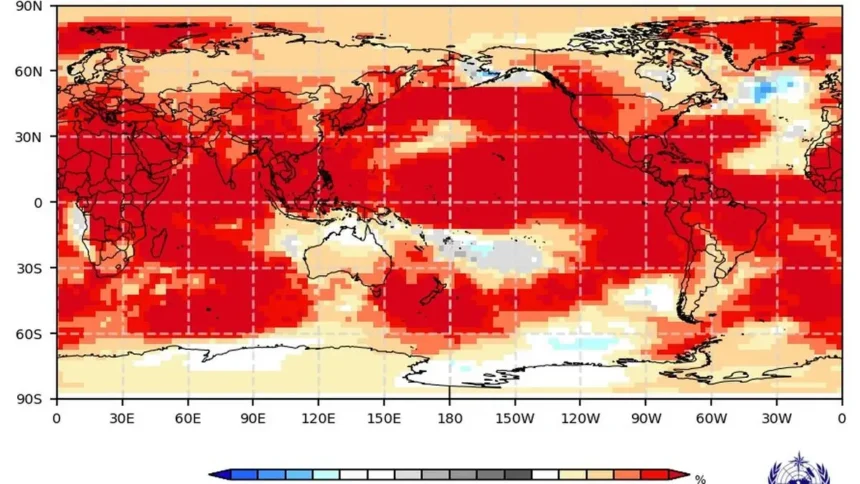
Global average temperatures are likely to continue at or near record levels over the next five years, the World Meteorological Organization (WMO) warned on Thursday, with the annual mean predicted to range between 1.3°C and 1.9°C above pre-industrial levels between 2026 and 2030 .
The report, titled the Global Annual-to-Decadal Update and produced by the UK’s Met Office, confirms that the world is entering a period of sustained extreme heat, driven by a combination of long-term human-caused warming and a predicted El Nino weather phenomenon .
A 86% chance of a new hottest year
Following the record-breaking heat of 2024—which was the first calendar year to temporarily exceed the 1.5°C threshold at 1.55°C above average—the WMO predicts that the streak of heat is far from over .
The report indicates an 86% probability that at least one year between 2026 and 2030 will surpass 2024 as the warmest year on record . Furthermore, there is a 91% chance that the global mean temperature will temporarily exceed 1.5°C above the 1850-1900 average for at least one year in this period .
For the first time, the WMO has also forecast a 75% chance that the five-year mean temperature for 2026-2030 will exceed 1.5°C . However, the report stressed that a single year or a five-year average exceeding 1.5°C does not constitute a permanent breach of the Paris Agreement, which refers to long-term warming sustained over decades .
El Nino’s return to fuel the fire
A key driver of the projected temperature spike is the predicted return of the El Nino climate pattern. The report notes that the average temperature in the central tropical Pacific indicates a tendency towards El Nino conditions over the next five years, particularly in 2027 and 2028 .
“There is an El Nino predicted for the end of 2026, which increases the chances of the following year, 2027, being the next record-breaking year,” said Dr. Leon Hermanson, lead author of the report .
The last major El Nino contributed to making 2023 the second-hottest year on record and 2024 the hottest .
Arctic amplification and extreme regional swings
The report also highlights the continued vulnerability of the polar regions, a phenomenon known as Arctic amplification. Arctic temperatures over the next five winters (November to March) are predicted to be 2.8°C above the 1991-2020 average—an anomaly more than three and a half times higher than the global mean anomaly .
Precipitation patterns are also expected to shift significantly. The report forecasts wetter-than-normal conditions for the Sahel region, northern Europe, Alaska, and Siberia during May to September, while the Amazon region is likely to face drier-than-normal conditions . Winters in northern Europe are specifically flagged for potentially “very wet” conditions, raising the risk of flooding .
A clarion call for preparedness
The forecasts, which boast “very high skill” according to scientists, are intended as guidance for governments and meteorological services to prepare for climate-related disasters .
With the world already experiencing severe heatwaves in Europe and India, the WMO’s message serves as a stark warning that the next five years will test the limits of the Paris Agreement’s goals, even if the long-term targets remain technically within reach .