

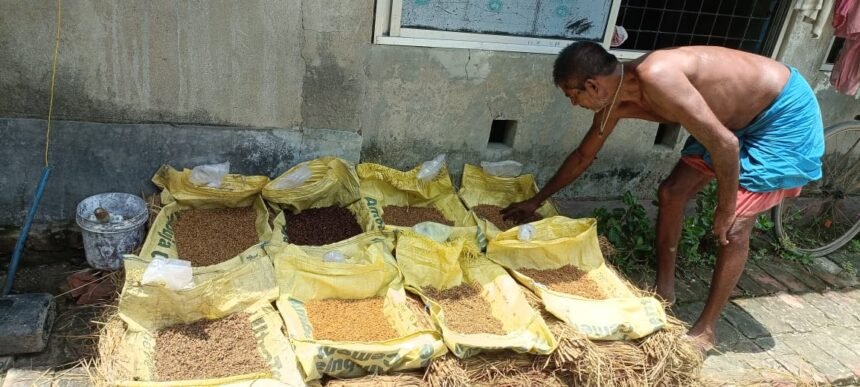
In the semi-arid landscape of Telangana, where groundwater levels have been dropping for decades and farmers are increasingly trapped in debt, a quiet revolution is taking root. A grassroots collective called Mukti (meaning liberation) has been systematically reviving indigenous paddy varieties — seeds that require less water, withstand pests, and offer resilience to climate shocks.
The movement began five years ago when a small group of farmers in Medak district decided to challenge the monopoly of hybrid seeds that had come to dominate Telangana’s paddy landscape. What started with three farmers experimenting with two indigenous varieties on five acres has now grown into a network of over 2,000 farmers across 40 villages, cultivating more than 120 traditional rice varieties on nearly 5,000 acres.
The problem with monoculture
Modern Green Revolution-era hybrid seeds, while high-yielding under ideal conditions, come with hidden costs. They require large amounts of water, chemical fertilizers, and pesticides. In Telangana, paddy cultivation consumes nearly 70% of the state’s irrigation water, contributing to severe groundwater depletion.
“We were trapped in a cycle,” says Komuraiah Goud, 58, a farmer from the collective. “Every season, we would buy new seeds from the market. Every season, the input costs would rise. And every season, the groundwater would drop a little more. We were working harder and earning less.”
What makes indigenous varieties different?
The traditional paddy varieties that Mukti has revived were developed over centuries by farmers, for farmers. Unlike hybrids that require replanting each season, many indigenous varieties can be saved from one harvest to the next, freeing farmers from dependence on seed companies.
They have other advantages:
Drought tolerance – Varieties like ‘Kalamkati’ and ‘Sona’ can survive with significantly less water than hybrids
Pest resistance – Traditional varieties have co-evolved with local pests, reducing the need for chemical pesticides
Nutritional diversity – Different varieties offer different nutritional profiles; some are rich in iron, others in antioxidants
Climate resilience – Many varieties can withstand temperature fluctuations and erratic rainfall better than hybrids
The water savings have been dramatic. Farmers in the collective report reducing paddy water usage by 30-40% after switching to indigenous varieties.
Beyond environmental benefits
The economic case for indigenous seeds is equally compelling. Farmers in the Mukti network report spending 50-60% less on inputs than they did with hybrids, since they no longer need to purchase seeds, chemical fertilizers, or pesticides every season. Yields are slightly lower — traditional varieties produce approximately 20-25% less grain per acre than hybrids under ideal conditions — but the reduction in input costs often makes them more profitable overall.
“The hybrid seed gave me 25 bags per acre, but cost me a fortune in chemicals and fertiliser,” says Lakshmi Bai, 45, a farmer in the collective. “The traditional seed gives me 20 bags per acre, but costs almost nothing. My profit is actually higher. And the soil is healthier.”
The seed bank network
At the heart of Mukti’s success is its seed bank network — community-managed storage facilities that preserve indigenous varieties and make them available to farmers before each planting season.
Currently, 12 seed banks operate across Medak and neighbouring districts, each maintaining between 30 and 50 varieties. The seeds are stored using traditional methods — mixing with neem leaves and ash to prevent pest infestation — that have been used for centuries.
“Before Mukti, if a farmer wanted indigenous seeds, they had to beg from elderly relatives or search remote villages,” says Jayashankar Reddy, a founding member. “Now, every village has a seed bank within walking distance.”
Breaking the debt trap
The transition has also reduced farmer debt. Commercial seed and fertilizer companies often extend credit to farmers at the beginning of the season, creating a cycle of dependency. Indigenous varieties, which require fewer external inputs, break this cycle.
Data collected by Mukti shows that farmers who switched to traditional varieties reduced their average debt by 65% within three seasons. Many are now completely debt-free for the first time in decades.
Challenges to scale
Despite its success, scaling the model remains difficult. The government’s subsidy and procurement systems remain overwhelmingly tilted toward hybrid varieties. The Minimum Support Price (MSP) for paddy, for instance, does not differentiate between hybrid and traditional grains — but procurement centres are more likely to reject traditional varieties due to their different grain characteristics.
“The system is built for hybrids,” says agricultural economist Dr. Meena Kumari. “Until MSP and procurement policies recognise the value of indigenous varieties, scaling will remain an uphill battle.”
The way forward
Mukti is now exploring direct marketing channels — selling traditional rice varieties directly to urban consumers who are willing to pay a premium for chemical-free, nutritious grain. The collective has also begun experimenting with value-added products: rice-based snacks, flours, and traditional medicinal preparations.
“We don’t want to just revive the seeds,” says Reddy. “We want to revive the entire ecosystem — the knowledge, the practices, the relationship with the land. That is the real mukti.”