
Troubled by the increasing availability of chemical-laden food, Amith Kishan quit his corporate job in the banking sector in Bengaluru to turn to traditional methods of farming and revolutionise the way food was grown, harvested, and consumed.
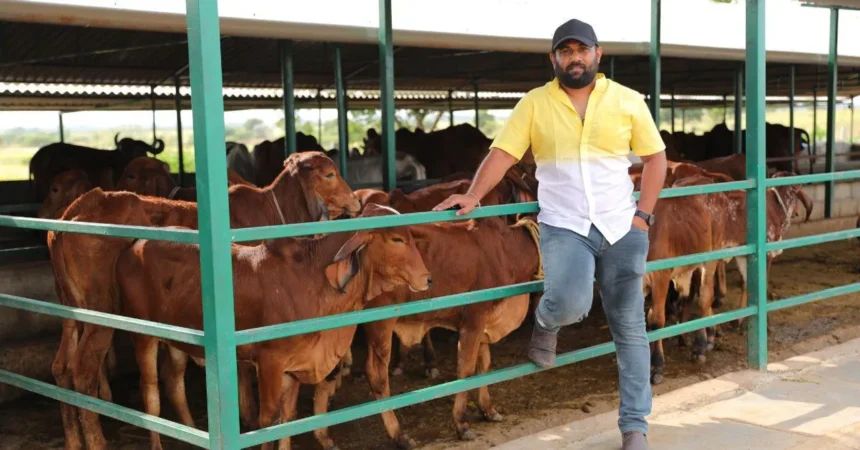
The 33-year-old runs Hebbuvu Farms with an aim to provide customers with organic and fresh vegetables, pulses, and dairy produce. Keeping sustainability at core, he adopted eco-friendly practices and replaced the use of plastics, chemicals, and tractors, relying on traditional farming methods.
“Farming should be done in a sustainable manner. For the past four years, we have been following zero budget farming and have been successful in it. We grow everything in a natural way and we do not use chemical fertilisers to ensure soil is safe in the long run,” the Penukonda resident tells The Better India.
From banks to farms
In a span of eight years, Amith worked with several banks including ICICI, Bajaj, Axis, HDFC, and Punjab National Bank handling top corporates in Bengaluru. But he always felt like going back to his roots and becoming a farmer, like his grandfather.
The motivation to leave the corporate world was triggered when he lost a client to cancer. “In a span of 1.5 years, he died of cancer. I did all the claiming formalities for the family. Looking at this, I understood that we need to correct ways of how we are living, and what we are eating as our food is not up to the mark.”
In 2016, Amith quit his job to become a farmer. After three years of research and development, he co-founded Hebbuvu Farms in 2019 with his brother Ashrith.
Sustainable farming practices
Amith grows about 40 varieties of food grains and vegetables besides dairy products and vegetable oils. He sells up to six tonnes of vegetables and 1,500 litres of milk every day. So far, he has catered to over 3 lakh customers, and around 1,800 customers daily through a store in Bengaluru and his website.
“We use desi cow dung and cow urine, we use bulls to plough the soil and produce wood-pressed oil. We sow native seeds and grow only what Mother Earth has given us. Indigenous farming is the uniqueness of our farm,” he says.
Empowering rural women
Besides a team of 120, Amith works with an army of rural women. So far, he has provided employment to more than 3,000 women from 18 nearby villages including Chinnamanthur, Mavutur, Peddamanthuru, Roddam, and Madakasira.
“We give 25 litres of milk every day to each woman to make ghee, paneer, and other dairy products. For every kilogram produced of our A2 desi cow Bilona ghee, one woman from the village receives a direct employment opportunity,” he says.
Govindamma from Mavaturu village has been working with Amith for the past three years. Before, the widow and mother of one would toil as a daily wager. “I would get work for only 12 days in a month, which would earn me Rs 200-300 per day. After the death of my husband, the entire financial burden fell on me.”
Today, the proud salaried worker earns a regular income of up to Rs 15,000 a month. “I have been able to construct a home for my family of four with this income,” she adds.
The numbers
Starting with a loan of Rs 1.5 crore and a 15-acre farmland, today Amith clocks an annual revenue of Rs 21 crore from his field spread across 650-acre farmland. His farm is home to 700 indigenous cows and buffaloes including Gir, Sahiwal, and Jafarabadi. He is also dependent on solar power, which has reduced his monthly power expenses from Rs 3 lakh to Rs 40,000.
A peaceful life
“In Bengaluru, I used to leave for work at 8 in the morning, hustle in the pollution, and come back only by 8 in the evening. We were dependent on burgers as a meal. Here, I live a peaceful slow life and spend sufficient quality time with my family and pluck fruits directly from the tree whenever we want,” he says.
“There, I used to work and exhaust myself for others, here I work for myself and my village,” he adds.