
With low investment, high demand, and government subsidies of up to 50%, goat farming is emerging as one of India’s most profitable agricultural ventures
Goat farming in India has emerged as a highly profitable and sustainable agricultural practice, driven by increasing demand for goat meat (chevon), milk, and fibre . Often called the “poor man’s cow,” goats are versatile animals that thrive on minimal resources, making them ideal for small and marginal farmers . The Indian animal husbandry market is projected to reach ₹2,218.8 billion by 2033, with goat farming playing a significant role in this growth .
Why goat farming is a good business opportunity
Goat farming offers several distinct advantages that make it an attractive venture :
- High demand: Goat meat is consumed widely with no religious restrictions and is a lean, low-cholesterol meat option.
- Low initial investment: Starting a goat farm requires much less capital compared to cattle or buffalo farming.
- Quick returns: Goats are prolific breeders with a short gestation period of about five months, often producing twins or triplets.
- Adaptability: Goats can thrive in various climatic conditions and can eat plants that other livestock avoid.
- Multi-purpose: Goats provide meat, milk, fibre (cashmere, mohair), skin, and high-quality manure rich in nitrogen, phosphorus, and potassium.
Understanding goat farming types
Before starting, determine your primary business focus :
- Meat goat farming: The most common type, with strong demand for chevon. Popular meat breeds include Boer, Sirohi, Barbari, and Black Bengal.
- Dairy goat farming: Growing in popularity due to goat milk’s easy digestibility. Breeds like Jamunapari, Beetal, and Saanen are preferred for high milk yield.
- Fibre goat farming: Angora and Cashmere goats are prized for their luxurious wool used in textiles.
- Integrated farming: Combining goat farming with crop cultivation or other livestock to maximize resource use and income.
- Breeding stock: Some farms focus on supplying high-quality bucks and does to other farmers.
Step-by-step guide to starting a goat farm
Step 1: Conduct market research
Analyse the demand for goat products in your area. Identify potential buyers, including local markets, meat shops, restaurants, dairy processors, and individual customers . Understanding your competition and target market will help you determine pricing and marketing strategies.
Step 2: Choose the right location and breed
Location: Select land with access to clean water, good drainage, and adequate grazing space . The site should be well-connected to markets, veterinary services, and feed suppliers. Avoid flood-prone areas and ensure a safe, disease-free environment .
Breed selection: Choose breeds based on your business goal :
| Breed | Purpose | Key Characteristics |
|---|---|---|
| Jamunapari | Dairy | High milk yield (2-3 litres/day), large size |
| Barbari | Meat | Small but highly productive, quick maturity |
| Sirohi | Dual purpose (meat & milk) | Hardy, adaptable to extreme weather |
| Beetal | Dairy & meat | Good milk yield, large body size, fast reproduction |
| Black Bengal | Meat | Popular for high-quality meat, prolific breeding |
| Boer | Meat | Fast growth, high-quality carcass |
| Osmanabadi | Dual purpose | Good milk supply, adaptable |
| Pashmina | Fibre | Produces high-quality wool (cashmere) |
| Angora | Fibre | Produces soft, silky mohair wool |
Step 3: Prepare a business plan
A well-structured business plan is essential for securing funding and guiding operations . Include the following elements:
- Executive summary and company overview
- Market analysis and target customer identification
- Type of goat farming business (meat, dairy, fibre, or mixed)
- Operational plan covering housing, feeding, and healthcare
- Financial projections including startup costs, revenue estimates, and profit margins
- Marketing and sales strategy
- Risk management plan
Step 4: Build proper housing and infrastructure
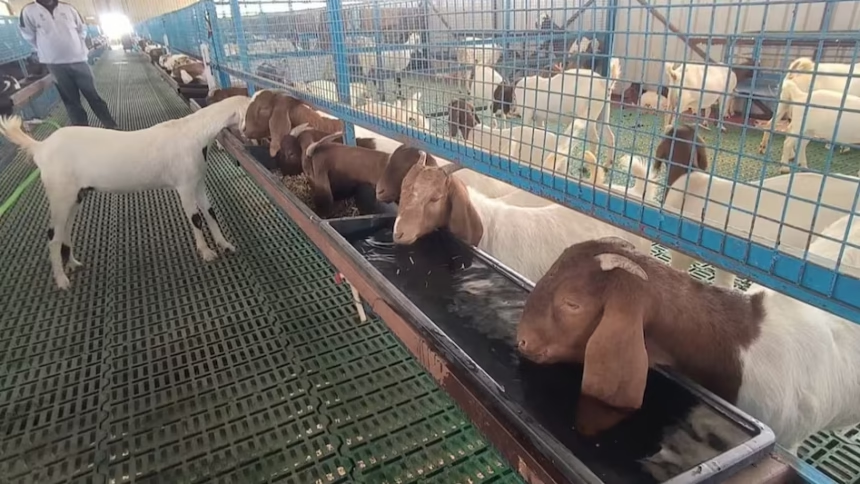
A well-designed goat shed is crucial for health and productivity . Ensure the shed is:
- Dry and well-ventilated to prevent respiratory infections
- Raised 2-3 feet to avoid waterlogging
- Spacious: 1.5–2 sq metres per goat
- Equipped with separate sections for kids, pregnant does, and sick animals
- Surrounded by fencing to protect from predators
Estimated shed cost for a 50-goat farm: ₹1.2–1.8 lakh
Step 5: Arrange nutrition and feeding
Goats require a balanced diet for optimal growth and productivity :
- Green fodder: Napier grass, Berseem, Lucerne
- Dry fodder: Hay, wheat or paddy straw
- Concentrates: Grains, oilseeds, and protein supplements
- Mineral supplements: Salt licks and mineral mixtures to prevent deficiencies
Feeding cost (annual for 50 goats): ₹1.5–2.2 lakh . A well-planned feeding program enhances growth, reproduction, and profitability.
Step 6: Manage health and breeding
Regular health management is essential to prevent disease and ensure herd productivity :
- Vaccination: Protect against PPR, Foot and Mouth Disease, and Enterotoxemia
- Deworming: Regular treatment for internal and external parasites
- Quarantine: Isolate sick animals to prevent disease spread
- Breeding: Allow breeding at 10-12 months of age for better fertility
- Gestation period: Approximately 150 days, with 1-2 kids per birth
Annual veterinary cost (for 50 goats): ₹20,000–30,000
Step 7: Plan marketing and sales
Develop a clear marketing strategy to sell your products effectively :
- Live goats and meat: Sell to local markets, meat shops, and wholesale dealers
- Milk: Supply directly to consumers, dairy companies, or produce value-added products like paneer and ghee
- Manure: Sell to organic farms and urban gardens
- Breeding stock: Market high-quality bucks and does to other farmers
Example from successful farmers: Patiala sisters Mannat and Eknoor Mehmi, aged 18 and 17, run a 150-goat Saanen breed farm in Punjab. Their annual earnings from breeding alone stand at ₹18–20 lakh, selling goats at ₹50,000 to ₹90,000 per animal .
Investment and profitability
Estimated costs for a 50-goat meat farm
| Component | Estimated Cost |
|---|---|
| Livestock (50 goats) | ₹1.76–2.64 lakh |
| Shed construction | ₹1.2–1.8 lakh |
| Equipment | ₹30,000–50,000 |
| Annual feed cost | ₹1.5–2.2 lakh |
| Annual labour cost | ₹72,000–1.2 lakh |
| Annual veterinary care | ₹20,000–30,000 |
| Total setup cost | ₹3.3–5 lakh |
| Annual operating cost | ₹2.6–3.7 lakh |
Annual revenue: Estimated ₹4.7–7.5 lakh (sell price ₹5,000–8,000 per animal)
Break-even period: Typically 18–24 months
Sample profitability for 50 goats
| Metric | Value |
|---|---|
| Monthly profit per animal | ₹363 (based on scientific management) |
| Annual net income | ₹1.5–3 lakh |
| Income per goat | ₹5,000–8,000 (meat sale) |
Government schemes and subsidies
The government offers significant financial support for goat farming :
National Livestock Mission – Entrepreneurship Development Programme (NLM-EDP): Provides 50% capital subsidy up to ₹50 lakh for establishing goat breeding farms .
| Unit Size (Females + Males) | Maximum Subsidy |
|---|---|
| 100 + 5 | ₹10 lakh |
| 200 + 10 | ₹20 lakh |
| 300 + 15 | ₹30 lakh |
| 400 + 20 | ₹40 lakh |
| 500 + 25 | ₹50 lakh |
Who can apply: Individual farmers, FPOs, SHGs, JLGs, FCOs, and Section 8 companies .
Eligibility: Minimum 100 female + 5 male goats, submit a Detailed Project Report (DPR), land documents, identity proof, and bank details .
Livestock Insurance: Beneficiaries pay 15% premium, with 85% subsidy from Central and State Governments (1 cattle unit = 10 goats) .
Financing options
Several financing options are available for goat farmers:
- Business loans: Tailored funding from Bajaj Finance and IIFL Finance for land, shed construction, equipment, and working capital
- Gold loans: Quick working capital against gold assets (maximum LTV ratio of 75%)
- MSME loans: Support for small-scale livestock businesses
- NABARD-linked schemes: Financial assistance through participating institutions