

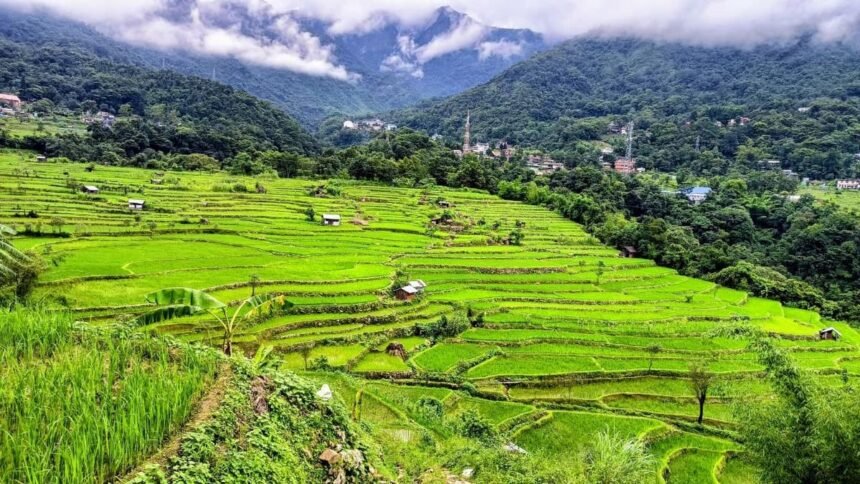
Researchers say the findings could help integrate development policies with culturally sensitive agricultural methods, going deeper into the social, cultural, and ecological system that supports the practice
Indigenous soil and water management is sustaining the terrace farming model of the Angami community in Nagaland, a study by a Nagaland University team has found.
According to the study, published in the Sage journal, the farming practices of the Angami Nagas are not only ecologically adaptive but also culturally resilient, contributing to long-term sustainability in food production and environmental stewardship. The authors of the study are Ketekhoto Neihu and Srikanth Yamsani of the university’s Tribal Research Centre.
Angami Traditions
Angami farmers construct bench terraces for paddy cultivation on steep slopes. This model is a deviation from the ubiquitous slash-and-burn or shifting cultivation practised largely across the rugged, mountainous terrain in the northeast.
The researchers note that among the indigenous communities, the Angamis have developed sophisticated agricultural practices, most notably the construction of bench terraces for paddy cultivation on steep slopes. Drawing on ethnographic insights, their study examines the Angamis’ resource management, arguing that the enduring sustainability of their terrace cultivation lies in the synergistic relationship between traditional ecological practices and community life.
Unlike previous studies, which focused on the technicalities of terrace farming, the present study goes deeper into the underlying social, cultural, and ecological knowledge system that supports the practice.
Traditional Practices
Much of the research focuses on traditional practices in soil conservation, water management, and organic farming. “The terrace farms are built using traditional construction methods, which reduce soil erosion and enable proper utilisation of water. The continued use of organic inputs, rather than chemical inputs, reflects efforts to protect the environment and human health,” the paper says.
“Our study found that the Angami Naga population continues to practice farming in close association with cycles and signs of nature. The farmers plant, transplant, and harvest using clues like plant bloom times, bird habits, and insects,” Dr. Yamsani said.
New Challenges
“While these forms of agricultural practice are still strong, it is important to point out the new challenges being faced by farmers, such as changing patterns of rainfall and climate variability. It is also important to note that the adaptive capacity of indigenous knowledge systems is very important,” he said.
Policy Implications
The results of the study are expected to help implement development policies and projects that could otherwise impede indigenous people from using their culturally sensitive agricultural methods.