

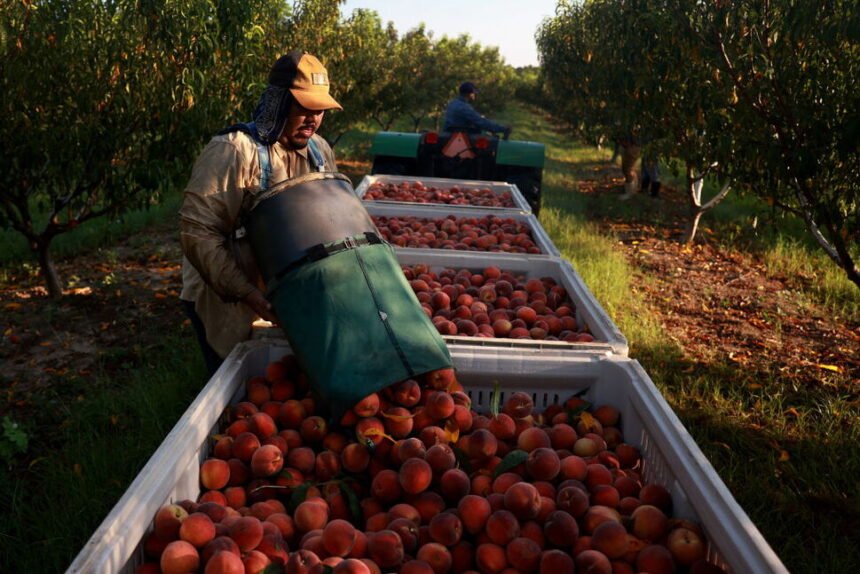
American farmers face soaring costs and declining commodity prices, while a Pew study reveals the complex emotions Americans feel when consuming news
The week’s developments brought a mixed bag of news, with American farmers facing mounting financial pressure and the news industry receiving a complex report card on how Americans feel about consuming news.
The Plight of American Farmers
American farmers continue to face a perfect storm of rising costs and falling prices. Since 2020, the USDA reports that labor costs are up 47%, seed expenses have risen 18%, fuel costs have climbed 32%, and fertilizer expenses have increased 37%. Meanwhile, corn prices have dropped to about $4 per bushel, down from a high above $7 per bushel in 2022.
A Farm Journal survey of more than 1,000 farmers in August and September found that nearly 80% of respondents say the U.S. is in, or on the brink of, a farm crisis. The Trump administration has doled out billions of dollars in aid to farmers since March, and the president is reportedly looking at a comprehensive bailout package of $10-15 billion. However, it remains unclear whether anything will move while the government is shut down.
AI Video Generation: A New Concern
The week also highlighted the growing concern over AI video generation technology. Apps like OpenAI’s Sora 2 can turn text prompts into very convincing videos, potentially making “video or it didn’t happen” obsolete. The technology could have scary applications, such as creating grainy security-camera-style footage of someone sabotaging a ballot box.
Gaza Ceasefire: Unanswered Questions
The Gaza ceasefire remains a rapidly evolving story with many unanswered questions. Key issues include whether Hamas will disarm, who will run Gaza, whether the ceasefire will hold, who will rebuild Gaza and how, and the future of the two-state solution for Middle East peace.
Good News About News
According to the nonpartisan Pew Research Center, the No. 1 thing Americans say they feel when they consume news is “informed.” Sixty-six percent of the biggest news consumers said they feel “informed,” compared to 40% of those who follow current events some of the time and 21% of those who do so less often.
However, the study also revealed that news consumption comes with a mix of emotions. Among all news consumers, 42% said the news makes them feel angry “extremely often” or “often,” 38% said it made them feel sad, 27% said scared, and 25% said confused.
These findings come alongside Gallup’s data showing that just 31% of Americans trust the media a great deal or a fair amount to report fully, accurately and fairly. Despite this, as the article notes, Americans will happily cite mainstream news coverage that reinforces their prior beliefs or serves their ideological purposes.