
A new study has found that global warming acutely affects dairy production across the Global South, especially the high milk production tract of Haryana
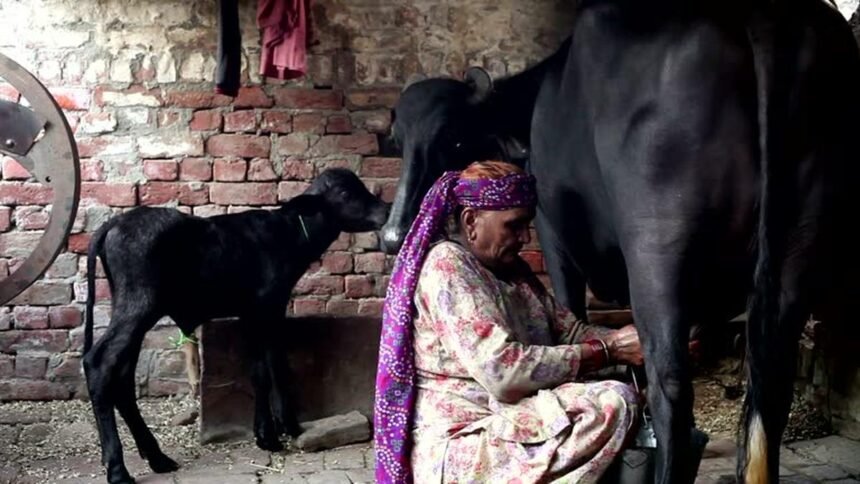
A massive decline in bovine milk production in India, especially among buffaloes in the trans-Gangetic plains of northwestern India—one of the country’s biggest sources of milk—has now been attributed to climate change. The phenomenon has a profound impact on the milk industry that caters to consumers every day.
While climate change significantly undermines livestock productivity worldwide, a new study published in Scientific Reports has found that global warming acutely affects dairy production across the global south, especially “the high milk production tract of Haryana.”
India is the world’s largest milk producer. Scientists studied data to assess the impact of climatic variables—including yearly minimum, maximum, and mean temperatures, heavy rainfall, temperature-humidity index, and evapotranspiration—on milk yield and production in buffaloes, indigenous cattle, and cross-bred cattle in Haryana, spanning over a decade, from 2004 to 2019.
They studied livestock populations across 1,148 villages, which included 4.66 million cross-bred cattle, 2.86 million indigenous cattle, and 35.56 million buffaloes. The study documented milk yield in these three bovine categories and found that high temperatures (over 38 °C), in combination with high humidity (over 70%) during July and August, “significantly reduce milk production.”
The Science Behind the Decline
Buffaloes, with their darker hue and bare skin, are particularly vulnerable to absorbing solar radiation. They also have fewer sweat glands than cattle: a unit increase in potential evapotranspiration reduces milk yield by around 1.4 litres per buffalo per day, the paper says. Likewise, cross-bred cattle showed a significant decline in productivity during heatwaves, but not indigenous cattle breeds such as Sahiwal and Hariana, perhaps because of their adaptation, such as loose skin, efficient sweating, and lower metabolic heat production.
The higher the temperature-humidity index, the greater the impact on livestock physiology and productivity: animals eat less, and the heat triggers homeostatic responses “in the form of panting, sweating, and reduced activity.” Stress hormones and raised cortisol levels “impair milk ejection and thereby cause a drop in milk yield and, in severe cases, livestock mortality.”
Economic Impact
Fodder also becomes a casualty of rising surface temperature, affecting the livestock production system: changes are triggered in the quantity, quality, and seasonal availability of feed and fodder. The paper estimates that such stressors in India lead to a loss of 3.2 million tonnes of milk, worth Rs 2,661 crore in monetary losses, which could rise to 15 million tonnes by the 2050s.
Abhinav Gaurav, lead advisor for sustainable dairy at Environmental Defense Fund India, told The Hindu that heat stress has a significant impact on milk productivity, health, and well-being of cattle and buffaloes. “During the intense summer months, the lactating animals are more vulnerable to heat stress, given that animals divert energy from milk production to regulate body temperature, resulting in a 20–30% decline in milk yield.”
Dr Gaurav quoted a report in The Lancet that estimates that climate change-induced temperature rise can reduce Indian milk production by 25% by 2085.
Adaptive Strategies and Solutions
Haryana’s farmers, interestingly, “were not only well aware of technologies and practices but implemented them in the summer season (provided wallowing ponds to buffalo, agroforestry, keeping livestock in shed, alteration of microclimate via sprinklers, foggers, mist, etc., feeding management), and reduced the negative effects of the extremes of summer months.”
The National Bureau of Animal Genetic Resources has identified heat-tolerance traits in cattle, such as heat shock proteins, coat colour, and hair characteristics. The research showed that the Sahiwal breed of cattle is significantly more heat-tolerant than exotic breeds with comparable milk productivity.
The findings underscore the need for a strategic shift toward resilience-oriented livestock management. The paper recommends the integration of potential evapotranspiration and temperature-humidity index into regional early warning systems to allow for proactive management. Furthermore, “long-term climate resilience should prioritise thermo-tolerant breeding programs that leverage Bos indicus traits.”
Indigenous breeds should be conserved as “reservoirs of climate-resilient traits,” and policies must prioritise in-situ conservation and farmer-led breed improvement programmes.
“The larger challenge now lies in scaling these solutions for millions of smallholder farmers, who often face limited awareness, inadequate financial resources, and the absence of a coordinated national climate-smart dairy strategy,” Dr Gaurav said.