

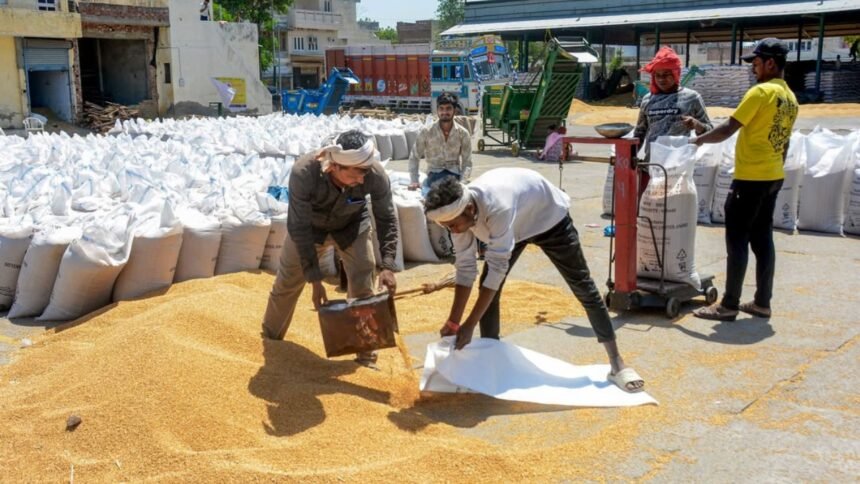
The Central government has finally relaxed the quality standards for wheat procurement from Punjab for the 2026-27 marketing season – a decision that is bound to perk up purchases for the Central pool. The move comes after unseasonal rains damaged the standing crop, leading to deterioration in grain quality and widespread farmer protests.
According to an official order, the government acted on requests from the Punjab government and the Food Corporation of India (FCI) – Punjab to relax the ‘uniform’ specifications for wheat crop in the state.
The New Quality Parameters
As per the new norms, FCI will now accept wheat with significantly relaxed quality standards:
| Quality Parameter | Existing Standard | New Standard (Punjab) |
|---|---|---|
| Shrivelled grains | 6% | 15% |
| Lustre loss | Not specified | 70% |
| Damaged/slightly damaged grains | Standard | Not exceeding 6% of total value |
| MSP (per quintal) | Rs 2,585 | Rs 2,585 (no reduction) |
The Central government also made it clear that wheat procurement under relaxed specifications must be stocked and accounted for separately. Any deterioration in quality during storage will be on the Punjab government.
Additionally, low-quality wheat stocks will be sold early, and all financial implications of this will be borne by the state government.
Why the Relaxation Was Needed
Punjab is one of the main contributors of wheat to the Central pool. However, unseasonal rains in Punjab and Chandigarh damaged the standing crop, causing:
- Increased shrivelled grains – beyond the standard 6% limit
- Lustre loss – making grain appear dull and less marketable
- Quality deterioration – leading to procurement stops
The Ground Reality
| Issue | Impact |
|---|---|
| Thousands of tonnes of wheat lying outside mandis | Procurement stopped due to quality concerns |
| 69% drop in procurement in first fortnight of April 2026 (vs same period last year) | Serious supply concern for Central pool |
| Farmer protests | Three-hour roadblock across Punjab demanding relaxation |
Major farmers’ groups had called for a three-hour roadblock across Punjab on the day of the announcement, demanding relaxation in procurement norms. The government’s decision came as a direct response to this pressure.
FCI’s Recommendation
On Thursday, April 16, FCI’s zonal office in Punjab had recommended that procurement of shrivelled or broken grains up to 20 percent be permitted in Punjab without any reduction in value – significantly higher than the existing standard of 6 percent.
Sources said that FCI’s recommendations were based on test reports of wheat samples collected directly from farmers. The final government decision (15 percent) fell between the existing norm and FCI’s recommendation.
Similar Relaxations in Other States
Punjab is not the only state to receive relaxation. Earlier, the Central government had granted similar relief to Haryana and Rajasthan, where unseasonal rains also damaged standing crops.
Haryana’s Relaxed Norms
| Parameter | Haryana Relaxation |
|---|---|
| Shrivelled/broken grains | 15% (vs 6% standard) |
| Lustre loss | 70% without value cut |
Rajasthan’s Status
Relaxation granted, though specific parameters were not detailed in this report.
The pattern suggests that the government is taking a region-specific approach to procurement quality norms, recognizing that unseasonal weather has affected different states to varying degrees.
The Procurement Numbers – A Sharp Decline
According to FCI data, due to quality issues, wheat procurement has come down by a massive 69 percent in the first fortnight of April 2026 compared to the same period last year.
| Period | Procurement Status |
|---|---|
| First fortnight of April 2025 | Baseline normal |
| First fortnight of April 2026 | Down 69% due to quality issues |
| Government target (2026-27 season) | Over 30 million tonnes |
Punjab, along with Haryana, Madhya Pradesh, and Rajasthan, are the main wheat-growing states in the country. Any significant drop in procurement from Punjab affects the Central pool’s ability to meet public distribution system (PDS) requirements.
Financial Implications – Who Bears the Cost?
The relaxation comes with important financial caveats:
State Government’s Responsibilities
| Responsibility | Detail |
|---|---|
| Storage deterioration | Any quality loss during storage on Punjab government |
| Early sale of low-quality stock | Government orders low-quality wheat to be sold first |
| Financial implications | All costs of the relaxation borne by state |
What Remains Unchanged
- MSP: Rs 2,585 per quintal (no reduction despite quality issues)
- Procurement process: FCI and state agencies will continue procurement
- Central pool contribution: Punjab remains key contributor
This cost-sharing arrangement is significant. While the Central government has allowed relaxation, it has shifted the financial risk of storing and selling lower-quality grain to the Punjab government.
The Political Context – Farmer Protests and Government Response
The relaxation did not happen in a vacuum. In the days leading up to the announcement:
- Thousands of tonnes of wheat lay outside mandis across Punjab
- Farmers blocked roads for three hours demanding action
- Major farmers’ groups organized protests
- Political pressure mounted on the Central government
The government’s decision to relax norms – while shifting financial risk to the state – represents a political compromise. Farmers get to sell their damaged crop at full MSP. The Central government protects its procurement targets. The state government bears the financial risk of storing lower-quality grain.
What This Means for the 2026-27 Wheat Season
For Farmers
| Impact | Detail |
|---|---|
| Immediate relief | Can now sell damaged crop at full MSP |
| Reduced wastage | Crop that would have been rejected is now accepted |
| Income protection | Rs 2,585 per quintal assured |
For the Central Pool
| Impact | Detail |
|---|---|
| Procurement recovery | Expected to pick up after 69% drop |
| Quality concerns | Lower-quality grain will enter the pool |
| Storage challenges | Deterioration risk during storage |
For the Punjab Government
| Impact | Detail |
|---|---|
| Financial liability | Bears cost of any further deterioration |
| Early sale required | Must sell low-quality stock first |
| Accounting burden | Must stock and account separately |
A Necessary Compromise
The Centre’s relaxation of wheat procurement norms for Punjab is a necessary compromise in an difficult agricultural season. Unseasonal rains damaged what was otherwise a promising crop. Farmers faced the prospect of being unable to sell their harvest at MSP – a devastating outcome.
By accepting 15 percent shrivelled grains (up from 6 percent) and 70 percent lustre loss, the government has ensured that Punjab’s wheat will enter the Central pool. Farmers get paid. Procurement targets can be met.
But the compromise comes with costs. Lower-quality grain is harder to store and more likely to deteriorate. The Punjab government now bears that risk. And the Central pool will need to manage a stock that is not up to usual standards.
Still, for the thousands of farmers who had wheat lying outside mandis, the relaxation is welcome news. As one farmer reportedly said: “At least now we can sell what we grew. That is all we ever wanted.”