

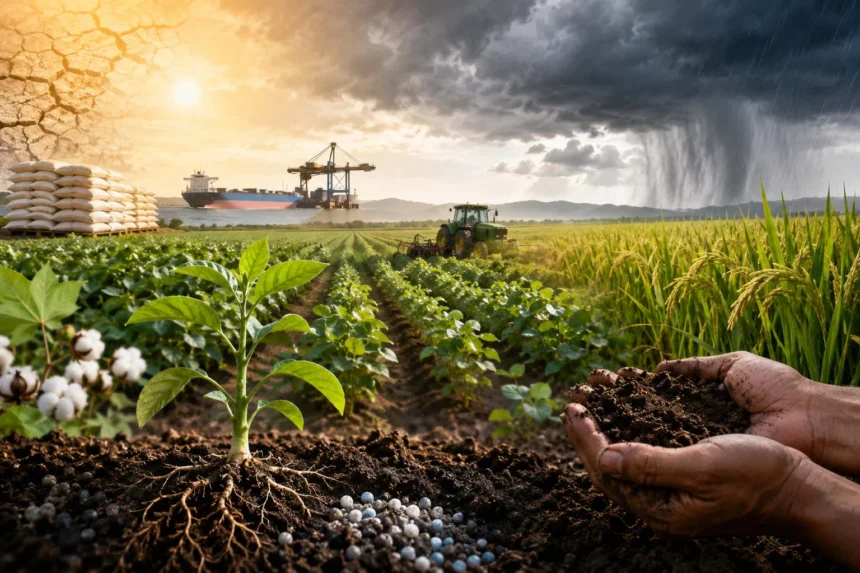
As Indian agribusiness gears up for the Kharif 2026 season, the landscape is dominated by a single, inescapable reality: risk. With the monsoon now officially delayed beyond its usual onset over Kerala and an El Niño forecast predicted to suppress rainfall across the country, the industry faces a daunting cocktail of climate unpredictability and geopolitical disruptions in the Red Sea and the Strait of Hormuz, threatening both input supplies and export markets.
Despite record foodgrain production of 376.5 million tonnes in 2025-26—an increase of 5.4% over the previous year—the potential impact of this season cannot be underestimated. Business leaders cannot control the monsoon, but they can transform their approach from reactive survival to proactive resilience.
The Monsoon and Market Volatility
The India Meteorological Department (IMD) has forecast a below-normal southwest monsoon for 2026, with rainfall likely to be around 92% of the long-period average (LPA). This lower rainfall projection is further compounded by the weak onset phase.
This year has broken the typical weather pattern, making the season inherently more vulnerable to “dry spells, floods, and pest attacks,” according to Niti Aayoyog member Ramesh Chand.
On the supply side, agri-input companies are already feeling the pressure. Escalation in West Asia is raising freight and insurance costs for imported raw materials, and a potential disruption in the Strait of Hormuz could trigger a sharp spike in fertilizer prices.
Redefining Strategic Risk Management
Industry leaders are now viewing risk not as a single event but as a continuous strategic function. Leading agribusinesses are integrating data and AI-driven models to move beyond traditional advisories into precision advisories, hyperlocal weather forecasts down to the gram panchayat level.
The upcoming season demands robust supply chain diversification for critical inputs like potash and phosphoric acid, moving away from concentration in a single region. On the financial front, the government is piloting parametric insurance products that provide quicker payouts based on rainfall or yield data.
Government’s Role and Technology Adoption
The newly re-elected Modi Cabinet has signalled continuity in its agri-reform agenda, prioritizing the Pradhan Mantri Fasal Bima Yojana (PMFBY) and the PM-KISAN income support scheme.
A senior official from the Ministry of Agriculture stated that state-run agencies will be ready with contingency plans, including alternative crop varieties.
Simultaneously, innovations in drought-resistant seed varieties and micro-irrigation systems are becoming critical to protect yields in water-stressed areas.
Looking Ahead
In 2026, the most successful agribusinesses will not merely be those that produce the best yield but those that ensure the greatest certainty of outcome for their farmer partners.
The delayed monsoon is not merely a weather event but a stress test. The industry’s ability to move from reacting to “rainfall deficits” to orchestrating a “resilience ecosystem” will define the success of the Indian harvest of 2026 .