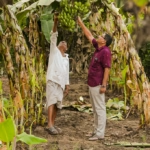

For K Bhimaya Reddy of Nakaram village in Odisha’s Ganjam district, farming has become an exercise in futility. For the past five years, he has abandoned paddy cultivation on his 2.02 hectares of land. The reason? Relentless raids by herds of wild boars that descend upon his fields as soon as the plants begin to grow .
Reddy is not alone. Across Ganjam district, particularly in the coastal blocks of Rangeilunda, Dankalpadu, and surrounding villages, wild boars have become the single biggest threat to traditional farming, pushing cultivators to abandon their primary source of livelihood .
From Paddy to Kewra: A Desperate Shift
Frustrated by repeated crop losses and what they describe as inadequate action from the Forest Department, several farmers have switched from paddy to kewra (screw pine) cultivation on fertile land near the Bay of Bengal .
“Several farmers from five to six villages declared a ‘crop holiday’. As the population of boars has increased many times over in the area, we sought vermin status for the animal, but it was not approved. With little hope of a sustainable future in farming, several families have migrated to other states for better opportunities for their children. Some others have chosen to plant kewra, which flowers five to seven years after planting,” said social activist N Dambaru Reddy .
The switch to kewra represents a compromise born of desperation. The hardy shrub, known for its fragrant flowers used in perfume-making and as a natural flavouring agent in biryani, requires less intense protection from wildlife. However, the long gestation period—five to seven years before flowering—means farmers are making a difficult, long-term bet on a crop that offers no immediate returns .
‘Crops Being Destroyed as Soon as They Grow’
The scale of destruction is severe. “Crops being destroyed by wild boars has been a problem for the last few years. As soon as the plant grows, herds of wild boars devour them. In many cases, we can’t recover the cost of plantation,” said Ch Sudhkar Reddy, a farmer in Dankalpadu .
The wild boar problem is not confined to Ganjam. In Kendrapada district’s Rajnagar and Mahakalapada regions, farmers report similar devastation. Villages including Rajendranarayanpur, Gobindapur, Paramanandpur, and Nalitapatia have reported extensive crop damage, with farmers forced to stay awake throughout the night to guard their ripening paddy fields .
“Whatever animals come, we have no choice but to guard our fields throughout the night,” a farmer from Kendrapada told OTV NEWS .
Dangerous Self-Help Measures
In the absence of effective government intervention, farmers have resorted to dangerous methods of crop protection. Many lay live wires by hooking them to nearby electricity poles—a practice that has proven fatal. Locals allege that at least seven to 10 people have died due to electrocution in Ganjam district over the past five years .
Other animals—leopards, spotted deer, and even humans—have also been killed after coming into contact with these unauthorised live wires. “Apart from wild boars, other animals such as elephants, leopards and spotted deer, and sometimes people, are electrocuted after coming into contact with the wires,” Dambaru Reddy said .
In areas such as Bhanjanagar, Polasara and Khallikote, farmers spend nights in makeshift shelters in their fields. “Our nights are spent chasing away the stray animals,” said Trinath Pradhan of Gunduribadi in Ghumusar North forest division .
The Blackbuck Paradox
While wild boars and monkeys cause widespread destruction, one animal enjoys remarkable protection from local farmers. The blackbuck (Antilope cervicapra), whose only habitat in Odisha is in Ganjam district, is never harmed despite causing crop damage. “Farmers believe it is a precursor of prosperity and don’t harm the animal despite the crop destruction,” said Amulya Upadhaya, president of the Ganjam District Blackbuck Protection Committee .
In Bhetanai village, near Aska, residents have voluntarily set aside more than 30 hectares of land for blackbuck grazing. “Earlier, our forefathers cultivated green gram and black gram in the area. They later left it for grazing by the blackbuck, an endangered species,” said Dr Nirakara Bhat, a local physician .
“Even though farmers have demanded compensation for crop loss caused by other animals, they have not sought ex-gratia for losses caused by blackbuck,” said Pramod Kumar Panda, Range Officer, Aska .
Compensation and Its Limitations
Official data shows that the state has paid compensation for wildlife-related crop losses. According to the Wildlife Odisha 2025 report, the state paid Rs 25,086.09 lakh in compensation for crop losses caused by wild animals, including elephants, over the 10 years from 2015-16 to 2024-25. During this period, crops spread over 63,273 hectares and belonging to 471,460 farmers were destroyed by wild animals .
However, farmers argue that compensation is insufficient and that prevention measures such as fencing remain limited. The complex process of claim verification, combined with delays in disbursement, means farmers often receive compensation long after they have already faced multiple crop losses.
Technology Offers a Lifeline
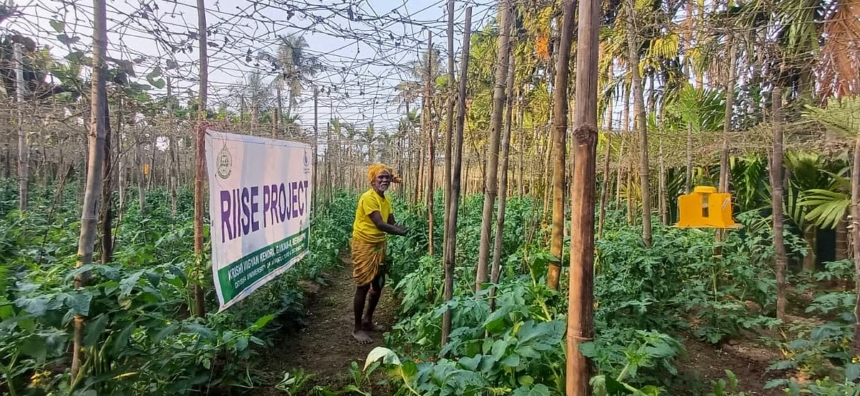
Amid the crisis, some farmers are turning to technology. Several have adopted solar-powered wild animal repellent machines and solar fencing to reduce damage from wild boars, monkeys and stray cattle, particularly in farms near forest fringes .
Subash Pradhan of Nandik village in Ganjam’s Hinjili block said damage to his standing vegetable crops had reduced after he installed a solar-powered repellent machine. “We have promoted the use of solar-based technology in farming systems under the ongoing Resilient and Inclusive Initiatives for Sustainability and Empowerment (RIISE) project,” said Sushant Kumar Nath, senior scientist and in-charge of Krishi Vigyan Kendra, Berhampur .
The three-year project, run by the World Food Programme and Odisha University of Agriculture and Technology, began in 2023-24 and is being implemented in 29 villages across four blocks—Chikiti, Digapahandi, Hinjili and Jagannath Prasad .
In Kandhamal district, the Integrated Tribal Development Agency (ITDA) Phulbani has installed solar fencing in fields to keep animals away. “We have installed solar fencing in 16 patches in different blocks, covering around 12 hectares. Farmers can save standing crops such as vegetables by using wire-mesh fencing,” said P Murali Mohan, Project Manager, ITDA, with financial support from the Odisha Livelihood Mission .
A Wider Crisis
The wild boar problem is part of a broader human-wildlife conflict crisis across Odisha. Elephants—not wild boars—cause the highest number of crop depredation cases and human fatalities. Forest department statistics suggest that around 192 of the 210 human deaths recorded in 2025-26 were linked to elephant encounters. During the same period, the state also lost around 86 elephants due to multiple causes, including conflicts .
In Angul district, surrounding the Satkosia Wildlife Sanctuary, elephants and wild boars together keep farmers in a state of perpetual vigilance. Residents have constructed bamboo watchtowers, set light fires, and used high-powered lamps, drums, and loudspeakers to scare away wild animals .
“We harvest rice, but elephants and wild boars destroy the crops. We stay awake at night with torches and microphones. We are scared, but we have no other option,” said farmer Ranjan Dehuri from Angul .
The forest department has acknowledged the crisis. Satkosia DFO Gadadhar Patra said compensation of Rs 20,000 per acre for paddy and Rs 25,000 per acre for vegetables is provided through the Anukampa App for verified crop damage . However, villagers maintain that the compensation is inadequate and the risk to life remains high.
The Way Forward
For the farmers of Ganjam, the choice is stark. Continue fighting a losing battle against wild boars, or abandon traditional paddy cultivation—a crop that has sustained generations—for alternatives like kewra that offer uncertain futures. As one farmer put it, “We are left with nothing but hope that things will change” .
The irony of the situation is not lost on the farmers. On one side of the forest, the government is cultivating paddy inside forest areas to provide food for elephants and reduce human-wildlife encounters . On the other side, farmers are abandoning paddy because wild boars are eating their crops before harvest.
For now, the wild boars have won. The fields of Ganjam tell a silent story: where paddy once swayed, kewra now stands—a testament to a conflict where the farmer has had to adapt or perish.