
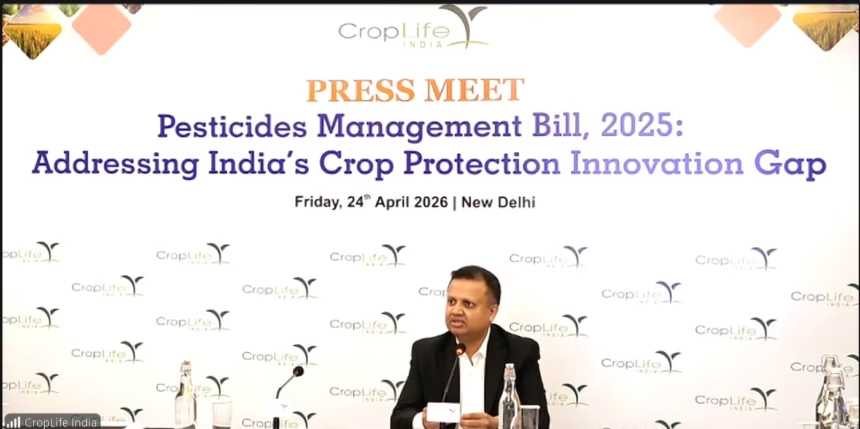
CropLife India, an industry body representing 17 R&D-driven crop science companies that account for approximately 70% of the country’s crop protection market, has urged the government to address the “innovation lag” in the draft Pesticides Management Bill, 2025 .
In a formal submission to the Ministry of Agriculture and Farmers Welfare, the association warned that farmers remain heavily dependent on molecules introduced three to four decades ago, even as climate variability and pest resistance increase . Indian agriculture faces annual crop losses of 10% to 35% due to pests and diseases, translating into economic losses exceeding Rs 2 lakh crore .
The Innovation Lag and Data Protection
A central concern is that the current draft does not address the policy gap contributing to this lag. Bringing a new molecule or new use to India requires major investment in safety, efficacy, and environmental data. Without a clear framework governing how that data is used, there is limited incentive for companies to introduce newer technologies early in the Indian market .
CropLife India has proposed a time-bound Protection of Regulatory Data (PRD) framework of about five years from first registration. This would create a more predictable pathway for newer solutions to reach farmers faster, while allowing competition through independent data generation .
The logic for such a framework has previously been examined by the Satwant Reddy Committee (2007), the Pesticides Management Bill (2008), and endorsed by the Parliamentary Standing Committee on Agriculture and the Committee on Doubling Farmers’ Income .
Ankur Aggarwal, Chairman of CropLife India, noted that stricter residue norms in markets such as the European Union are already pressuring Indian exports. Industry bodies in Assam have flagged that nearly 40 million kilograms of premium tea exports to Europe and the UK are exposed to tighter residue requirements .
“We cannot expect Indian agriculture to respond to these challenges with older chemistries alone,” Aggarwal said. “The final law must keep regulation science-based and time-bound, act firmly against illegal trade, and create a credible pathway for newer, safer and more effective crop protection technologies to reach farmers faster” .
E-commerce and Unauthorized Sales
The submission also flagged the unchecked growth of online sales as one of the most serious emerging threats to genuine pesticides . Under the existing framework, e-commerce platforms are not explicitly required to obtain licences or verify Principal Certificates of sellers. Currently, online sales account for less than 1% of India’s Rs 26,000 crore pesticide market, but visibility has risen since the government allowed online sales in 2021 .
CropLife India has called for explicit statutory obligations on platforms, including licence and Principal Certificate verification, product traceability, and territorial compliance .
Corporate Liability and Penalties
On corporate liability, the association cautioned against the indiscriminate prosecution of directors and senior officials with no operational link to an alleged violation. It recommended that only nominated responsible persons—on the model of the Food Safety and Standards Act, 2006—be held liable, with a decriminalization framework for minor inadvertent deviations .
The submission further raised alarms over the draft Bill’s emergency prohibition provisions. Under the Insecticides Act, 1968, emergency prohibitions were limited to 60 days, extendable to a maximum of 30 more days. The new draft allows a pesticide to be provisionally prohibited for one year, extended by another 180 days, which the industry argues converts a temporary measure into a de facto permanent ban without conclusive scientific findings .
Union Agriculture Minister Shivraj Singh Chouhan had previously indicated that the Union government will bring an amended Seeds and Pesticide Management Bill in the upcoming session of Parliament . The draft Bill aims to repeal the Insecticides Act of 1968 and promote “biological and based on traditional knowledge” pesticides .