

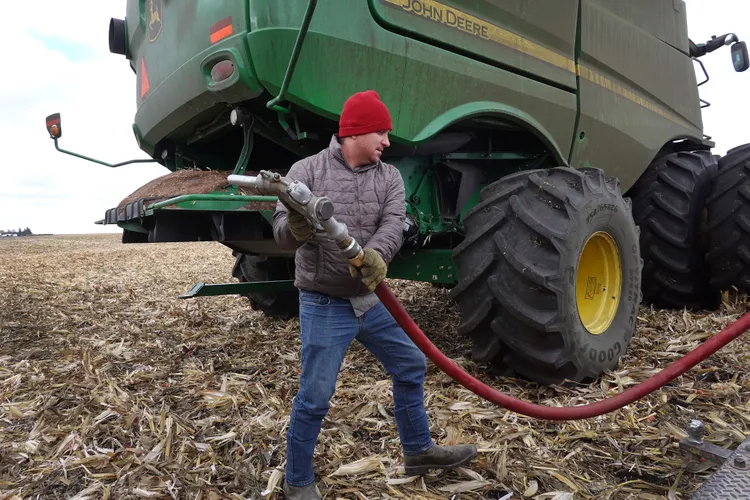
Washington: Late Monday evening, the Trump administration announced the Harvest Fuel Relief Program that will provide farmers with $8 billion as a response to heightened diesel costs during the harvest season. President Trump first announced the aid program while in Kansas as part of midterm election campaign efforts .
“Diesel prices have surged globally as the U.S.-Iran conflict constrains fuel exports through the Strait of Hormuz,” reported Ben Westcott of Bloomberg. “Retail prices in the U.S. hit a record at $6.50 a gallon in September, creating headaches for the U.S. president ahead of midterm elections. The Trump administration has sought to ease the impact on growers — traditionally loyal Trump followers — ahead of the vote, including an effort earlier this month to ease limits restricting the use of a tax-exempt variety of diesel” .
Administered by USDA’s Farm Service Agency, the program will provide one-time payments to help cover a portion of modeled losses for the 2026 crop year. USDA plans to announce commodity-specific payment rates for Title I crops in November, and pre-filled applications will be available in January 2027 .
Industry Reactions
Farm groups welcomed the relief while pushing for long-term solutions.
American Farm Bureau Federation (AFBF): “Farmers and ranchers welcome the administration’s announcement of $8 billion in relief through the Harvest Fuel Relief program to help farmers struggling with high diesel prices. We appreciate President Trump and Secretary Rollins recognizing that higher diesel prices have squeezed farmers’ bottom lines. By building on the Farmer Bridge Assistance program, USDA will be able to quickly deliver this relief to farm country,” said AFBF President Zippy Duvall. “We look forward to working with the president and USDA to ensure specialty crop growers, livestock producers, fishermen, and others get the support they need so they can continue growing the food America’s families rely on. We also value the president’s continued support for Congress passing a modernized farm bill, allowing year-round E15 and addressing agriculture’s labor needs” .
National Association of Wheat Growers (NAWG): “NAWG thanks President Trump and Secretary Rollins for recognizing the financial pressures facing wheat growers and providing assistance to help offset rising fuel costs,” said NAWG CEO Sam Kieffer. “While this relief is welcome, high fuel prices and other input costs continue to squeeze farm margins and threaten the viability of family farms. NAWG remains ready to roll up our sleeves and work with the Administration and Congress to address the farm input cost crisis and advance long-term solutions that help keep American wheat growers competitive” .
National Corn Growers Association (NCGA): “We appreciate the administration recognizing how the high cost of inputs, especially diesel fuel prices during harvest time, is adding to the economic pain of America’s farmers. Corn growers are eager to learn more details about the Harvest Fuel Relief program design and implementation for the 2026 crop year,” said NCGA President Matt Frostic. “As we work to tackle the many economic challenges facing growers and rural communities, we urge Washington to focus on durable, bipartisan, long-term solutions that will result in lasting improvements to the farm and national economy. Such solutions include passing legislation that will allow for the year-round sale of E15, renewing the U.S.-Mexico-Canada Agreement, taking actions to improve access to new markets for U.S. farmers, like maritime and sustainable aviation fuel, and passing a robust farm bill. We will continue to work with Congress and the administration to get these priorities over the finish line this year” .
National Farmers Union (NFU): “This is the second round of emergency aid this year to address losses that were largely foreseeable,” said President Rob Larew. “While this assistance will be helpful for some farmers as they manage a costly harvest, trade disruptions, and rising fuel costs tied to conflict abroad have put family farmers in a difficult position, and one-time payments can’t provide the stability they need to plan for the future” .


