
The 4th annual Youth Storytellers Field to Film Festival has brought together young people from smallholder, rural, and Indigenous farming communities across Latin America, South Asia, and West Africa to document how their communities are transforming food systems through agroecology .
The festival, organized by Groundswell International as part of its Youth Storyteller Program, creates a global platform for youth filmmakers to share their own narratives — challenging the dominant myth that industrial agriculture is the only way to feed the world .
A Growing Movement
What began in 2021 with just four partner organizations across Ecuador, Burkina Faso, Nepal, and Honduras has since expanded to engage nearly 500 youth participants and produce over 50 short films . The program now includes 11 partner groups across Mali, Ghana, Senegal, Mexico, Guatemala, and Haiti .
The 2026 festival placed a special emphasis on women farmers, aligning with the United Nations’ International Year of the Woman Farmer. “Many of the female youth who participate in this program play many roles,” Groundswell International Program Director Rebecca Wolff tells Food Tank. “While they are youth, they are also parents, entrepreneurs, farmers, or students, responsible for the wellbeing of their families and land” .
Why Centering Youth Voices Matters
According to the U.N. Food and Agriculture Organization (FAO), nearly 85 percent of global youth live in low- and lower-middle-income countries where agrifood systems are essential to their livelihoods . While 44 percent of working young people rely on agrifood systems for employment — compared to 38 percent of working adults — youth perspectives are rarely centered in stories about agriculture .
“Centering youth voices is also a matter of justice. The next generation is inheriting food systems that deplete landscapes, harm health, and deepen inequality,” Maylis MouBarak, Groundswell International’s Storytelling and Communications Manager, tells Food Tank. “Including rural youth in these conversations is essential. They bring firsthand experience of what works on the ground and can help identify and scale solutions” .
From Participants to Filmmakers
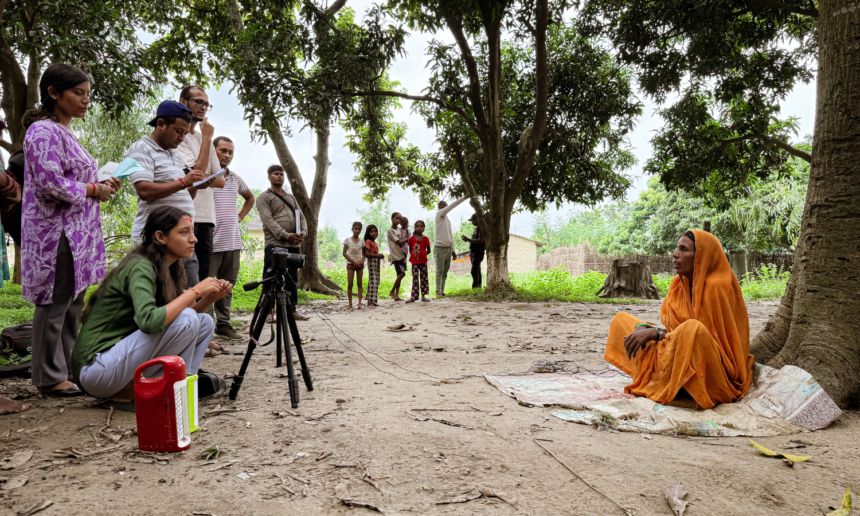
The Youth Storyteller Program equips participants with equipment, ongoing support, and long-term training from local consultants and professional storytellers — covering interviewing, filming, editing, and narrative development. Importantly, creative control remains entirely in their hands .
Through the process, many participants discover their own agency in food and agriculture systems. Saroj Upadhyaya, a storyteller and filmmaker from Nepal, shares: “Initially I used to think agriculture meant farming in large areas, huge production and not suitable for marginal farmers. But when I visited farmers during the video shooting, I saw people practicing agriculture on their own, raising three to four goats in small spaces nearby their house, maintaining kitchen gardens, and getting healthy nutritious foods year-round” .
Spotlight on Women Farmers
The 2026 festival’s theme celebrated the central role of women farmers in rural food systems. Young women filmmakers from across the Global South produced powerful documentaries exploring gender, access to resources, and leadership.
Justine Natama, a filmmaker from Burkina Faso, presented “Women’s Access to Resources: A Lever for Agroecology and Sustainability.” Melissa López, a youth Honduran filmmaker, explores similar intersections in her work. “At the local level, I would like people to value the work done by rural women,” she tells Food Tank .
For some participants, the process is an affirmation of their place in both farming and storytelling. “As a young girl, I used to think that photojournalism and fieldwork were jobs for men,” says Justine Natama. “Today, I am proud to prove the opposite” .
Regional Festival Events
This year’s festival featured three online events tailored to different regions :
- South Asia – February 28, 2026 (Nepali with English interpretation)
- Latin America & the Caribbean – March 6, 2026 (Spanish and Haitian Creole with English interpretation)
- West Africa – March 12, 2026 (French and English interpretation)
The short films remain available for streaming, offering a global library of youth-produced stories documenting how communities are building healthy farming and food systems .
Beyond the Festival
The Field to Film Festival is part of a growing global movement recognizing the power of Indigenous and rural youth storytelling. Similar initiatives include India’s CMS Vatavaran Travelling Film Festival, whose 2026 theme “Roots & Renewal: Indigenous Knowledge, Youth Voices, Planetary Stewardship” emphasized the role of young people in environmental storytelling . Inaugurating the festival, governor Santosh Kumar Gangwar noted: “Films are not just entertainment; they are powerful instruments that can shape thought and direction” .
Challenging Industrial Agriculture
Together, the youth storytellers form a diverse, collective voice demanding a shift in the global food paradigm — for systems that nourish instead of harm, uplift instead of impose, regenerate instead of extract. “And they don’t just call for change: they invite us to their communities and show us how they are taking action” .
Their films have reached policymakers, influenced farming practices, and inspired communities far beyond where they were made — proving that the most powerful stories about rural life are the ones told by those who live it .