
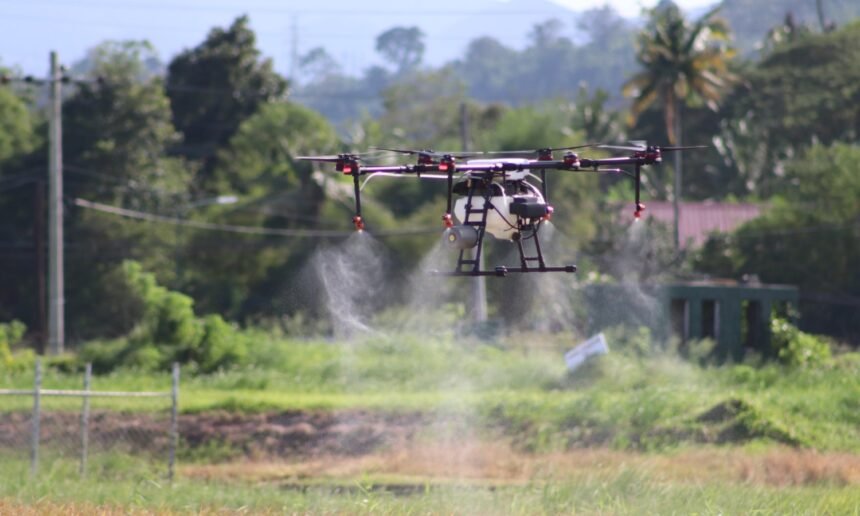
A recent report from the Health, Environment, Agriculture, and Labor (HEAL) Food Alliance argues that precision agriculture (PA) is — in their words — “a costly distraction” from real climate solutions.
The report cautions policymakers against overreliance on PA technologies to solve agricultural challenges, instead calling for investment in regenerative farming methods.
“Precision ag doesn’t transform agriculture; it just makes industrial systems more efficient at causing harm.”
— Celize Christy, Member Organizing Lead at HEAL
What Is Precision Agriculture?
| Technology | Application in PA |
|---|---|
| GPS | Field mapping and guidance |
| Drones | Crop monitoring and spraying |
| Robotics | Automated planting and weeding |
| AI / Data centers | Analysis and decision-making |
The goal: efficiently apply chemical inputs (fertilizers, pesticides) on specific areas of a field rather than whole fields.
Public Investment in PA
| Year | Investment (approx.) |
|---|---|
| 2021 | $11.1 billion (public sector globally) |
Corporations and lawmakers have promoted PA as a way to boost automation and productivity.
HEAL’s Core Argument: A ‘False Solution’
HEAL calls PA a “false solution that diverts attention and resources away from proven solutions.”
They believe regenerative farming methods are more climate-resilient and more accessible to small and mid-sized farms.
| Regenerative Methods | Description |
|---|---|
| Intercropping | Growing multiple crops together |
| Agroforestry | Integrating trees with crops/livestock |
| Silvopastoralism | Combining forestry with grazing |
| Cover cropping | Planting crops to protect soil |
| Biodynamic farming | Holistic, ecological approach |
The Efficiency vs. Sustainability Trap
Celize Christy explains the problem with conflating efficiency and sustainability:
“Proponents of PA argue innovations can reduce the amount of water or fertilizer used per acre, but it doesn’t cut the emissions from these fertilizers.”
The Evidence: Fertilizer Use Didn’t Go Down
| Time Period | PA Adoption | Fertilizer Use Trend |
|---|---|---|
| 2010-2012 | ~50% of US corn/soybean acreage | Increased (USDA data) |
HEAL’s conclusion after 30 years of observation:
“There is minimal reliable evidence to support that PA has reduced the use of chemical inputs.”
The Hidden Cost: Data Centers and Resource Extraction
Jevons Paradox
The report invokes the Jevons Paradox — the principle that increased resource efficiency can actually lead to an increase in resource consumption in the long term.
| Finding | Detail |
|---|---|
| US data centers (2,600+) | Used to operate AI in agriculture |
| Water consumption | Among top 10 water users in US commercial/industrial sectors (as of 2022) |
“Precision ag might make one farm more efficient, but across the system it drives more extraction of water and energy to power the data centers.”
Who Benefits? Consolidation and Inequality
Corporate Giants Benefit Most
“What [PA] has done is drive consolidation, putting more power and land into the hands of corporations like Bayer and John Deere.”
Disproportionate Impact on Small and BIPOC Farmers
| Issue | Detail |
|---|---|
| PA favors large farms | Better suited to large monocropping (corn, soybeans) |
| Small farms | More likely to grow diversified specialty crops with regenerative practices |
| BIPOC farmers | More likely to operate small-scale family farms (due to discriminatory land access and lending practices) |
| PA accuracy | Research shows PA can give inaccurate assessments for diversified cropping |
Financial Barriers
“High costs and data-driven platforms will push out small BIPOC farmers… it creates a future where farming is dictated by algorithms, not ecosystems.”
“It’s a model that prioritizes machines over communities, and efficiency over equity, deepening the very crises it claims to solve.”
HEAL’s Recommendations for Policymakers
| Recommendation | Detail |
|---|---|
| Reckon with costs | Environmental and social costs of PA production and use |
| Divest from PA | Redirect funding away from false solutions |
| Invest in regenerative practices | Federal support and incentives for holistic input reduction |
| Promote equitable Farm Bill initiatives | Reach small, diversified, BIPOC producers |
| Greater oversight | Policymaker oversight in PA use |
| Collaborate with farmers | Work with small/mid-size farmers to determine beneficial practices |
| Support proven practices | Agroforestry, silvopasture, cover crops, integrated crop-livestock |
Success Stories Already Exist
HEAL notes that biodynamic farming systems — relying on agroecological practices like intercropping and cover cropping — have already been adopted across the country.
| Proven Benefits | Detail |
|---|---|
| Decreased emissions | Lower carbon footprint |
| Increased nutrient availability | Reduced reliance on chemical inputs |
Now they want to see them adopted at scale.
Summary: Key Takeaways
| PA Promises | HEAL’s Reality Check |
|---|---|
| Efficiency | Doesn’t reduce emissions |
| Reduced inputs | Evidence shows fertilizer use increased |
| Technological solution | Creates new problems (data centers, water use) |
| Accessible to all | Favors large farms, corporates, white owners |
| Future of farming | Distraction from real climate solutions |
Climate Solutions Should Serve Communities
The HEAL report is a direct challenge to the prevailing narrative that high-tech agriculture is the path to sustainability.
As Celize Christy puts it:
“Climate solutions should serve communities. Not corporations.”
Whether policymakers will divest from PA and invest in regenerative methods remains to be seen. But the report adds a powerful voice to a growing movement questioning the role of AgTech in solving — or worsening — the climate crisis.