
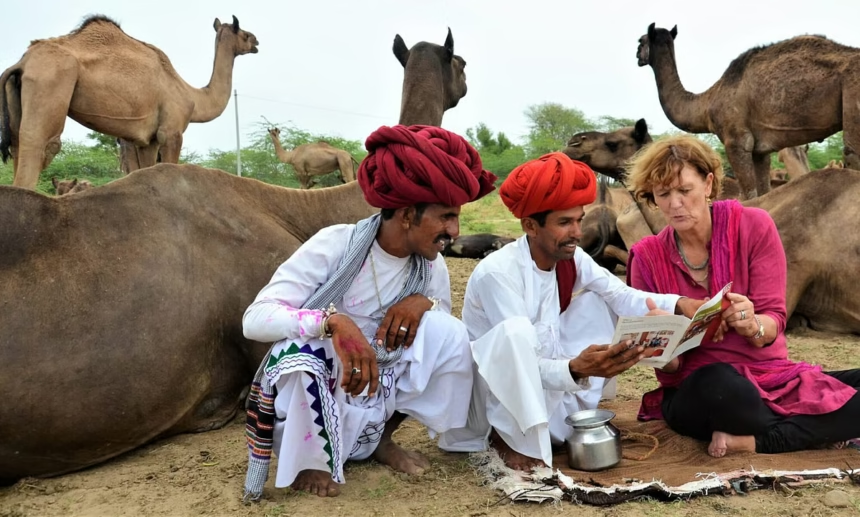
As the United Nations marks the International Year of Camelids, a German scientist who has spent over three decades living and working with camel herders in Rajasthan has issued a stark warning: industrial camel production is not the answer.
Dr. Ilse Köhler-Rollefson, co-founder of the social enterprise Camel Charisma, has been a powerful voice for camels in India at a time when their numbers are declining sharply. In a conversation with Down To Earth, she explained why replicating the industrial models used for cattle, pigs, and poultry would be a disaster for the animals, the environment, and the pastoralist communities who have cared for them for centuries.
The decline of the camel in India
While camel populations are thriving in Pakistan, the Middle East, and Africa, India has witnessed a worrying decline. According to Köhler-Rollefson, several factors have contributed to this. A ban on the export of camels across state borders has diminished their economic value. Grazing areas have vanished due to development projects, mining, and green energy initiatives. And crucially, there are no established value chains for camel products.
This is not just an animal crisis—it is a cultural one. The Raika people of Rajasthan have a deep spiritual and practical connection to camels. But as the animals lose their utility and value, the entire knowledge system built around them is at risk.
Pastoralism versus industrial farming
Köhler-Rollefson is unequivocal in her stance. “The world does not need industrial camel production, in fact we must strive to prevent camels following in the tracks of pigs, cattle and poultry,” she told Down To Earth.
Industrial livestock farming keeps animals confined, stalls them to maximize milk production, and prioritises profit over welfare. In contrast, pastoralist communities treat their camels as part of the family, allowing them to roam freely and choose their own diets. According to traditional knowledge, camels eat as many as 36 different plants—a diversity that boosts milk quality and keeps the animals healthy.
“We don’t follow the industrial model of camel milk production where camels are stall-fed to maximise the production,” she explains. “The community believes that camels need to move to be happy and healthy; they need to have dietary choices of trees from which they wish to nibble. In contrast to commercial dairy enterprises, we don’t separate the mother from the calves.”
The hidden climate solution
The benefits of traditional camel herding extend far beyond animal welfare. Köhler-Rollefson argues that managed grazing systems, where livestock are kept moving, mimic the behaviour of wild herbivores. These animals spread seeds, trample organic matter into the soil, nourish microbes, and support insects that feed birds. Under these conditions, livestock can have a positive impact on the environment.
The Raika, she notes, barely leave a carbon footprint. They use nothing they do not need, and live in close harmony with natural cycles.
By contrast, industrial livestock production is a major driver of climate change, biodiversity loss, and land degradation.
Building a cruelty-free model
Köhler-Rollefson has not simply critiqued the industrial model—she has built an alternative. In 2019, she and her co-founder Hanwant Singh Rathore set up Rajasthan’s first dedicated camel dairy, Kumbalgarh Camel Dairy, through their social enterprise Camel Charisma.
The enterprise sells camel milk, cheese, wool products, and even paper made from camel dung, providing a sustainable income for Raika herders. Camel milk has documented health benefits, including potential to reduce insulin dependence in Type 1 diabetes patients.
“The only difference can be made through camel milk,” she told the Hindustan Times. But unlike commercial dairies, Camel Charisma ensures the milk comes from happy, free-roaming animals. The milk is not standardised, meaning its fat and water content fluctuate with the seasons—pure, natural, and untouched.
A call to policymakers
As camels are declared a state animal in Rajasthan and laws restrict their movement, Köhler-Rollefson fears that well-intentioned but misguided policies may accelerate their decline rather than protect them.
She argues that the starting point for any intervention must be to support pastoralist cultures by protecting grazing areas, investing in local processing infrastructure, and linking herders to markets. If the stated goals of the International Year of Camelids are to be met—poverty alleviation, food security, and sustainable development—then industrialisation must be rejected.
“Ultimately, the communities who have taken care of and acted as custodians of these animals should benefit, rather than outsiders and corporations who just want to use them to make money,” she said.