
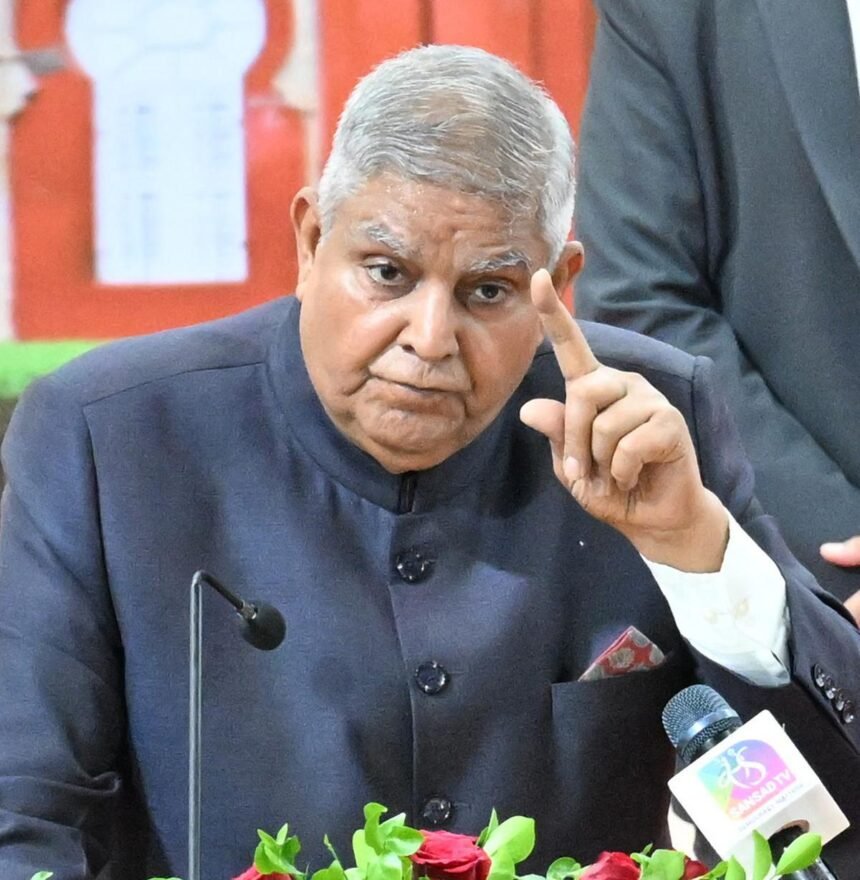
Vice President Jagdeep Dhankhar has reiterated his call for a fundamental reform in India’s agricultural subsidy framework, advocating for all government subsidies to be transferred directly to farmers’ bank accounts. He argued that this shift would dramatically increase farmer incomes and empower them to make independent decisions about their agricultural practices .
A ‘game-changer’ for farmer income
Speaking at multiple events, the Vice President highlighted the inefficiency of the current indirect subsidy system, where support for fertilisers, seeds, and other inputs is routed through intermediaries and government machinery. He estimated that if all subsidies, particularly the massive ₹3 lakh crore annual fertiliser subsidy, were transferred directly, each farmer family could receive between ₹30,000 and ₹35,000 per year .
“There will be a real uplift in farmers’ income when every form of assistance reaches them directly,” Dhankhar stated at the Agri-Industry Conclave in Narsinghpur, Madhya Pradesh .
The US model: a benchmark for India
Dhankhar repeatedly cited the United States as a successful example where farmers receive direct government support without bureaucratic filtering. He noted that in the US, “the average annual income of a typical household is less than the average income of a farmer family” .
He explained that when farmers receive aid directly, they have the freedom to decide how to best use the money—whether to purchase livestock for manure, invest in natural farming, or buy chemical fertilisers. This autonomy, he argued, leads to better decision-making and higher incomes .
Beyond subsidies: a shift to agripreneurship
The Vice President’s vision extends beyond direct transfers. He stressed the need to transform farmers from mere producers into “agripreneurs” (agriculture entrepreneurs) . He emphasised that farmers must participate in the entire value chain, including processing, marketing, and selling their produce, rather than limiting themselves to cultivation .
“Just look at the enormous scale of agricultural marketing… But is the farmer a stakeholder in this? No. The farmer has been reduced to being just a producer. We must change this mindset,” he said .
Link to Inflation and PM-KISAN
Dhankhar also called for subsidies to be linked to inflation, drawing a parallel to how salaries of legislators and MPs are revised. He pointed out that the ₹6,000 provided annually under the PM-KISAN scheme, while a “significant start,” has lost purchasing power since its introduction .
“Any economist will tell you that the purchasing power of ₹6,000 when it was introduced is no longer the same,” he said .
Empowering choice and sustainability
A key argument for direct subsidies is that it would give farmers the freedom to choose between chemical and natural farming methods . If subsidies were direct, farmers could decide to invest in organic inputs or livestock, potentially reducing chemical dependence and promoting sustainable agriculture, while still receiving government support .
Dhankhar expressed confidence that this shift could reshape Indian agriculture and urged institutions like the Indian Council of Agricultural Research (ICAR) to study and implement this model . He also emphasised the need to train rural youth as “agripreneurs” to bridge the gap between production and market access .