

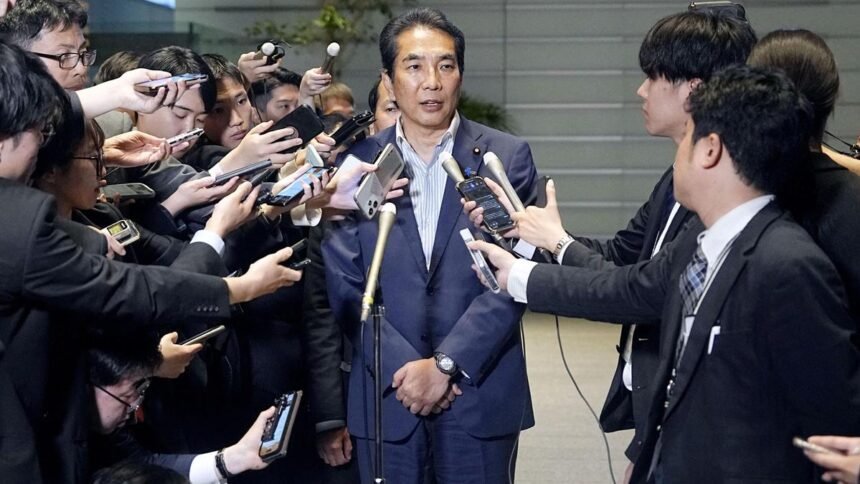
Japan’s Agriculture, Forestry and Fisheries Minister Taku Eto resigned on Wednesday, becoming the first member of Prime Minister Shigeru Ishiba’s cabinet to be dismissed after a controversial remark about rice sparked public outrage and threatened to destabilize the government ahead of crucial elections .
Eto’s comment that he “never had to buy rice” because his supporters gave it to him as gifts was seen as deeply insensitive as the country grapples with soaring rice prices, which have nearly doubled over the past year .
“I made an extremely inappropriate remark at a time when consumers are struggling with soaring rice prices,” Eto told reporters after submitting his resignation . He was the first minister to resign under Ishiba’s leadership, which began in October 2024 .
The triggering remark
At a seminar for the Liberal Democratic Party (LDP) on Sunday, Eto said he did not buy rice because supporters gave him “plenty” as gifts, adding that he had so much at home he “could sell some” . He later clarified that he was referring to brown rice and that he does buy white rice for his family .
The remark was met with immediate condemnation from opposition parties, ruling party members, and the public, who saw it as a sign of being out of touch with ordinary people struggling to afford the staple grain .
Rice crisis context
Japan has been facing a severe rice shortage since a poor harvest in 2023 due to unusually hot weather. Panic buying followed a government warning about a potential major earthquake last August, squeezing supplies further .
The average retail price of 5 kilograms of rice reached 4,268 yen (approximately $29) in the week leading up to May 11, nearly double the price from a year earlier . Despite the government releasing rice from emergency stockpiles for the first time, the grain has been slow to reach supermarket shelves .
Several factors have contributed to the crisis, including higher fertilizer and production costs, increased demand from tourism, and government policies that have capped rice production to protect farmers, leaving the country ill-prepared for demand surges .
Political fallout and succession
Opposition parties threatened to submit a no-confidence motion against Eto if he did not resign voluntarily . Prime Minister Ishiba initially attempted to keep Eto in his post, advising him to retract his remarks, but the growing political pressure and fears of a negative impact on the upcoming July upper house election forced his hand .
Ishiba’s approval rating had already sunk to a record low of 21% . Eto’s replacement is Shinjiro Koizumi, a popular former environment minister and the son of a former prime minister, who has been tasked with stabilizing the rice supply and reforming Japan’s long-standing rice policies .
“I was told to put rice before anything,” Koizumi told reporters, adding that he would “do my utmost to speedily tackle the high rice prices that people feel and worry about in their everyday lives” . He stressed the need to reform Japanese rice policy, which has focused on powerful organizations representing farmers, to focus more on the benefit of consumers .
The rice crisis has emerged as one of the defining issues of the upcoming election, determining whether Ishiba’s ruling coalition can secure a majority in the upper house. Having already lost its majority in the lower house in October 2024, the government may be set for another crushing defeat .