
As the West Asia crisis severely disrupts global supply lines, experts caution India to avoid a sudden shift away from chemical fertilizers. Instead, they urge policymakers to heed the costly lessons from Sri Lanka’s abrupt 2021 ban .
India must carefully balance immediate food security needs with long-term sustainability goals. Sudha Meiyappan, Member of the Economic Affairs Committee of the Southern India Chamber of Commerce and Industry (SICCI), stated that while New Delhi should aim to move towards natural farming, it must avoid the “shock treatment” that led to economic collapse in the neighboring island nation .
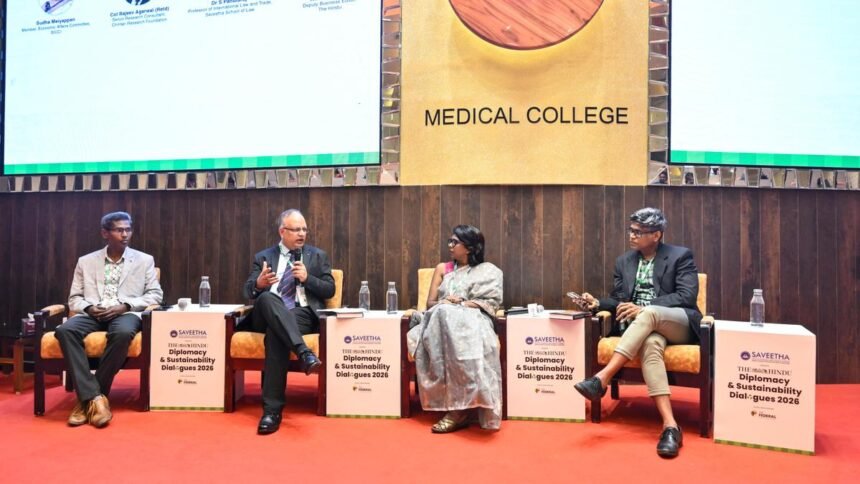
“In the short term, you continue doing what you are doing today. You don’t change to organic today… You can’t get rid of fertilizers but [determine] how much you are using and for what crop you are using,” Ms. Meiyappan said during a panel discussion in Chennai in mid-May .
The Sri Lankan Precedent: A Case of ‘Organic Shock’
Sri Lanka’s experience serves as a stark warning. In April 2021, former President Gotabaya Rajapaksa imposed a sudden ban on chemical fertilizer imports, aiming to create the world’s first fully organic farming nation. The result was catastrophic: rice production plummeted, dropping from pre-ban highs to below 2.8 million tonnes in subsequent seasons, with yields dropping by over 30% . To compensate, the country was forced to import $292.5 million worth of rice .
Experts argue the policy backfired so severely that it exacerbated the island nation’s worst financial crisis in over seven decades, triggered public unrest, and ultimately contributed to the downfall of the Rajapaksa government . Although the ban was lifted within months, the agricultural sector has struggled to recover. The academic analysis suggests that abrupt and large-scale imposition of organic farming is “doomed to fail in the absence of prior consultation with stakeholders… and technical and logistical planning” .
India’s Vulnerability in the Current Crisis
India’s current position is precarious. The country is highly dependent on global markets for essential inputs. India imports 60% of its DAP (Di-Ammonium Phosphate) requirements and is entirely dependent on imports for Potash. Furthermore, even domestic Urea production relies heavily on imported Liquefied Natural Gas (LNG) .
The West Asia conflict has already triggered a sharp spike in global prices. While the government has so far absorbed these shocks through increased subsidies to protect farmers, the fiscal burden is immense. A prolonged crisis could push up inflation and reduce GDP growth if supply chains are severely disrupted .
The Path Forward: Gradual Transition and Efficiency
Experts highlight that instead of banning fertilizers, India must focus on efficiency and reduction. Initiatives like the PM-PRANAM scheme aim to incentivize states to cut chemical use, but the transition requires time, farmer education, and the development of viable biofertilizer alternatives .
“A gradual transition…is essential. Sri Lanka’s experience is a valuable lesson for all emerging economies,” experts note, emphasizing that “regenerative processes focus on improving soil quality” rather than delivering the short-term yield spikes farmers currently expect from chemical inputs .
For now, experts agree that India must continue current policies to ensure Kharif sowing goes smoothly, while quietly building the infrastructure for a more resilient, less import-dependent agricultural future .