
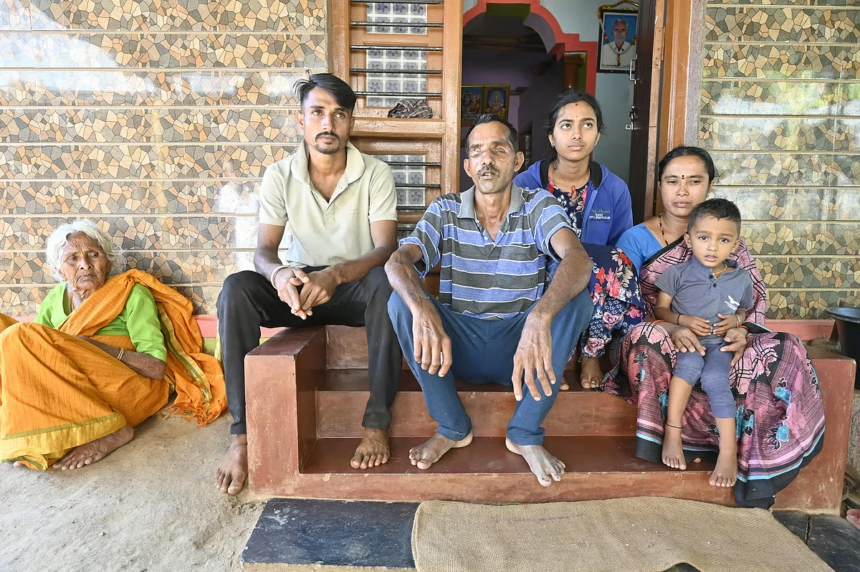
M. Boregowda, a 58-year-old farmer in Ponnampet village on the fringes of the Bandipur Tiger Reserve, has watched his family’s plantation dwindle over the last decade. “They come at night and destroy everything—sugarcane, ragi, vegetables,” he said, referring to herds of wild elephants. “We are left with nothing.”
Boregowda’s story is not unique. Across the buffer zones of Bandipur and Nagarahole Tiger Reserves in Karnataka’s Chamarajanagar and Mysuru districts, a silent but devastating conflict is unfolding: the forest has entered the field.
A protected landscape, a growing population
Bandipur and Nagarahole, part of the Nilgiri Biosphere Reserve, are among India’s most successful conservation stories. Tiger and elephant populations have risen steadily due to strict protection measures. According to the 2023 all-India elephant census, Karnataka has an estimated 6,000 elephants — the highest of any state.
But success in the forest has become a crisis for farmers on its edges.
The human cost
Elephants are not the only animals causing damage. Wild boars, peafowl, and gaurs also raid crops. But elephants are the most destructive. A single herd can decimate several acres of crops in one night — sugarcane, banana, maize, ragi, and vegetables being the most vulnerable.
For small and marginal farmers, a single night of crop loss can push a family below the poverty line. Many have abandoned agriculture altogether, selling their land to real estate developers and migrating to nearby towns for daily wage labour.
“Earlier, I cultivated ten acres. Now, I cannot even manage two,” said Boregowda. “The younger generation does not want to farm. There is no future here.”
Inadequate compensation
The Karnataka government provides ex gratia payments for crop loss and human injury or death caused by wildlife. However, farmers say the compensation — ₹6,000 per acre for crop damage — is grossly inadequate.
“By the time the survey is done and the paperwork is completed, we have already lost two more crops to the elephants,” said Boregowda. “The process takes months. We need immediate relief, not a bureaucratic maze.”
Human casualties
The conflict has also claimed human lives. Between 2019 and 2024, Karnataka reported over 150 human deaths due to elephant attacks, according to state forest department data. Many of the victims were farmers working in their fields at dawn or dusk — the hours when elephants are most active.
In April 2026, a 65-year-old farmer in Hangala village near Nagarahole was trampled to death by a lone elephant while guarding his arecanut plantation. His family received ₹10 lakh in compensation, but the loss of the primary earner has left them dependent on relatives.
Mitigation measures and their limitations
The Forest Department has experimented with multiple mitigation strategies: solar-powered fences, trenches, bio-fencing using lemon and beehive, and early warning systems using sensor cameras.
However, farmers report that elephants have learned to break through solar fences or push boulders into trenches to cross them. The early warning system — which sends SMS alerts to registered mobile phones when elephants enter a forested area near a village — suffers from poor network coverage in remote regions.
‘We share the blame’
Forest Department officials acknowledge that the solution is not simple.
“We are dealing with a landscape where animals have been moving for centuries,” said a senior official at the Bandipur Tiger Reserve. “Our goal is not to drive them away but to ensure coexistence. That requires not just infrastructure but also changing cropping patterns, providing quick compensation, and most importantly, winning the trust of the community.”
The way forward
Conservationists argue that long-term solutions must go beyond compensation and fencing. Key recommendations include:
- Crop diversification to less palatable crops
- Relocating families from high-conflict zones to safer areas
- Creating dedicated elephant corridors with no cultivation
- Strengthening rapid response teams to drive elephants back into forests before they enter agricultural land
- Increasing compensation and streamlining the disbursal process