

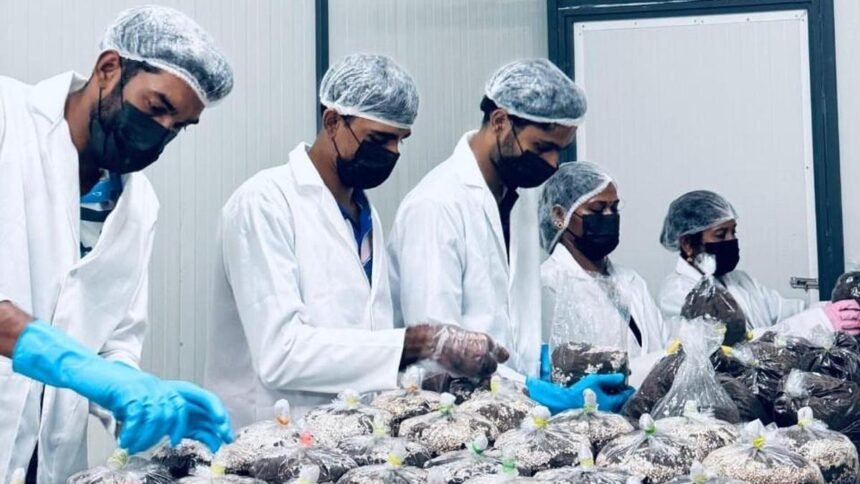
The lockdown of 2020 shattered the dreams of many athletes. For three young volleyball players from Kerala’s Kollam district, it became the starting point of a completely different game – mushroom farming.
What began as a desperate attempt to earn a living has now blossomed into ‘Spike Mushrooms,’ a thriving enterprise that produces over 500 kg of mushrooms weekly and supplies to hotels, retailers, and online customers across south Kerala.
From the volleyball court to the growing room
Arun Raj, 28, along with his teammates Vineeth Kumar, 27, and Sijo Joseph, 29, had represented Kollam district in several state-level volleyball tournaments. When the COVID-19 lockdown wiped out all sporting events in 2020, the trio found themselves without income or direction.
“We had no backup plan. Volleyball was our life,” says Arun, who was working as a physical education teacher on a contract basis. “When that stopped, we had bills to pay and families to support.”
One evening, a chance video on YouTube about mushroom cultivation caught their attention. The low investment, quick turnaround, and minimal space requirement seemed perfect.
The difficult beginning
With just ₹15,000 pooled together, they bought 300 spawn packets and built a small makeshift shed behind Arun’s house. The first harvest was a disaster – high humidity ruined half the crop.
“We lost money. Our families thought we had lost our minds. Some neighbors laughed,” recalls Vineeth. “But we had already failed as athletes that season. We weren’t afraid of failing again.”
They approached the Kerala Agricultural University’s Krishi Vigyan Kendra for training. Scientists taught them climate control, hygiene protocols, and pest management.
The turning point
By the third month, production stabilized. They were harvesting 50 kg of oyster and milky mushrooms daily. Local vegetable vendors started placing regular orders.
When hotels reopened post-lockdown, ‘Spike Mushrooms’ became a preferred supplier – fresh produce, delivered daily, with consistent quality.
“We played volleyball together for seven years. We knew each other’s strengths. Arun handles marketing, Vineeth manages production, and I look after finance. That teamwork made all the difference,” says Sijo.
Scaling up
Today, the business operates from a 2,000 sq. ft. climate-controlled unit with investment of ₹8 lakh, sourced through government schemes for youth agri-entrepreneurs. They employ six local women for sorting and packing.
Monthly revenue now touches ₹1.5 lakh, with net profit around ₹60,000 – far more than what they earned from coaching and small tournaments.
They have also diversified into value-added products: mushroom pickles, mushroom powder, and ready-to-cook mushroom biryani kits under their own brand.
Giving back to the community
The trio now trains other unemployed youth in mushroom cultivation. Over 50 individuals have been mentored, with 12 starting their own small units.
“We didn’t become international volleyball players. But we became entrepreneurs. And honestly, that feels like a bigger win,” says Arun.
Future plans
The team is now exploring export opportunities to Gulf countries, where demand for fresh oyster mushrooms is high. A cold storage facility is next on their list.
For anyone thinking of a similar journey, Vineeth has simple advice: “The court teaches you to get up after every fall. Farming is no different. Just start.”