
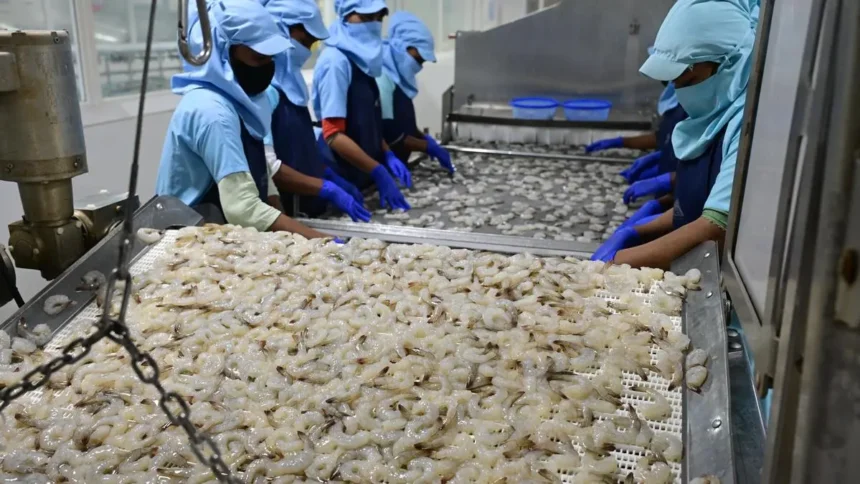
A one-day knowledge-sharing programme for prawn farmers was held at the Kerala University of Fisheries and Ocean Studies (KUFOS) as part of Blue India 2026 .
The event was jointly organised by KUFOS and the Prawn Farmers Federation of India, with support from the Coastal Aquaculture Authority (CAA), the Central Institute of Brackishwater Aquaculture (CIBA), and the National Fisheries Development Board .
Innovation and sustainability at the forefront
Inaugurating the programme, A. Biju Kumar underscored the need for innovation, scientific aquaculture practices, and sustainable resource management to strengthen the shrimp farming sector. He emphasised that knowledge-driven farming and greater collaboration among stakeholders are crucial for enhancing productivity and profitability .
The programme brought together shrimp farmers, aquaculture experts, researchers, exporters, and policymakers from across the country .
Technical sessions
Technical sessions covered a range of critical topics, including:
- Super-intensive shrimp farming
- Coastal aquaculture regulations
- Disease management and biosecurity
- Traceability in the supply chain
- Market access and export prospects
Experts from CIBA, CAA, KUFOS, and the aquaculture industry shared practical insights and field experiences with participants .
Focus on mud crab fattening
A special session showcased KUFOS-developed mud crab fattening technology, offering farmers an opportunity to explore aquaculture diversification as an additional income stream .
Participants also visited the university’s Mud Crab Fattening Facility for hands-on exposure to sustainable farming practices and technologies .
KUFOS: A hub for aquaculture research
The Kerala University of Fisheries and Ocean Studies, established in 2010 and headquartered in Kochi, is India’s first university dedicated to fisheries and ocean sciences. It leads education and research in fisheries management, aquaculture, seafood processing, and marine resource governance, contributing to India’s vision for a sustainable blue economy .
The university provides both technical and financial support to fish farmers and fisherfolk in establishing small-scale units, creating employment opportunities and providing livelihood security . Demonstration units established by KUFOS in diversified aquaculture practices—including cage culture, pen culture, and ornamental fish culture—help motivate farmers to adopt eco-friendly and sustainable technologies .
Among the technologies available at KUFOS are cage culture of seabass, pearl spot, red snapper, giant trevally, and Nile Tilapia; freshwater fish and scampi farming; brackish water fish and shrimp farming; Vannamei shrimp farming; integrated farming; ornamental fish culture and seed production; live feed culture; feed preparation; air-breathing fish culture; and preparation of value-added fishery products .
Looking ahead
The workshop aligns with Kerala’s broader efforts to strengthen its fisheries sector. The State government has announced plans for comprehensive development of the fisheries sector in partnership with Norway, with KUFOS playing a key role in hosting workshops and facilitating global expert participation .
Additionally, the Seafood Exporters Association has urged the State Fisheries Department to formulate comprehensive guidelines for enhancing sustainable shrimp production in traditional aquaculture fields like Pokkali and Kaippad, which have been celebrated for their sustainable shrimp production spanning centuries . A study presented at a previous KUFOS-hosted congress highlighted that these fields yield approximately 2,597 kg/ha of shrimp during the six-month season from November to April .
The workshop served as a platform for knowledge exchange and capacity building, reinforcing the commitment of KUFOS and its partners to advancing scientific shrimp farming practices in India .