

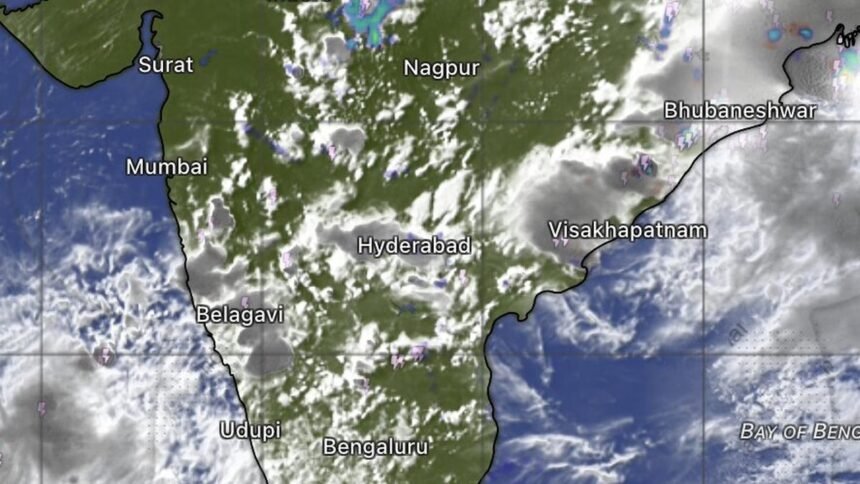
The Southwest Monsoon has officially advanced over Kerala and parts of South India after a brief delay, bringing relief to the region. However, the encouraging start is overshadowed by rapidly strengthening El Niño conditions in the Pacific Ocean, which threaten to disrupt rainfall distribution during the crucial Kharif season.
According to the India Meteorological Department (IMD), the monsoon arrived in Kerala on June 4—three days after its normal onset date of June 1—and is now expected to progress steadily across southern and eastern states.
El Niño gains strength
Despite the active monsoon onset, scientists are closely monitoring the equatorial Pacific, where sea surface temperatures have warmed significantly. The World Meteorological Organization (WMO) confirmed on June 2 that El Niño conditions are developing, with an 80% likelihood of a full event taking hold between June and August 2026.
The probability of these conditions persisting through at least November is near or above 90%, meaning the impact could be felt across the entire four-month monsoon season.
Forecasters predict below-normal rainfall
The IMD has already revised its 2026 monsoon forecast downward, projecting seasonal rainfall at 90% of the Long Period Average (LPA)—the threshold between a normal and a deficient monsoon.
Crucially, the weather office has assigned a 60% probability of a deficient monsoon outcome and warned that El Niño conditions are likely to intensify during the second half of the season, particularly during the critical July-September window for crop sowing and development.
What this means for Kharif crops
For India’s agricultural sector, which depends on the monsoon for nearly 70% of its annual rainfall, the developing El Niño presents a significant risk.
Historically, strong El Niño events have often coincided with prolonged dry spells and uneven rainfall distribution across the subcontinent. The 1982 and 2015 super El Niño events both produced significantly deficient monsoons in India, leading to lower soil moisture, reduced harvests for rice, maize, pulses, and cotton, and increased pressure on reservoir levels.
However, experts note that not all El Niño years automatically produce droughts. The 1997 event, one of the strongest on record, delivered near-normal rainfall because a positive Indian Ocean Dipole (IOD) helped counterbalance El Niño’s adverse effects.
Relief in sight for North India?
For northern and central regions still awaiting the arrival of monsoon rains, the wait may continue. Meteorologists expect the monsoon to reach eastern states such as West Bengal, Bihar, and Jharkhand around mid-June, while Delhi, Haryana, Punjab, and western Uttar Pradesh may have to wait until the final week of June or the beginning of July.
Until then, these regions will depend on pre-monsoon thunderstorms and western disturbances for relief from soaring temperatures.
Government prepares contingency plans
The agriculture ministry has convened a meeting to review the country’s preparedness, with Union Minister Shivraj Singh Chouhan directing states to remain alert and implement district-level contingency plans.
Proposed interventions include promoting drought-tolerant crop varieties, shifting to less water-consuming crops such as millets, and improving water management through efficient irrigation practices.
Officials have noted that current water levels in the country’s reservoirs are satisfactory, with overall storage reported at 127% of normal levels for this period, providing a crucial buffer heading into the season.