

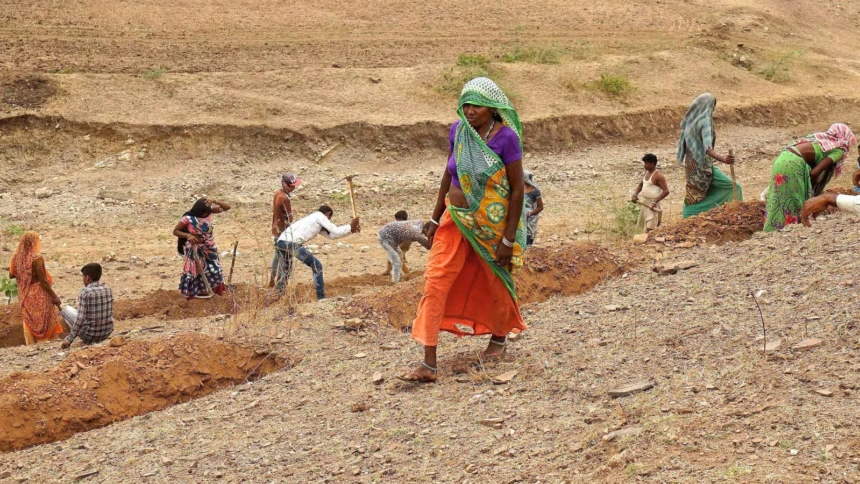
The Centre is set to adopt the same “objective parameters” for normative allocation of funds under the Viksit Bharat – Guarantee for Rozgar and Ajeevika Mission (Gramin) (VB–G RAM G) scheme, which will be rolled out from July 1 this year, bringing down the curtain on the two-decade-old Mahatma Gandhi National Rural Employment Guarantee Scheme (MGNREGS) .
Normative allocation based on Finance Commission formula
The Ministry of Rural Development on Friday released the draft of Objective Parameters for Normative Allocation Rules, 2026, seeking public comments within 30 days. As per the draft rules, “The Central Government shall, for each financial year, determine the normative allocation of the funds for every State based on the objective parameters specified in these rules” .
“For the purpose of determining normative allocation for each financial year, the Central Government shall adopt the objective parameters used for horizontal devolution among States as recommended by the Sixteenth Finance Commission and accepted by the Government of India,” states the sub-rule 4(1) of the draft rules .
The formula for horizontal devolution recommended by the 16th Finance Commission is based on six parameters: population (2011 Census) with a weight of 17.5%, demographic performance (10% weight), area (10%), forest (10%), per capita Gross State Domestic Product Distance (42.5%), and contribution to GDP (10%) .
Performance-linked allocation component
According to the draft rules, from the financial year immediately after the first year of commencement of the Act, a portion of the normative allocation may also be determined on the basis of performance criteria including: timely payment of wages; compliance with social audit requirements; the percentage of completion of works in a financial year; and such other performance-related indicators as may be specified by the central government from time to time .
For Union Territories where horizontal devolution is not applicable, the central government shall determine the normative allocation on the basis of the performance criteria specified and such other criteria as may be considered appropriate by the central government .
Key shift: From demand-based to allocation-based model
Unlike MGNREGS, where states were provided money based on demand for unskilled work, VB-G RAM G introduces a normative allocation framework. This marks a fundamental shift from a demand-driven legal entitlement to an allocation-based scheme, where states will only be able to spend within the funds allocated by the Centre .
The government has faced criticism over bringing in the concept of normative allocation. Critics argue that the bottom-up approach of guaranteed employment on demand by workers is gone, and many better-developed states may see lower allocations .
Cost-sharing formula revised
Departing from MGNREGA, the VB–G RAM G Act proposes a higher share of states in the funding of the rural job programme. As per Section 22(1) of the VB-G Ram-G Act, the fund-sharing pattern between the Centre and states shall be 90:10 for the northeastern states, Himalayan states, and UTs with legislature (Uttarakhand, Himachal Pradesh, and Jammu and Kashmir), while it will be 60:40 for all other states and union territories with legislature .
Under MGNREGA, the Centre paid the entire wage bill and shared 75% of material and administrative costs. Under the new law, states will have to provide 40% of funds for general category states, significantly increasing their financial burden .
VB-G RAM G allocation for 2026-27
For the financial year 2026–27, a Central share provision of ₹95,692.31 crore has been made for VB-G RAM G, representing the largest allocation ever for a rural employment programme at the Budget Estimate stage. With the inclusion of the corresponding estimated State share, the total programme outlay is likely to exceed ₹1.51 lakh crore, which is expected to significantly accelerate rural transformation and large-scale employment generation in rural areas .
Political opposition to the new Act
Several state governments, particularly those led by opposition parties, have expressed strong reservations about the new legislation. Karnataka Chief Minister Siddaramaiah said in the state Assembly that many states will be under financial stress when they implement VB-GRAM-G, as the Centre-state share has been reworked to 60:40 .
“We had demanded 50 per cent, even Prime Minister Narendra Modi had demanded it when he was Gujarat CM. Should not Modi’s stand be the same, whether he is CM or PM?” he questioned. Siddaramaiah also alleged that through VB-G RAM G, the powers of gram sabhas have been taken away as they cannot select works according to their needs .
Karnataka Minister Priyank Kharge strongly criticised the VB-G RAM G Act, claiming that the changes weaken and undermine the previous act’s core promise as a rights-based rural employment programme. He argued that the act would gradually make the scheme untenable by transforming it from a demand-driven legal entitlement into a supply-driven arrangement, thereby stripping citizens of their right to demand work .
VB-G RAM G: Key features
The VB-G RAM G Act, enacted in December 2025, replaces the MGNREGS Act of 2005 and increases the guaranteed days of wage employment from 100 to 125 days per financial year for rural households whose adult members volunteer for unskilled manual work .
The scheme retains the unemployment allowance provision, requiring state governments to pay compensation if work is not provided within 15 days of application. However, the Centre’s role shifts from a demand-based entitlement to an allocation-based model with normative distribution determined by objective parameters linked to the Finance Commission’s formula .
Looking ahead
The draft rules for normative allocation parameters are open for public comments for 30 days. The VB-G RAM G scheme is scheduled to be rolled out from July 1, 2026. The transition from MGNREGS to the new framework represents one of the most significant changes in India’s rural employment guarantee landscape in two decades, with far-reaching implications for state finances, fiscal federalism, and rural livelihoods