

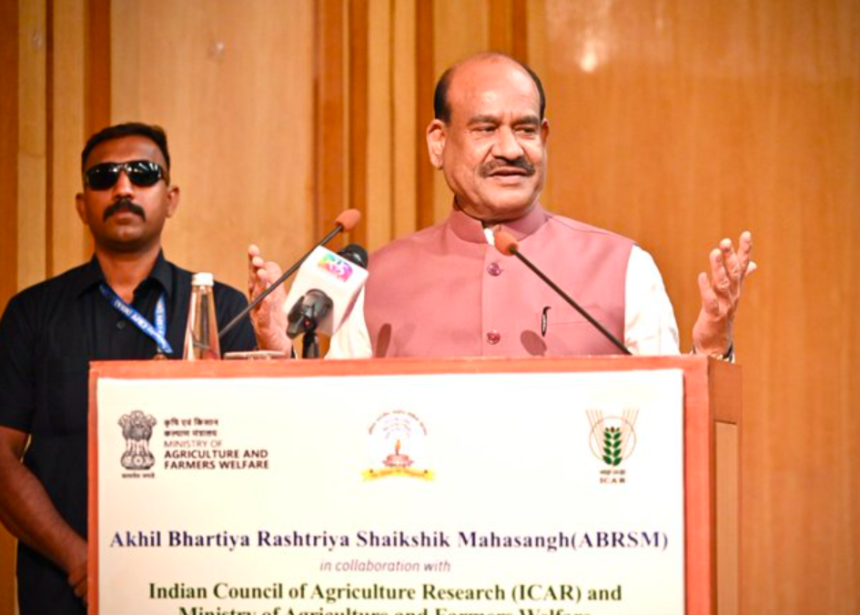
Lok Sabha Speaker Om Birla on Saturday asserted that India’s journey toward becoming a developed nation by 2047 passes through its farms, fields and villages, emphasizing that sustainable agriculture, innovation and research form the bedrock of Viksit Bharat@2047 .
Speaking at the inaugural session of the two-day National Conference on “Sustainable Agriculture for Viksit Bharat@2047: Tradition, Technology and Tangible Outcomes” in New Delhi, Birla said agriculture in India is far more than an economic sector—it is an integral part of the nation’s culture, civilization and way of life .
The conference was organized by the Akhil Bharatiya Rashtriya Shaikshik Mahasangh (ABRSM) in collaboration with the Indian Council of Agricultural Research (ICAR) and the Ministry of Agriculture and Farmers Welfare .
‘India’s villages are the country’s true strength’
“India’s journey toward becoming a developed nation by 2047 passes through its farms, fields and villages,” Birla said, adding that the country can emerge as a global leader in agriculture by effectively combining traditional knowledge with modern technology .
He noted that farming will remain central to the vision of a developed India by ensuring food security, rural prosperity, social harmony and inclusive growth.
“India’s villages are the country’s true strength, and our farmers continue to be the backbone of both our economy and social fabric,” he stated .
Highlighting the challenges posed by climate change and evolving global dynamics, Birla stressed that science-driven, research-backed and innovation-led agriculture is the need of the hour .
He underlined the importance of integrating time-tested traditional wisdom with modern technology to create a farming ecosystem that is sustainable, profitable and resilient .
Technology as a game-changer
Birla identified agricultural universities, research institutions, scientists and innovators as the primary pillars of India’s agricultural future. He observed that next-generation technologies—such as drones, artificial intelligence, data analytics and digital farming—are making agriculture increasingly precise and productive .
He also emphasized the urgent need to expand agro-based industries, food processing units and agri-startups to accelerate rural development and uplift farmers’ livelihoods .
Focus on environmental sustainability
Turning to environmental concerns, the Lok Sabha Speaker highlighted the critical importance of water conservation, efficient micro-irrigation, soil health management, high-quality seeds, optimized fertilizer use and climate-resilient crop varieties .
He lauded the continuous efforts of ICAR and the wider scientific community in engineering solutions that reinforce agricultural productivity while ensuring sustainability .
A collective effort for a self-reliant future
Birla observed that youth energy, women’s leadership and grassroots innovation will provide vital momentum to the rural economy. He called upon teachers, scientists, researchers, policymakers and farmers to work collectively toward developing self-reliant agricultural models that foster long-term prosperity .
Describing the conference as a reflection of the nation’s collective intellectual strength, Birla reiterated that the vision of Viksit Bharat@2047 can only be achieved through the combined efforts of citizens, academic institutions, social organizations and policymakers .
Expressing confidence in the event’s outcome, Birla concluded that the deliberations over the two days would significantly strengthen agricultural education and sustainable farming practices, ultimately transforming the lives of farmers and accelerating India’s journey toward self-reliance .
The conference comes as India intensifies efforts to modernize its agricultural sector while balancing productivity, sustainability and climate resilience—key priorities in the government’s roadmap for achieving the Viksit Bharat vision by 2047 .