
Rice is one of the most water-intensive crops in the world, consuming more water than almost any other staple food. Here’s a breakdown of why it needs so much water, how much it uses, and what makes it unique.
The Numbers: How Much Water Does Rice Actually Use?
You’ve likely heard staggering figures about rice’s water consumption, and they are largely accurate. Globally, it takes an average of approximately 2,500 liters of water to produce 1 kilogram of rice. However, this number can vary dramatically.
- Range of Variability: Depending on the region, farming practices, and soil type, the water required to produce 1 kg of rice can range from as little as 800 liters to as high as 5,000 liters.
- Comparison to Other Cereals: On a field scale, water inputs for rice are typically 2–3 times higher than for other major cereals like wheat or maize.
| Crop | Evapotranspiration Water Need (mm) |
|---|---|
| Rice | 370 mm (Rainfed) to 562 mm (Irrigated) |
| Wheat | 331 mm (Rainfed) to 406 mm (Irrigated) |
| Soybean | 394 mm (Rainfed) to 471 mm (Irrigated) |
(Note: The table shows the ‘crop water use’ or evapotranspiration, which is a key measure of water consumption).
The Main Reason: The Biology of a Swamp Plant
The primary reason rice is so water-intensive is deeply rooted in its biology and history. In a fascinating twist, rice does not actually need standing water to survive. Historical records indicate that rice was originally cultivated as a dry-seeded crop.
So, why the association with water? It was an ingenious form of weed control. In Asia, transplanting rice seedlings into flooded paddies gave the tall rice plants a “head start” over weeds, which cannot survive under water. This method was so effective that it became the dominant practice across the continent.
Adaptation: The Aerenchyma
Over centuries, rice has evolved a unique adaptation to survive in these man-made flooded conditions. Its stems contain a specialized spongy tissue called aerenchyma. This tissue creates air channels that allow oxygen from the leaves to travel down to the roots, preventing them from drowning even when the field is submerged for long periods. This biological adaptation is what makes rice one of the few crops that can thrive where others rot.
The Farming Practice: Puddling and Ponding
The traditional, and still most common, method of growing rice exaggerates its water needs:
1. Puddling
Before planting, farmers flood the field and perform “puddling”—a process of intense wet tillage. This breaks down soil aggregates, creating a dense, impermeable layer that minimizes water loss through percolation. While this helps retain water in the short term, it is a very water-intensive process itself. Land preparation alone can require 200 mm of water.
2. Continuous Flooding
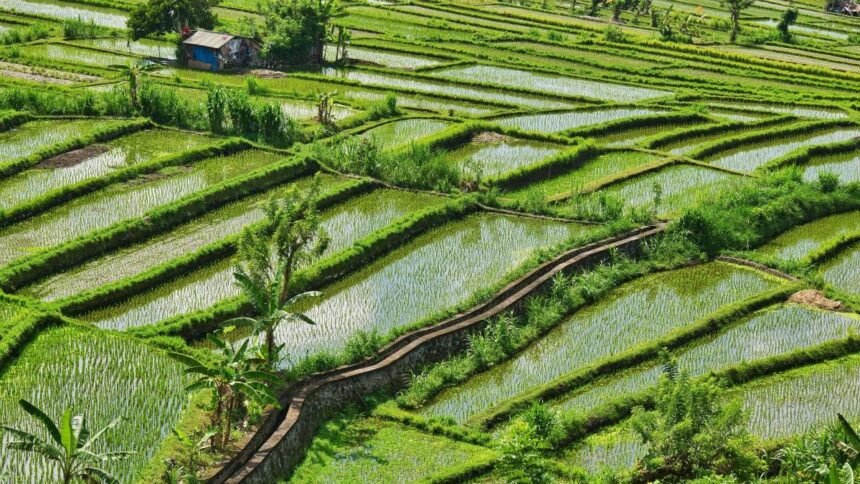
After transplanting seedlings, farmers typically maintain a shallow layer of standing water (5-10 cm) throughout the growing season. This continuous flooding, which can require field irrigation of 800 to 1200 mm just for the cropping period, is what makes rice so thirsty. The table below shows a typical schedule for water depth management in a paddy field:
| Stage of Crop Growth | Depth of Submergence (cm) |
|---|---|
| At transplanting | 2 cm |
| After transplanting for 3 days | 5 cm |
| 3 days after to max tillering | 2 cm |
| Panicle initiation to 21 days after flowering | 5 cm |
The Result: A Drain on Asia’s Water Resources
The combination of rice’s biological suitability for wet conditions and its pervasive “puddle and flood” farming method has created a massive demand for water across Asia, particularly for groundwater.
- The Subsidy Problem: In India, government policies (minimum support prices, electricity subsidies) actively encourage farmers to cultivate water-intensive rice, even in water-scarce regions like Punjab and Haryana.
- Draining Aquifers: This has led to a severe groundwater crisis. Farmers report that a decade ago, water was available at 30 feet; today, borewells must be drilled to 80 to 200 feet to find it.
- The ‘Virtual Water’ Export: When a water-stressed country like India exports rice, it is effectively exporting billions of liters of its precious water. It is estimated that India exports over 24 billion cubic meters of “virtual water” through its rice trade every year.
The Big Question: Is There a Better Way?
The good news is that it is possible to grow rice with significantly less water. Methods such as the System of Rice Intensification (SRI) and Alternate Wetting and Drying (AWD) have proven highly effective.
For instance, the AWD method involves allowing the field to dry out before re-flooding it, which can reduce water use by up to 30% without harming yields. Studies on drip-irrigated rice have shown that it can slash water consumption by a staggering 65% while even increasing yields. The primary barrier to adopting these water-saving methods is not technical but cultural—overcoming the deep-seated belief that rice must grow in standing water.