

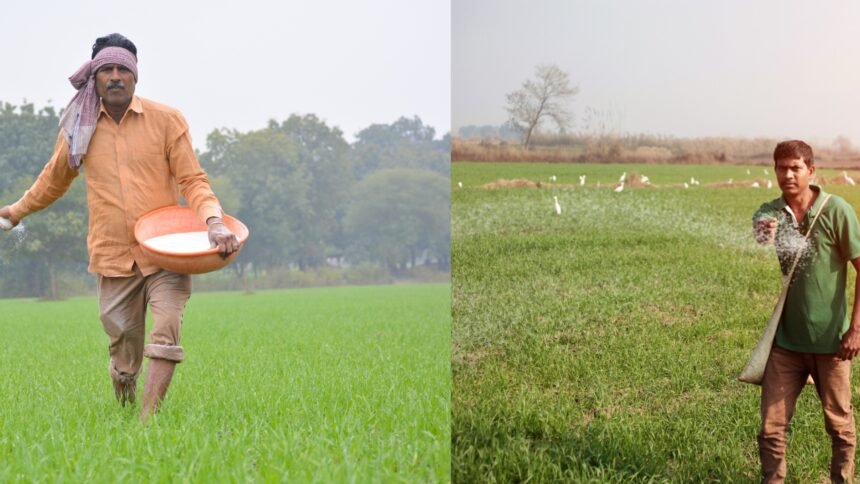
India’s fertiliser production within the Index of Eight Core Industries recorded its weakest annual growth in 13 years in 2025-26 (FY26), contracting 0.1 per cent year-on-year (Y-o-Y) . This marks the first negative print since the 3.3 per cent plunge in 2012-13 (FY13) – the first full year under the current series.
The contraction comes at a critical time, as the kharif (summer) sowing season approaches. Fertiliser availability and affordability are crucial for crop yields and farmer incomes.
The Numbers – A Tale of Two Halves
While full-year data shows a contraction, the monthly pattern reveals the severity of the disruption.
| Period | Fertiliser Production Performance |
|---|---|
| April 2025 – February 2026 | Positive growth |
| March 2026 | Sharp decline, pulling full-year into negative |
The March 2026 drag was significant enough to flip the entire year’s performance from positive to negative.
Comparison to Previous Low
| Year | Fertiliser Production Growth |
|---|---|
| 2012-13 (FY13) | -3.3% (previous low) |
| 2025-26 (FY26) | -0.1% (weakest since FY13) |
While the current contraction is smaller in magnitude than FY13, it is still a concerning signal for a sector critical to agriculture.
Why the Contraction? – LNG Shortages and Shutdowns
The article points to two primary causes:
| Cause | Impact |
|---|---|
| LNG shortages | Fertiliser production is gas-intensive; reduced gas availability forced output cuts |
| Plant shutdowns | Premature or extended maintenance shutdowns reduced production capacity |
The LNG Crisis Connection
India has been facing liquefied natural gas (LNG) shortages due to:
- West Asia crisis – Strait of Hormuz disruptions affecting imports
- Higher spot prices – Making imports unaffordable
- Domestic gas allocation – Prioritizing other sectors (power, city gas)
Fertiliser plants, which rely on natural gas as both fuel and feedstock, were forced to reduce production when gas supplies were curtailed.
Premature Shutdowns
Some fertiliser units went for premature routine shutdowns because of low gas supplies. These shutdowns – normally scheduled for off-peak periods – occurred earlier than planned, reducing output during what should have been peak production months.
The Index of Eight Core Industries Context
Fertiliser production is one of the eight core industries tracked by the government. These industries have significant weightage in the Index of Industrial Production (IIP).
| Core Industry | Weight in IIP |
|---|---|
| Fertiliser | 2.63% (smaller weight) |
| Electricity | 19.85% |
| Steel | 17.92% |
| Refinery products | 28.04% |
While fertiliser has a relatively small weight, its contraction is symbolically significant because it indicates stress in a sector vital to agriculture.
Implications for the Kharif Season
The timing of the production contraction is problematic. The kharif season (summer planting) typically begins in June, with fertiliser demand peaking in June-July.
| Concern | Implication |
|---|---|
| Lower domestic production | Greater reliance on imports |
| Import prices high | Global prices elevated due to West Asia crisis |
| Subsidy burden | Higher import prices increase government subsidy costs |
| Farmer prices | Could face higher prices if subsidies don’t fully cover costs |
The government has been working to secure fertiliser supplies through imports, but global prices remain elevated due to the ongoing West Asia crisis.
Comparison to Previous Crises
The fertiliser sector has faced challenges before, but the current situation is unique.
| Period | Crisis | Impact on Fertiliser |
|---|---|---|
| 2008-09 | Global financial crisis | Demand destruction |
| 2012-13 | Policy uncertainty | Previous low (-3.3%) |
| 2020-21 | COVID-19 | Supply chain disruptions |
| 2022-23 | Russia-Ukraine war | Price spike, supply concerns |
| 2025-26 | West Asia crisis + LNG shortage | Production contraction (-0.1%) |
The current contraction is driven by input shortages (LNG) rather than demand destruction or policy uncertainty – a different kind of challenge requiring different solutions.
Government Response
The government has taken several steps to address the fertiliser supply situation:
| Action | Purpose |
|---|---|
| Import tenders | Issued by IPL, RCF, others to secure additional urea |
| LNG procurement | Aggressive spot buying to restart plants |
| Domestic production incentives | Encouraging plants to maximize output |
| Subsidy allocation | Ensuring funds for imports |
However, the production data for FY26 shows that these measures have not fully offset the impact of LNG shortages.
The Road Ahead – FY27 Outlook
Several factors will determine fertiliser production in the current financial year (FY26-27):
| Factor | Outlook |
|---|---|
| LNG availability | Improving but still constrained |
| West Asia crisis | Uncertain duration |
| Domestic gas production | Limited scope for increase |
| Import prices | Expected to remain elevated |
| Government procurement | Active tendering continues |
If LNG supplies normalize and plants operate at full capacity, production could rebound. However, the West Asia crisis shows no signs of rapid resolution, suggesting continued pressure.
Farmer Impact – What to Expect
For farmers, the production contraction has several implications:
| Impact | Detail |
|---|---|
| Urea availability | Government prioritizing imports to maintain supply |
| DAP/NPK availability | More dependent on imports; potential shortages |
| Prices | MSP increased for crops, but input costs may rise |
| Subsidy | Government likely to absorb higher costs |
The government has historically prioritized fertiliser availability over fiscal concerns, so widespread shortages are unlikely. However, localized disruptions cannot be ruled out.
A Wake-Up Call
India’s fertiliser production contracting for the first time in 13 years is a wake-up call. The sector’s dependence on imported LNG – and the vulnerability of those imports to geopolitical crises – has been exposed.
| Key Takeaway | Implication |
|---|---|
| LNG dependence | Fertiliser security tied to energy security |
| Geopolitical risk | West Asia crisis directly impacts Indian agriculture |
| Import reliance | Even urea, where India is nearly self-sufficient, faces pressure |
| Need for diversification | Alternative feedstocks, domestic gas exploration |
As the kharif season approaches, all eyes will be on fertiliser availability. The government has tools to manage the situation – imports, subsidies, and buffer stocks. But the FY26 production data is a reminder that India’s fertiliser sector is not immune to global shocks.
For farmers, the message is mixed: supplies should be adequate, but prices may be volatile. For policymakers, the message is clear: energy security and fertiliser security are inseparable.