

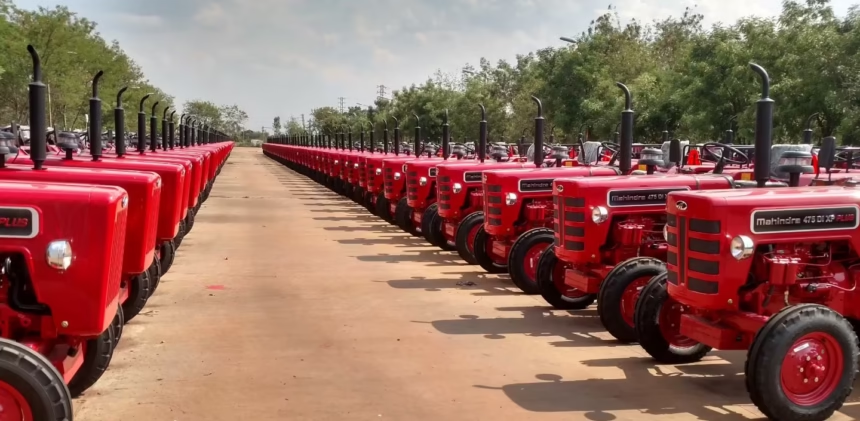
Mahindra & Mahindra Ltd.’s Farm Equipment Business (FEB) , part of the Mahindra Group, announced its tractor sales numbers for March 2026 — and the figures are impressive.
Domestic sales in March 2026 stood at 43,403 units , as against 32,582 units in March 2025, reflecting a 33 per cent year-on-year growth.
Total tractor sales (domestic plus exports) during March 2026 were at 45,035 units , as against 34,934 units for the same period last year — a 29 per cent growth. Exports for the month stood at 1,632 units.
Highest Ever Annual Sales: FY26 at 5,05,930 Units
The company ended Financial Year 2026 (FY26) with its highest ever sales of 5,05,930 tractors , registering a 24 per cent growth over the previous fiscal year (FY25: 4,07,094 units).
This milestone underscores Mahindra’s continued dominance in the Indian tractor market and its ability to capitalize on favorable agricultural conditions and festive demand.
Veejay Nakra: ‘Full Navratri Season Falling in March’ Drove Growth
Commenting on the performance, Veejay Nakra , President of Farm Equipment Business at Mahindra & Mahindra Ltd., said:
“We have sold 43,403 tractors in the domestic market during March 2026 registering a robust growth of 33 per cent over last year.”
He attributed a significant part of this high growth to the full Navratri season falling entirely in March 2026 , unlike last year when it was split between March and April.
“We ended FY26 with highest ever sales of 5,05,930 registering growth of 24 per cent. In the exports market, we have sold 1,632 tractors.”
Navratri Effect: Why the Calendar Mattered
The Navratri festival is considered an auspicious time for major purchases in many parts of India, including tractors and other farm equipment.
In 2025, the Navratri period was split between March and April, diluting the sales impact in any single month.
In 2026, the entire Navratri season fell in March , concentrating the festive demand into a single month and contributing significantly to the 33 per cent year-on-year growth.
This calendar effect, combined with strong agricultural conditions and a healthy rabi harvest, created the perfect environment for tractor sales.
Domestic vs. Exports: A Tale of Two Markets
Domestic sales in March 2026 were the star performer — 43,403 units , up 33 per cent from March 2025.
Exports, however, declined to 1,632 units from 2,352 units in March 2025 — a 31 per cent drop.
For the full financial year, domestic sales grew 24 per cent (5,05,930 units vs. 4,07,094 units), while exports grew 17 per cent (20,473 units vs. 17,547 units).
The export decline in March could be attributed to:
- Global supply chain disruptions
- Currency fluctuations making Indian tractors more expensive in international markets
- Seasonal factors in key export markets (Africa, Middle East, South America)
- Shipping container availability issues
Despite the March dip, the full-year export performance remained positive.
The Numbers at a Glance (March 2026 vs. March 2025)
Domestic sales in March 2026: 43,403 units; March 2025: 32,582 units; change: +33 per cent.
Exports in March 2026: 1,632 units; March 2025: 2,352 units; change: -31 per cent.
Total sales (domestic + exports) in March 2026: 45,035 units; March 2025: 34,934 units; change: +29 per cent.
For the full financial year (FY26 vs. FY25): Domestic sales: 5,05,930 versus 4,07,094, +24 per cent; Exports: 20,473 versus 17,547, +17 per cent; Total: 5,26,403 versus 4,24,641, +24 per cent.
Industry Context: Tractor Sales as an Economic Indicator
Tractor sales are considered a key indicator of rural economic health in India. When farmers are optimistic about their incomes (due to good monsoons, high crop prices, or government support), they invest in tractors and other farm equipment.
The 33 per cent growth in March 2026 suggests:
- Strong rabi harvest (winter crops)
- Healthy crop prices for key commodities
- Continued government support through MSP (Minimum Support Price)
- Favorable credit availability for farmers
The full-year 24 per cent growth — the highest ever sales volume — indicates sustained rural demand.
Mahindra’s Market Leadership
Mahindra & Mahindra is the world’s largest tractor company by volume , with a dominant market share in India.
Its Farm Equipment Business (FEB) manufactures and markets a wide range of tractors (from 15 HP to over 75 HP), as well as farm implements and solutions.
Key brands include:
- Mahindra series (Yuvraj, Jivo, Arjun, etc.)
- Swaraj tractors (popular in northern India)
- Traktor (export brand)
The company has been investing in:
- Electric tractors (as part of its sustainability push)
- Precision farming technologies
- Digital platforms connecting farmers with equipment and services
The Role of Exports: A Strategic Priority
While March exports declined, the full-year export growth of 17 per cent is still positive.
Mahindra exports tractors to over 100 countries, with key markets including:
- Africa (South Africa, Nigeria, Kenya, Tanzania)
- Middle East (UAE, Saudi Arabia, Iran)
- South America (Brazil, Argentina)
- Southeast Asia (Vietnam, Indonesia, Philippines)
- North America (though smaller volumes, as North American farmers prefer larger, more powerful tractors)
The company continues to invest in export markets, but faces stiff competition from:
- John Deere (US)
- New Holland (CNH Industrial, US/Italy)
- Kubota (Japan)
- Massey Ferguson (AGCO, US)
- Sonalika (India)
Mahindra Group: Beyond Tractors
Founded in 1945, the Mahindra Group is one of the largest and most admired multinational federations of companies, with 3,24,000 employees in over 100 countries.
It enjoys a leadership position in:
- Farm equipment (tractors and implements)
- Utility vehicles (SUVs like Scorpio, XUV, Thar)
- Information technology (Tech Mahindra)
- Financial services (Mahindra Finance)
It also has a strong presence in:
- Renewable energy
- Agriculture
- Logistics
- Hospitality
- Real estate
The Mahindra Group has a clear focus on leading ESG globally (Environmental, Social, Governance), enabling rural prosperity and enhancing urban living.
Outlook for FY27
While March 2026 was exceptionally strong due to the calendar effect (full Navratri in March), the company faces several factors in FY27:
Positive factors: Continued government support for agriculture; good monsoon forecast; rising rural incomes; demand for mechanization as farm labor becomes scarce.
Challenges: Uncertain global economic conditions affecting exports; rising input costs (steel, aluminum, rubber); potential raw material price volatility; competition from other tractor brands.
Veejay Nakra and the Mahindra management team will need to navigate these factors to sustain the 24 per cent growth rate achieved in FY26.