

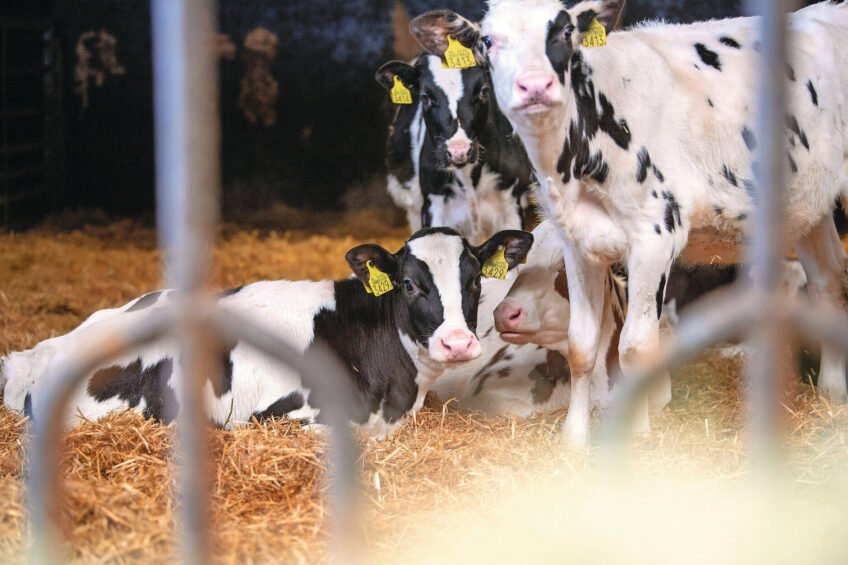
Research from Utrecht University shows that calves do not need extra space for play the whole day. The EFSA standard of 20 square metres per calf does not appear to be necessary at all times.
Within the Dutch Covenant on Humane Livestock Farming (Convenant Dierwaardige Veehouderij) , there is a strong focus on space for calves. This goes beyond merely providing more space for social interaction in the form of dual housing and placing calves in group housing earlier.
Last year, ZuivelNL commissioned Utrecht University to investigate the needs of calves in relation to space. Caroline Huetink , program manager for Animal Health and Welfare, recently presented the first research results during the youth day ‘The Calf at the Centre.’
The EFSA Target: 20 Square Metres per Calf
It is clear that play behaviour in calves has a beneficial influence on overall welfare and growth. However, the amount of space required per calf for this is unknown.
Huetink explained: “The European Food Safety Authority (EFSA) states that a minimum of 20 square metres per calf is required. This figure is based on only one study, and the tricky part is that we are now seeing this figure reflected everywhere in decision-making.”
Earlier research focused on spaces of 1.5 to 4 square metres, but there was hardly any scientific literature on the effect of space between 4 and 20 square metres per calf.
The Utrecht Study Findings: More Space, But Not All Day
The results of the Utrecht study now indicate that more space leads to more playful behaviour. However, the 20 square metres stipulated by EFSA is not necessary.
The researchers conclude that it may be sufficient to grant a calf access to a more spacious pen for play for only part of the day.
Why? Because calves do not engage in social behaviour and play among themselves for the entire day. Calves spend at most 2% of their time on play and social interaction, and this does not increase with a further increase in pen surface area.
The ‘Playtime’ Alternative
Huetink raised an important question for the animal welfare debate:
“Should every calf be given more space, which would have a major impact on farm operations, or could it be sufficient to offer small groups of calves daily ‘playtime’ together?”
More research is needed for this — with larger groups of calves and situations in which they are given a little extra space to play daily.
The implication is significant: if part-day access to larger pens is sufficient, farmers could keep calves in smaller pens for most of the day while providing dedicated play periods. This would reduce the operational and financial burden of rebuilding facilities to meet the 20-square-metre standard.
Don’t Lose Sight of Health
According to Huetink, calf health is often overlooked in discussions on animal dignity.
More room for natural behaviour, including play, is not necessarily better for health. This is especially true if, for the sake of space, calves come into contact with older peers and specific pathogens at a very young age.
Young calves have immature immune systems. Mixing them with older calves or allowing contact with adult cows can expose them to diseases like coccidiosis, cryptosporidiosis, and bovine respiratory disease (BRD).
The welfare debate cannot focus only on behavioural freedom — it must also consider health outcomes.
Practical Advice for Farmers
Huetink advised her audience to already take potential new housing requirements for calves into account:
“Make sure you are already preparing and see what adjustments might need to be made to buildings. Also take permits, financing, and potential subsidies into account.”
Even though the research is ongoing, farmers should not wait for final regulations. The direction of travel — toward more space and social housing — is clear.
The Dutch Context: Covenant on Humane Livestock Farming
The Dutch Covenant on Humane Livestock Farming (Convenant Dierwaardige Veehouderij) is a multi-stakeholder agreement involving farmers, industry, NGOs, and the government.
Its goals include improving animal welfare across all livestock sectors, including dairy. For calves, the focus has been on:
- Group housing (rather than individual pens)
- Social interaction (calves need contact with peers)
- Space allowance (how much room per calf)
The Utrecht study was commissioned by ZuivelNL , the Dutch dairy industry organization, to provide science-based guidance on space requirements.
The EFSA Standard: Where Did 20 Square Metres Come From?
The European Food Safety Authority (EFSA) is the EU agency that provides scientific advice on food safety and animal welfare.
The 20 square metres per calf figure is mentioned in EFSA opinions on calf welfare. However, as Huetink noted, it is based on only one study. The figure has been widely repeated in policy documents and industry guidelines — without sufficient scientific backing.
The Utrecht study is an attempt to fill that gap, providing more robust evidence on what calves actually need.
Play Behaviour in Calves: Why It Matters
Play behaviour in calves includes:
- Locomotor play (running, jumping, bucking)
- Social play (butting, chasing, mounting)
- Object play (playing with feeders, brushes, or novel items)
Play is important for:
- Musculoskeletal development (strengthening bones and muscles)
- Cognitive development (learning and problem-solving)
- Social skills (interacting with peers)
- Stress reduction (playful calves are less stressed)
However, as the study shows, calves do not need to play all day. They play in short bursts, then rest, eat, or ruminate.
The Time Budget of a Calf
Calves spend their day on several activities:
- Resting and ruminating — 60-70% of the day
- Eating and drinking — 10-15%
- Exploring and investigating — 5-10%
- Play and social interaction — at most 2%
Because play occupies such a small fraction of the day, the Utrecht researchers argue that providing high space continuously is unnecessary.
Implications for Farm Design
If part-day access to larger pens is sufficient, farmers could:
- Keep calves in smaller, more efficient pens for most of the day
- Move them to a larger play pen or pasture for a few hours daily
- Spend less on building new facilities
- Maintain health benefits (avoiding mixing with older, potentially diseased animals)
This approach would balance three goals:
- Welfare (allowing natural play behaviour)
- Health (avoiding pathogen exposure)
- Economics (farm viability)
More Research Needed
The Utrecht study is not the final word. Huetink emphasized that more research is needed:
- With larger groups of calves (not just small experimental groups)
- Testing different play pen sizes and durations
- Measuring health outcomes alongside behavioural outcomes
- In commercial farm conditions (not just research facilities)
The goal is to develop practical, science-based recommendations that farmers can actually implement.