
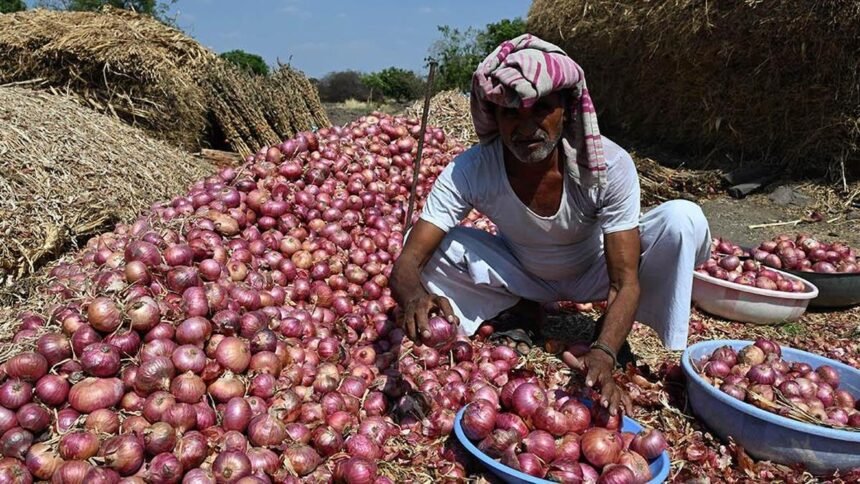
Thousands of onion farmers in Maharashtra and Gujarat staged protests on Wednesday, demanding immediate government intervention as prices crashed to below production costs.
The farmers are seeking two specific relief measures: compensation of ₹1500 per quintal for their losses, and direct government procurement of onions at ₹25 per kilogram.
What triggered the crisis
Onion prices in wholesale markets have fallen to ₹5-8 per kilogram in major hubs like Lasalgaon (Nashik) and Gondal (Gujarat). This is significantly below the average production cost of ₹15-18 per kilogram.
With each farmer incurring losses of ₹700-1000 per quintal, distress has spread across the growing regions. Maharashtra, which produces nearly 40% of India’s onions, has been the worst affected.
“We spent ₹80,000 per acre on seeds, fertilisers, labour, and irrigation. The same produce is now selling for ₹15,000. How do we feed our families?” asked Santosh Pingle, a farmer from Lasalgaon.
The demand explained
Farmers are demanding the government to:
1. Provide compensation of ₹1500 per quintal – This would cover their production cost (₹1500-1800 per quintal) and provide a small margin. Currently, they are getting only ₹500-800 per quintal.
2. Procure onions directly at ₹25 per kg – Farmers want the National Agricultural Cooperative Marketing Federation (NAFED) and state agencies to buy their stock at this support price, creating a government buffer stock.
Why prices collapsed
Three factors have combined to crash onion prices:
Excess supply – Late rains and unseasonal weather in March-April led to overlapping harvests. Kharif and late kharif crops arrived simultaneously, flooding the market.
Export ban hangover – Although the government lifted the onion export ban in March 2026, export volumes have not recovered. Bangladesh and Nepal, key buyers, have sourced cheaper onions from China and Egypt.
Poor storage – Damaged rabi crop quality means onions cannot be stored for more than 30 days, forcing distress sales.
Government’s response so far
The central government has announced a ₹500 crore onion price stabilization fund, but farmers say it is insufficient.
State governments have started limited procurement. Maharashtra has procured only 50,000 tonnes so far – a fraction of the estimated 2.5 million tonnes surplus.
“We have requested the central government to allocate additional funds for large-scale procurement. The farmers’ demand is being examined,” said the Maharashtra Agriculture Minister.
However, officials privately admit that meeting the ₹1500 per quintal compensation demand would require approximately ₹3,750 crore – a significant fiscal burden.
Political heat
Opposition parties have latched onto the issue. Congress leader Rahul Gandhi visited Nashik on Tuesday, promising a “legal guarantee for minimum support price on all crops” if his party returns to power.
“Today it is onion. Tomorrow it could be tomato or potato. Farmers need price protection, not empty promises,” Gandhi told the protesting farmers.
The ruling BJP has defended its record, pointing to record procurement of pulses and oilseeds under the Price Support Scheme. “Onion is a perishable commodity. Procuring and storing it is logistically difficult. We are trying our best,” said a party spokesperson.
Impact on consumers
Ironically, while farmers are suffering, consumers are enjoying cheap onions. Retail prices have fallen to ₹15-20 per kg in most cities, compared to ₹50-60 just six months ago.
However, economists warn that sustained low prices will discourage next season’s planting, leading to a supply crunch and price spike later.
What happens next
The Agriculture Ministry has convened an emergency meeting on May 25 with onion-growing states. Possible solutions include:
- Expanding buffer stock target from 5 lakh tonnes to 10 lakh tonnes
- Subsidizing onion exports to Southeast Asian markets
- Direct cash transfers to small and marginal onion farmers
Farmers have threatened to intensify protests if no concrete assurance is given by May 30. “We will block highways. We will dump onions at the collector’s office. We have nothing left to lose,” a protest leader warned.