
India’s cereal ecosystem—spanning procurement, storage, distribution, and crop diversification—has arrived at a difficult juncture. An excessive focus on paddy and rice under the Minimum Support Price (MSP) system, escalating procurement costs, rising import dependence on edible oils and pulses, and growing logistical inefficiencies have created structural vulnerabilities that demand urgent attention .
The scale of the surplus
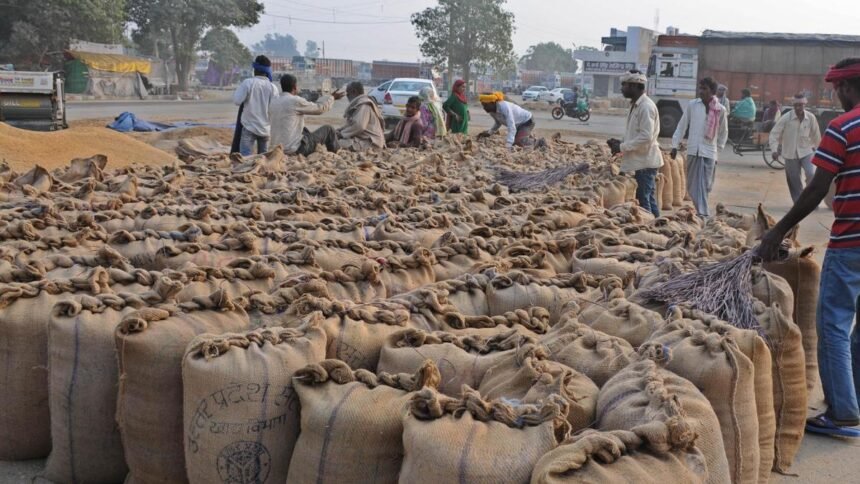
The numbers are staggering. Central rice stocks reached 37.48 million tonnes as of July 2025, the highest in two decades and over three times the buffer norm . By January 2026, total food grain stocks in the central pool stood at 58.4 million tonnes, about 10.9 million tonnes higher than the same period the previous year . Rice stocks alone—excluding 19.89 million tonnes of grain yet to be received from millers—far exceeded the prescribed buffer of 13.54 million tonnes . The average MSP procurement of rice in the last four seasons has been in excess of 55 million tonnes, adding about 10-12 million tonnes of surplus rice stocks annually to the central pool .
This surplus comes at a significant cost. The Food Corporation of India’s (FCI) economic cost of rice—including MSP, storage, and carrying costs—is estimated at ₹4,173 per quintal for 2025-26 . With excess inventories held longer, the annual carrying cost of food grain stocks is roughly ₹2,400 per tonne, or about ₹200 per tonne per month . Food subsidy expenditure for FY26 is projected to exceed the Budget Estimate of ₹2.03 lakh crore by over ₹22,000 crore, driven primarily by the rising cost of holding surplus grains .
Why India overproduces cereals
The overproduction of rice and wheat is a direct consequence of policy design. Open-ended procurement at MSP, combined with periodic annual increases in MSP (3-7 per cent), has created assured returns for farmers growing these crops . In recent years, many states have compounded the problem by offering bonuses over the central MSP—Odisha gives input subsidy of Rs 800 per quintal over paddy MSP, Chhattisgarh pays Rs 9,000 per acre with a ceiling of 15 quintals, and Kerala announced a state bonus of Rs 631 per quintal for kharif 2025-26 .
The Commission for Agricultural Costs and Prices (CACP) has warned that these state bonuses “adversely affect crop diversification initiatives, restrict private trade participation and competition and result in excess stocks” . The Commission has recommended imposing a limit on procurement, particularly in states that offer bonuses over MSP .
The paradox of plenty amidst deficits
While India sits on overflowing cereal stocks, it remains structurally dependent on imports for other essential commodities. India meets about 60 per cent of its edible oil demand through imports, and imports approximately 5-7 million tonnes of pulses annually to meet domestic consumption needs . This misalignment between production patterns and consumption needs reflects a system optimised for calorie security rather than nutritional security or economic efficiency.
The Economic Survey 2025-26 explicitly flagged crop diversification as a policy priority, arguing that India’s production pattern must shift away from excessive concentration in rice and wheat toward pulses, oilseeds, and other crops better aligned with consumption needs, resource sustainability, and import reduction .
Water and environmental stress
Paddy cultivation is highly water-intensive, contributing to groundwater depletion, soil degradation, and higher energy use—particularly in north-western India . The continued dominance of the wheat-paddy cycle has created not just fiscal pressures but environmental ones: soil degradation in one-third of agricultural land, water stress in more than half the country’s districts, and critically low soil organic carbon levels .
The millet alternative
One promising pathway for diversification lies in reviving millets—nutri-cereals that require significantly less water than paddy and offer superior nutritional profiles. India’s millet movement is gaining momentum through a blend of policy, innovation, and community-level action. The National Mission on Nutri-Cereals (NFSM-Millet), the Paramparagat Krishi Vikas Yojana (PKVY), and state-level initiatives—including the Odisha Millet Mission, Karnataka’s integration of millets into the Public Distribution System, and Tamil Nadu’s plans to replace rice with millets in ration shops—are bolstering production and promoting millet-based farming systems . Millets’ high fibre content, low glycemic index, and nutrient-rich profile also support dietary prevention strategies against India’s rising burden of non-communicable diseases like diabetes and obesity .
The path forward
The solution does not lie in dismantling the food security architecture but in recalibrating it. The Economic Survey has proposed a voluntary, incentive-led shift away from the wheat-paddy cycle. This would use savings from improved stock management—reduced storage, handling, and interest costs—to support voluntary crop diversification .
The Expenditure Department has already communicated to states to refrain from announcing bonuses over MSP, warning that the “surplus continues to rise year after year, creating a significant and recurring burden on the public exchequer” . A comprehensive review of the open-ended procurement policy, as recommended by CACP, could help align procurement with actual food security requirements rather than allowing unlimited accumulation . This would be complemented by strengthening market linkages for alternative crops, improving processing infrastructure, and ensuring that farmers receive assured returns for diversifying away from paddy and wheat.
India’s cereal management crisis is not one of shortage but of imbalance—overproduction of rice and wheat coexisting with deficits in pulses and edible oils, rising subsidy costs, and environmental degradation. Addressing this requires a fundamental shift away from a system optimised for maximum yield and towards one optimised for sustainability, nutrition, and economic efficiency. The time to sort out India’s cereal mess is now.