
The Centre has directed farm machinery manufacturers to pass on the benefit of the reduced Goods and Services Tax (GST) rates to farmers by cutting prices on tractors and agricultural equipment. Union Agriculture Minister Shivraj Singh Chouhan also warned against any attempts to exploit farmers through profiteering, asserting that this tax relief is meant to directly reduce their financial burden.
Price reductions mandated
Following the GST Council’s decision to slash tax on farm equipment from 12% to 5%, the Ministry of Agriculture convened a meeting with industry representatives from the Tractor and Mechanization Association, All India Combine Manufacturers Association, Agricultural Machinery Manufacturers Association, and Power Tiller Association of India . During this meeting, Chouhan stressed that the savings must reach the end-user and not be absorbed by manufacturers or dealers.
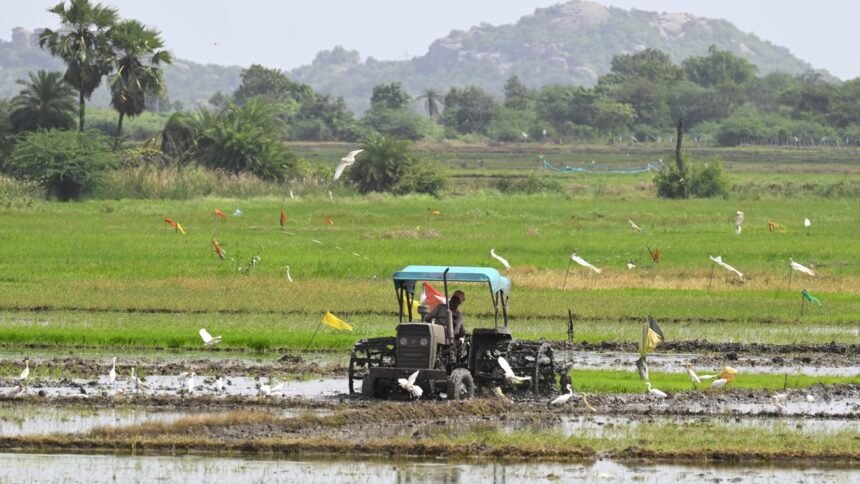
The GST rate cut applies to a wide range of agricultural machinery and components, including tractors (below 1800 cc), power tillers, harvesters, threshers, drip irrigation systems, sprayers, and tractor parts such as tyres and hydraulic pumps . Following this reduction, tractors are expected to see price cuts ranging from ₹41,000 to ₹63,000 depending on horsepower, with harvesters witnessing one of the biggest drops—a saving of ₹1,87,500 .
The structural reform behind the rate cut
The GST Council’s 56th meeting, held on September 3, 2025, introduced a simplified two-rate structure (5% and 18%), eliminating the 12% and 28% slabs for most essential goods . Finance Minister Nirmala Sitharaman described this as a “structural reform” that would also correct the inverted duty structure and resolve classification-related issues . The changes came into effect on September 22, 2025 .
On farm equipment specifically, the reduction was designed to strike a balance between supporting farmers and protecting domestic manufacturers. While a full exemption would prevent manufacturers from claiming Input Tax Credit on raw materials, the reduced 5% rate allows them to claim ITC while still lowering the cost for farmers .
Impact on demand and farmer incomes
The tax cut is already showing positive results for the sector. Industry players reported that the GST reduction “has already begun to trigger demand” and is expected to have a sustained positive impact . The CEO of VST Tillers stated that the GST cut “directly supports the smaller farmer” by reducing their investment burden . Tractor sales grew by 19.3% year-on-year in May 2026, driven in part by improved affordability .
Rural development and agriculture minister Shivraj Singh Chouhan had previously noted that the rate cuts are designed to make farming more profitable, boost mechanisation, and encourage a shift towards bio-fertilisers and modern equipment .
Government’s warning against exploitation
As the government implements the GST changes, the central directive to manufacturers is intended to ensure that farmers reap the full benefit. The ministry has made it clear that any attempt to unfairly raise prices would be viewed seriously. This aligns with the broader “Next Generation GST” reforms that Prime Minister Narendra Modi has championed as part of a citizen-centric approach to economic policy .
By facilitating easier access to affordable farm machinery, the government aims to promote mechanisation, improve productivity, and ultimately enhance the incomes of farmers, particularly small and marginal ones, who are most reliant on cost-effective agricultural inputs.