
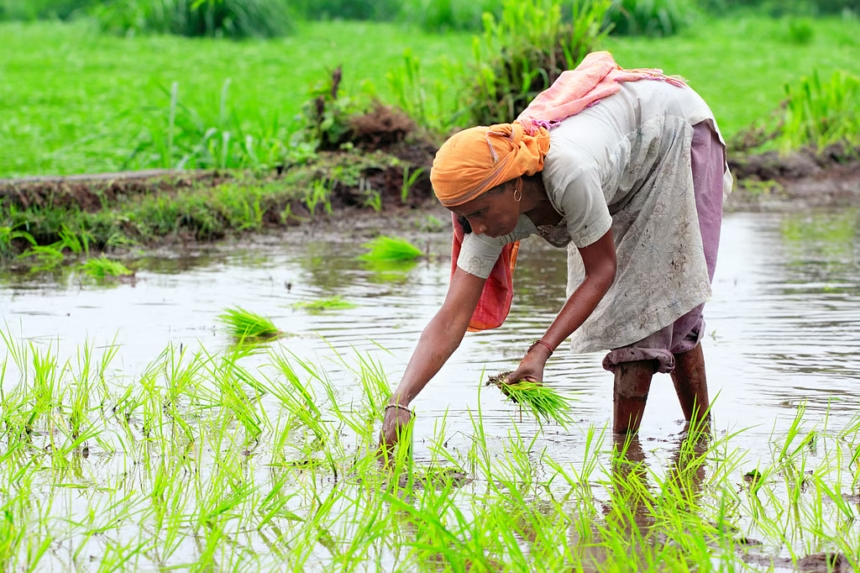
The United Nations has designated 2026 as the International Year of the Woman Farmer (IYWF) . This landmark declaration aims to spotlight the millions of women worldwide who form the “invisible backbone” of agriculture and food systems . It is a global call to action to recognize their contributions, address the structural barriers they face, and support their empowerment .
The Reality of Women in Agriculture
Globally, women make up approximately 41% of the agricultural workforce, and in regions like South Asia and sub-Saharan Africa, this figure can be as high as 70% . In China, it is estimated that rural women constitute 60% of the agricultural workforce . They are deeply involved in every aspect of food production, from planting and harvesting to processing, trading, and ensuring household nutrition .
Despite their crucial role, women farmers remain largely invisible in policy and statistics . Their work is often informal, underpaid, and unrecognized . A significant challenge is the disproportionate burden of unpaid care work they shoulder—in Bangladesh, for example, women spend 7.3 times as many hours as men on care and domestic work daily .
Persistent Structural Barriers
Women farmers face numerous systemic obstacles that limit their productivity and economic independence . These include:
- Limited Access to Land: In many regions, women have significantly less access to land ownership and control than men. For example, only about 13% of rural women in Bangladesh have sole or joint land ownership, compared to 70% of men .
- The Productivity Gap: Due to these inequalities, when women and men farm plots of the same size, women’s output is on average 24% lower . In addition, women working in agrifood systems earn only 78 cents for every dollar earned by men .
- Lack of Access to Resources: Women often have less access to credit, training, technology, extension services, and markets, which hampers their ability to innovate and adapt to challenges like climate change .
The Opportunity and the Call to Action
The IYWF is not just about recognition; it is about driving action . Studies have shown that closing the gender gap in agriculture could bring immense economic and social benefits. For instance, the Food and Agriculture Organization (FAO) estimates that equalizing agricultural productivity and wages between men and women could raise global GDP by USD 1 trillion and reduce food insecurity for 45 million people .
Women farmers are not passive beneficiaries. They are powerful agents of change . The International Year of the Woman Farmer 2026 provides a pivotal opportunity to move from symbolism to tangible change—to ensure that the women who feed the world are no longer invisible, but are recognized as central to building resilient, ethical, and sustainable futures .