
Ames, Iowa: The challenge with conservation drainage is knowing which practice fits which field and understanding what each practice can realistically accomplish. “I think of conservation drainage as ‘from the field to the stream’ and how we can design and implement practices to reduce downstream nutrient loss and enhance productivity in the field,” said Matt Helmers, a professor at Iowa State University and director of the Iowa Nutrient Research Center .
The practices differ in where they fit, what they cost, and problems solved. But they share a purpose: intercepting nitrates before they leave the farm.
Controlled Drainage
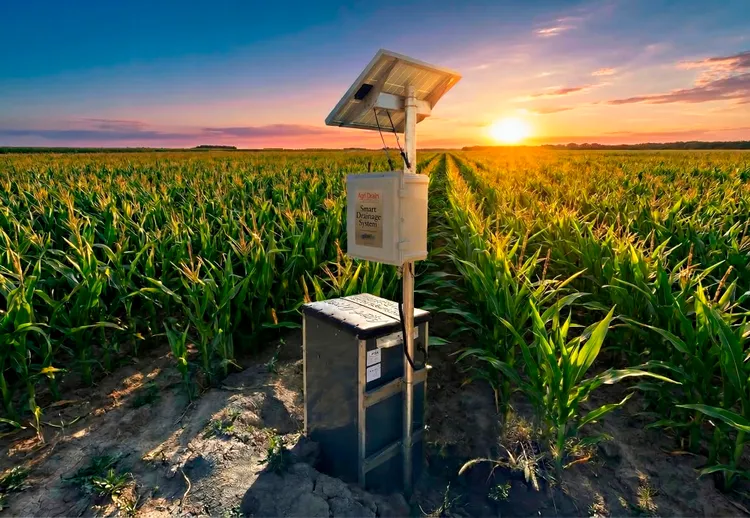
Controlled drainage, also called drainage water management, uses a water control structure within a tile system to hold water in the soil profile rather than draining it away continuously, said Scott Lukan, CEO of Agri Drain. Following spring fieldwork, farmers can set the water table by crop root depth — for corn, often 24–28 inches through the growing season, dropping to 48 inches during fall fieldwork.
“We’re seeing an additional yield increase of 5–15% beyond what you already got by installing the tile alone,” Lukan said.
Topography determines where controlled drainage fits. Fields with slopes of 1–2% are generally the best candidates, but the entire field doesn’t have to qualify, said Keegan Kult, executive director of the Agricultural Drainage Management Coalition. “You might have a 15- or 20-acre area that’s flat enough, where you can put a structure to manage that water,” he said. Recent Michigan State University research has also found controlled drainage can reduce nitrate loss even on sloped fields, challenging long-standing recommendations .
Saturated Buffers
Saturated buffers route the water through a perforated pipe buried in an existing grass buffer rather than let it drain straight into a stream. This typically reduces nitrate by 40–45%, said Laura Christianson, adjunct research associate professor at the University of Illinois.
But the site has to fit. “You have to have the buffer space, and the average length of a saturated buffer distribution pipe is about a thousand feet,” Christianson said. “Underground, you can’t have layers of gravel or sandy layers, because the water will move too quickly to the creek through that sandy layer.”
Life span is measured in decades, Christianson said, with relatively little maintenance beyond periodically checking that water is flowing properly and the control structures are set correctly. Farmer Recker estimated his saturated buffer cost about $8,000 to install, although costs vary by site and timing. “I set it and never touch it,” Recker said, aside from opening the stop logs occasionally to drain the area before mowing.
Wood-Chip Bioreactors
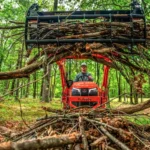
Wood-chip bioreactors are, in Christianson’s description, “literally pits full of wood chips” that tile water routes through, in which bacteria convert nitrate to nitrogen gas. Bioreactors have small footprints, about 0.1% of the drainage area, making them more adaptable to odd corners than saturated buffers.
Christianson estimated bioreactors reduce overall nitrate loads by about 25%. The wood chips can remove a greater share of nitrate from the water that passes through them, but during high-flow events, roughly half the drainage water may bypass the bioreactor by design. That keeps the bioreactor from restricting drainage and backing water up into the field.
The wood chips don’t last forever. Michael Ganschow, a farmer in northern Illinois, installed a 15×30-foot bioreactor. The system, which treats 17–18 acres, cost about $30,000, covered through a 2018 Farm Bureau cost-share program. “The wood chips have been degrading so much that I probably need to add more,” Ganschow said. He said the chips have decomposed and settled 3 or 4 feet since installation.
Wetlands
Wetlands require considerably more land than saturated buffers and bioreactors, making available space an important consideration. “If you had a 1,000-acre drainage area, you would need 10 acres for the wetland and then 20 additional acres around for the buffer area,” Christianson said.
Constructed wetlands can vary widely in scale. Iowa has emphasized larger wetlands that receive drainage from 1,000–2,000 acres, while Illinois has focused more on smaller wetlands treating 30–50 acres, Christianson said. Both sizes can be found across the Midwest.
Recker’s 21-acre wetland, built in 2020 to treat 750 acres of watershed upstream of his farm, cost roughly $250,000. He figured the annual cost, spread across an expected 100-year life span, at around $2 an acre. Of the practices he’s installed, Recker said the wetland is his favorite. “It’s a permanent conservation [practice],” he said.