
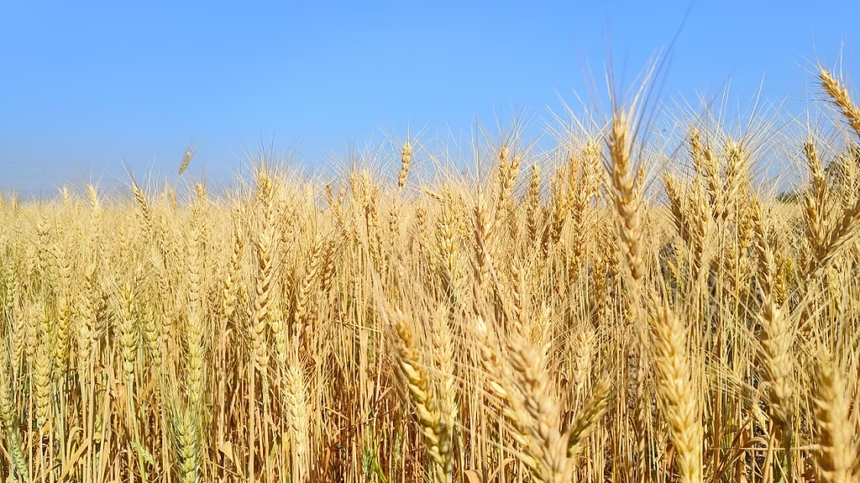
The origin story of the world‘s most consumed cereal grain has been rewritten. An international study published in the Proceedings of the National Academy of Sciences (PNAS) has confirmed that the South Caucasus region, specifically Georgia, served as an independent and oldest documented centre for the domestication of bread wheat (Triticum aestivum) .
The research, led by Academician David Lordkipanidze of the Georgian National Museum, provides direct archaeological evidence that Neolithic farmers were cultivating bread wheat approximately 8,000 years ago . This discovery bridges the gap between previous genetic theories and physical proof, establishing the region as a pivotal location in agricultural history.
Solving an 8,000-Year-Old Mystery
For years, genetic studies suggested that bread wheat originated around 8,000 years ago from a hybridization of domesticated free-threshing wheat and the wild goatgrass (Aegilops tauschii) . While geneticists pointed to the South Caucasus or southwestern Caspian region as the likely location—based on the distribution of wild goatgrass—physical proof had remained elusive .
This study changes that. By analyzing charred plant remains excavated from the Neolithic villages of Gadachrili Gora and Shulaveris Gora in Georgia, scientists identified the distinct rachis segments (the part of the plant that holds the grain) of bread wheat . To distinguish it from the similar-looking durum wheat, the team relied on precise morphological analysis.
Radiocarbon dating conducted at the Weizmann Institute of Science in Israel confirmed the samples date back to the beginning of the sixth millennium B.C. (approximately 5922 to 5747 B.C.E.), making them the oldest known physical evidence of bread wheat in the archaeological record .
The Cradle of Bread and Wine
The farmers responsible for this agricultural breakthrough belonged to the Shulaveri-Shomutepe culture. Intriguingly, earlier research at the same sites uncovered evidence of the world’s oldest known grape domestication and wine production .
This paints a picture of a highly advanced neolithic society where agriculture, grain processing, and winemaking emerged simultaneously.
“It is the first documented evidence of bread wheat,” David Lordkipanidze told Discover Magazine. “Our ancestors were hunter-gatherers, and they were becoming farmers, which is a big shift in human history. Here we can see the evidence” .
Co-author Stephen Batiuk from the University of Toronto noted that this research challenges the historical narrative of the region. “The Caucasus have long been seen as a ‘peripheral’ region… Our research challenges this narrative, highlighting that the Caucasus is an important region where key innovations to the development of the Near Eastern World were first created” .
Why Bread Wheat Matters
Today, bread wheat accounts for 95% of all wheat consumed worldwide, making it one of the most crucial crops for global food security . Unlike its hulled predecessors, which required arduous processing to remove the tough husk, bread wheat is ‘free-threshing‘—a genetic trait that made harvesting and consumption significantly more efficient.
Georgian officials have embraced the finding. Minister of Environmental Protection and Agriculture David Songulashvili stated, “Our land, which for centuries has preserved the unique tradition of vine and wine culture, can now be definitively recognised as the homeland of bread as well” . The government has noted that five of the world‘s known wheat species are endemic to Georgia .
The study not only rewrites the history books for one of humanity’s most essential foods but also solidifies the South Caucasus’s reputation as a independent innovator in the dawn of agriculture .