
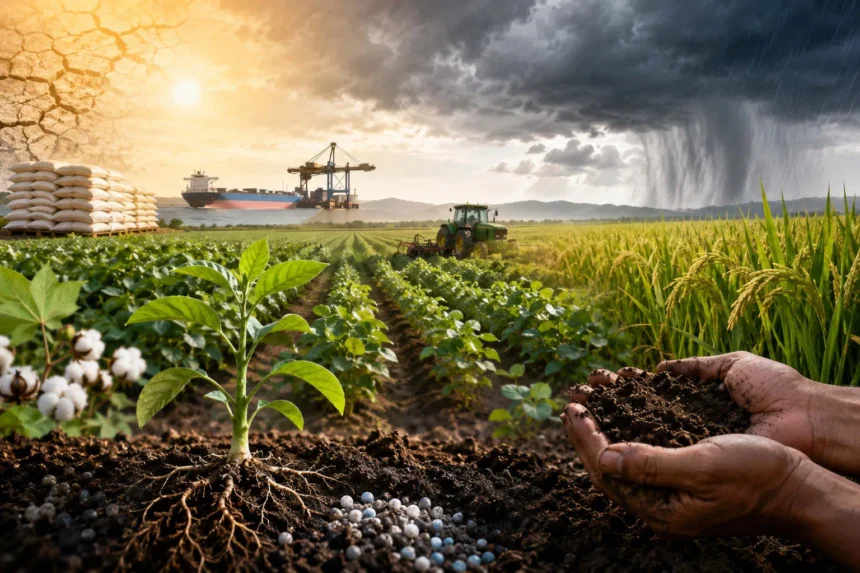
Global food markets have learned to price climate risk. Every monsoon forecast, every dry El Niño prediction, every flood in a major growing region now moves commodity prices almost instantly. The cost of inaction is calculated, hedged, and passed down the supply chain. The insurance premiums are adjusted. The futures markets react.
But the agronomic response—the actual practice of farming in a destabilized climate—remains stubbornly, dangerously underdeveloped.
This is the gap that threatens food security more than any single extreme weather event. Climate risk is priced in, but the agronomic response is not.
Why adoption lags despite available solutions
The International Crops Research Institute for the Semi-Arid Tropics (ICRISAT) and CIMMYT, with funding from the Novo Nordisk Foundation, recently launched a five-year initiative to fast-track climate-resilient crops for dryland farmers in Eastern Africa and India . The initiative combines AI-driven predictive breeding, genomic selection, and speed breeding to reduce breeding cycle times by at least two years .
The technology exists. The science is accelerating. Yet farmers are not adopting it at scale.
A study published in Scientific Reports examined barriers to climate-smart agriculture (CSA) adoption among 321 smallholder farmers in Odisha, a state frequently affected by droughts, floods, and cyclones. The findings were stark: socio-economic challenges—particularly lack of finance (70-74%), small landholdings (34-41%), and insecure land tenure (33-40%)—were the strongest barriers . Technological hurdles such as limited knowledge (38-39%) and lack of technical skills (25-27%) also constrained uptake .
The gap is not just about access to technology. It is about the ecosystem required to make that technology usable.
The NICRA paradox
India’s National Innovations in Climate Resilient Agriculture (NICRA) project, implemented by ICAR, has identified 310 climatically vulnerable districts, of which 109 are categorized as ‘very high’ risk and 201 as ‘highly’ vulnerable . Under NICRA, location-specific climate-resilient technologies have been demonstrated in 151 districts across 448 Climate Resilient Villages .
Yet the same study found that participation in NICRA sometimes increased the reporting of barriers, possibly because it heightened awareness of the challenges involved in implementing climate-resilient farming . Farmers became more conscious of what they lacked—finance, knowledge, secure land rights—without necessarily gaining the means to overcome those gaps.
This is the paradox of well-intentioned programs: awareness without enablement can deepen frustration.
The institutional gap
Institutional support plays a mixed role. Cooperative membership and larger household size were associated with lower barriers, suggesting that social networks and labour availability help farmers adopt new practices . But institutional barriers—inadequate market connections, poor extension services, and limited access to financing—remain higher in non-NICRA villages .
The Asia-Pacific Climate Change Adaptation Information Platform’s case study on coastal South Asia further underscores the policy-practice gap. National climate policies and agricultural programs do not always incorporate field realities in coastal zones, and climate-resilient agro-farming is not yet fully reflected in national implementation .
The researchers used multi-criteria decision-making tools to assess agricultural sustainability and policy coherence, finding significant gaps between national instruments and farm-level practice across Bangladesh, India, Pakistan, and Sri Lanka .
The financial dimension
Even a 1 degree Celsius rise in temperature can reduce crop yields by 4.5–9%, potentially causing economy-wide losses of up to 1.5% of GDP annually, according to Crisil Intelligence . Yet funding for climate-resilient agriculture remains limited.
Schemes such as PM-PRANAM and Market Development Assistance, which aim to promote balanced and organic inputs, account for just 0.1% of the fertiliser budget in FY26 . The investment in adaptation does not match the scale of the risk.
The AI opportunity
One promising pathway is AI-powered agromet advisory services. ICRISAT and its partners have developed platforms—the Intelligent Systems Advisory Tool (iSAT) and Next-Gen Climate Services Dashboard (NGCS)—that integrate historical climate data, real-time forecasts, and local agronomic information to generate automated, context-specific advisories .
Field pilots across India have demonstrated significant improvements, with 72% of farmers rating the advisories as highly useful . These platforms are now being scaled under India’s Monsoon Mission-III and adapted for Africa through CGIAR initiatives .
But advisories alone do not solve the adoption problem. A farmer who receives a precision irrigation advisory still needs access to water. A farmer who receives a pest forecast still needs affordable biological inputs. Knowledge without infrastructure is not actionable.
What success looks like
In Kenya’s drylands, ICRISAT’s AICCRA project has taken a different approach. By providing energy-saving ovens to organized women’s groups and training them in value addition for drought-tolerant crops such as sorghum, millets, pigeon pea, and groundnuts, the project has created both climate resilience and economic opportunity .
The intervention addresses multiple barriers simultaneously: technological (through equipment), economic (through income generation), and institutional (through group-based enterprise). Women are not just adapting—they are building businesses.
This model is replicable. It requires coordination across seed systems, extension services, market linkages, and financial inclusion. It treats agronomic response not as a technology transfer problem but as a systems change problem.
The path forward
Climate risk is now priced into global markets. But the agronomic response—the actual ability of farmers to adapt—remains disconnected from that price signal.
The barriers are well documented: lack of finance, small landholdings, insecure tenure, limited knowledge, weak institutions. The solutions exist: AI-powered advisories, drought-tolerant seeds, precision irrigation, value addition infrastructure. The missing link is not technology—it is the coordinated investment and institutional design to make these solutions accessible, affordable, and actionable at farm scale.