

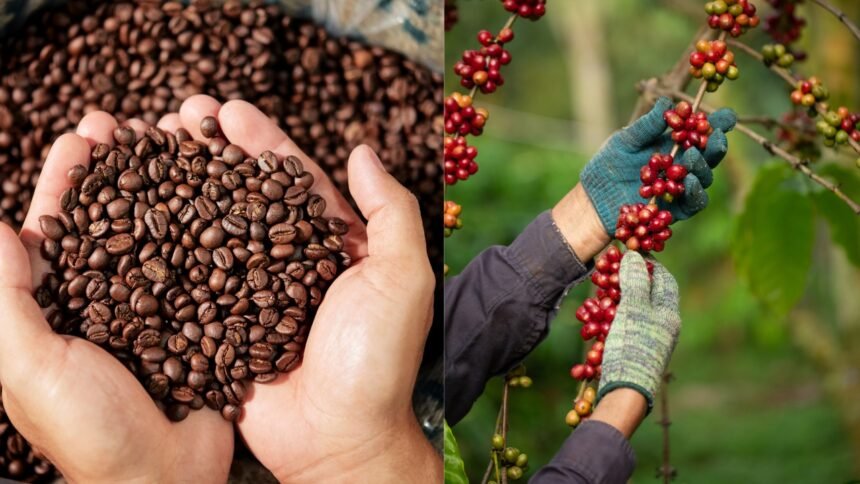
The International Coffee Organisation (ICO) has issued a stark warning: rising fertiliser prices, driven by geopolitical tensions in West Asia, pose a significant risk to global coffee production. While the current 2025-26 crop may not suffer immediately, prolonged disruption could seriously impact the 2026-27 harvest.
In its latest market report for March 2026, the ICO highlighted that between one-quarter and one-third of global fertiliser trade – including up to one-third of nitrogen fertilisers (urea) – transits through the Strait of Hormuz. The Gulf region is also a major fertiliser producer, making supply chains particularly vulnerable.
Coffee Prices Rebound After Three Months of Decline
Global coffee prices rebounded in March 2026 after three consecutive months of decline, driven largely by tensions in West Asia that disrupted shipping routes through the Strait of Hormuz.
| Indicator | March 2026 Value | Change vs Feb 2026 |
|---|---|---|
| ICO Composite Indicator Price | 273.70 US cents/lb | +2.3% |
| Colombian Milds | 337.45 US cents/lb | +2.0% |
| Other Milds | 334.34 US cents/lb | +4.0% |
| Brazilian Naturals | 320.51 US cents/lb | +3.9% |
| Robustas | 176.77 US cents/lb | -1.6% |
The price rebound reflects heightened freight costs and supply chain uncertainty. Around 25% of the world’s seaborne oil trade and almost 20% of global liquified natural gas exports transit through the Strait of Hormuz, making any disruption highly consequential for agricultural input costs.
Why Fertiliser Prices Matter for Coffee
Fertilisers are essential for coffee cultivation. Nitrogen-based fertilisers, in particular, help coffee plants develop healthy foliage and maximise cherry production. When fertiliser prices spike, growers face a difficult choice:
- Absorb the higher costs – reducing profit margins
- Reduce fertiliser application – leading to lower yields in future harvests
- Abandon or reduce planted area – especially for smallholder farmers
According to the ICO, fertilisers have already been applied for the current 2025-26 crop in most cases, so immediate production is unlikely to suffer significantly. However, if the disruption is prolonged, the 2026-27 crop is at risk.
Global Coffee Exports Decline Amid Supply Constraints
Global green bean exports of Robustas fell 3.7% to 4.05 million bags in February 2026, compared to 4.2 million bags in February 2025. The decline was primarily due to reduced shipments from Vietnam, the world’s largest Robusta exporter.
Overall coffee exports declined 5.7% year-on-year to 11.46 million bags in February 2026, reflecting weaker supply from major producers such as Brazil and Colombia.
| Region | Export Performance |
|---|---|
| South America | Exports plunged 21.8% |
| Colombia | Shipments dropped sharply due to lower production |
| Asia & Oceania | Exports fell 4.7% (partially offset by India) |
India Emerges as a Beneficiary
Amid global supply disruptions, India has emerged as a significant beneficiary. The country’s coffee exports posted a strong growth of an estimated 38.5% in February 2026, reaching about 0.79 million bags, compared with 0.57 million bags a year earlier.
India’s Coffee Export Performance (FY ending March 2026)
- Record exports: $2.136 billion
- Volumes: Over 4.07 lakh tonnes (approximately 4.07 million bags)
- Key driver: Higher prices and modest volume increase
The surge in Indian shipments came at a time when Vietnam, the world’s largest Robusta exporter, saw a sharp drop in exports due to the timing of the Tết holiday. This created an opportunity for Indian exporters, particularly in the Robusta and soluble coffee segments, to capture additional market share.
Besides India, other exporters such as Brazil and Indonesia also benefited from Vietnam’s downturn.
Mixed Price Trends Across Coffee Varieties
While the overall ICO Composite Indicator rose, different coffee varieties experienced varied price movements in March 2026:
Price Increases:
- Colombian Milds: +2.0% to 337.45 US cents/lb
- Other Milds: +4.0% to 334.34 US cents/lb
- Brazilian Naturals: +3.9% to 320.51 US cents/lb
Price Decline:
- Robustas: -1.6% to 176.77 US cents/lb
On futures exchanges:
- London ICE (Robusta): Decreased 2.5% to 161.91 US cents/lb
- New York ICE (Arabica): Increased 0.5% to 290.18 US cents/lb
The Bigger Picture – West Asia Tensions and Global Agriculture
The ICO’s warning is part of a broader narrative about how geopolitical instability in West Asia is rippling through global agricultural markets. The Strait of Hormuz blockade – whether full or partial – directly impacts:
- Fertiliser shipments from Gulf producers
- Natural gas exports needed for nitrogen fertiliser production
- Freight and insurance costs for all goods transiting the region
These factors do not just affect coffee. They impact every crop that relies on synthetic fertilisers, including wheat, corn, rice, and vegetables. However, coffee is particularly sensitive because:
- Most coffee is grown by smallholder farmers with thin profit margins
- Coffee is a perennial crop – trees take years to mature, so reduced fertiliser application has long-lasting effects
- Supply chains are less flexible than for annual crops
A Bitter Harvest Ahead?
The ICO’s report makes clear that the coffee industry is facing a two-stage threat:
| Stage | Impact | Timeline |
|---|---|---|
| Immediate | Higher fertiliser prices → higher production costs | Now – 2026 |
| Secondary | Reduced fertiliser application → lower yields | 2026-27 crop |
For now, coffee drinkers may see modest price increases at cafes and supermarkets. But if the Strait of Hormuz disruption continues into the second half of 2026, the 2026-27 harvest could be significantly smaller, leading to sharper price increases in 2027 and beyond.
As one analyst noted: “The world’s coffee supply chain is more fragile than most consumers realise. A disruption in one narrow waterway can affect millions of farmers and billions of coffee drinkers.”
For India, the crisis presents both a challenge and an opportunity. Higher global prices benefit exporters, but sustained fertiliser cost inflation could eventually erode profitability for domestic growers. For now, Indian coffee exporters are capitalising on Vietnam’s temporary slowdown – but the long-term outlook remains uncertain.