

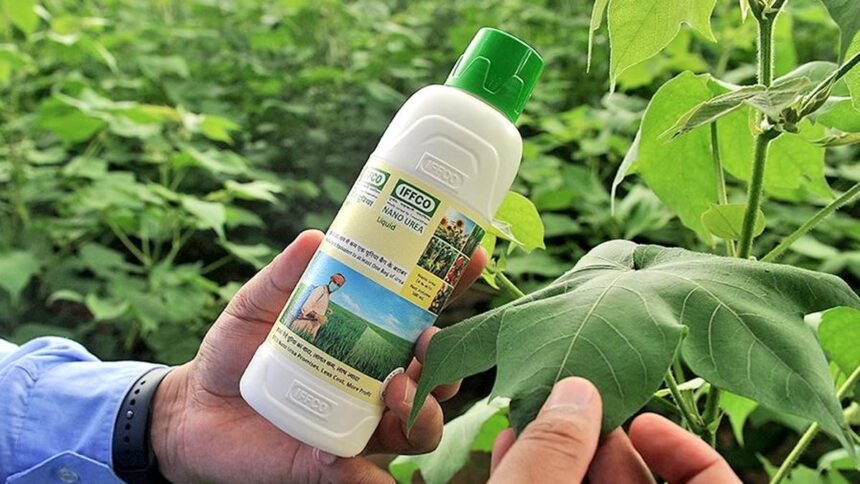
India’s agricultural transformation has long been driven by technological shifts. Today, nano urea is being positioned as the next leap: a precision input that promises higher efficiency, lower environmental damage, and reduced dependence on conventional fertilisers. Backed by policy support and fast-tracked approvals, its rollout has been rapid and ambitious.
Yet a critical question remains insufficiently examined: are we scaling nano urea faster than we are understanding its long-term implications for public health and environmental safety?
The Promise of Nano Urea
| Claim | Details |
|---|---|
| Size | 20-50 nanometre range (designed for foliar application) |
| Nitrogen-Use Efficiency | Could rise to nearly 70% (vs 30-35% for conventional urea) |
| Yield Gains | 3-9% (as per field trials) |
| Conventional Urea Reduction | Could fall by up to 25% |
In a country grappling with nitrogen overuse, groundwater contamination, and rising fertiliser subsidies, these gains matter. But efficiency alone does not make a technology risk-free.
When Size Changes Behaviour: The Nanotoxicology Concern
| Aspect | Risk |
|---|---|
| Small Size | Allows crossing of biological barriers |
| High Reactivity | Can interact with cellular systems |
| Particle Persistence | May accumulate within tissues (liver, lungs, kidneys, brain) |
| Oxidative Stress | Can trigger inflammation, DNA damage, apoptosis |
| Potential Links | Carcinogenic and neurodegenerative outcomes (Alzheimer’s, Parkinson’s) |
What sets nano urea apart is not just its formulation, but its scale. At the nanoscale, materials behave differently. Nanotoxicology research shows that engineered nanoparticles can enter systemic circulation and get deposited in organs, where persistence may trigger chronic toxicity.
Crucially, toxicity rises as particle size falls. Reducing size from about 30 nm to 3 nm can increase reactive surface atoms from roughly 10% to nearly 50%, amplifying biological interactions.
Pathways We Barely Track
| Exposure Pathway | Uncertainty |
|---|---|
| Spray Drift & Runoff | Fate of nanoparticle carriers or stabilising agents unclear |
| Dietary Exposure | Do nanoparticles persist in plant tissues? Can they enter the food chain? |
| Monitoring Gaps | India lacks systematic mechanisms to track such pathways |
The risks extend beyond direct exposure. Spray drift and runoff can introduce nano urea into soil and water systems. While conventional urea hydrolyses into ammonium and nitrate, the fate of nanoparticle carriers or stabilising agents remains unclear.
Even more uncertain is dietary exposure. Do nanoparticles persist in plant tissues? Can they enter the food chain?
Early Warnings, Familiar Patterns
| Past Example | Lesson |
|---|---|
| DDT and Endosulfan | Health impacts emerged after widespread use |
| Bhopal Gas Disaster | Catastrophic consequences of delayed regulation |
| Arsenic & Fluoride Contamination | Long-term public health costs |
| Mercury Pollution (Kodaikanal) | Environmental and health damage |
| E-waste Recycling (Seelampur) | Toxic exposure from informal sector |
The risks associated with new materials often become evident only after widespread, long-term exposure. India’s past experiences underscore a recurring pattern of delayed regulation and substantial long-term public health costs.
Regulation Still Catching Up
| Action | Gap |
|---|---|
| 2026 amendment to Fertiliser Control Order | Stricter biosafety testing, product approvals, safety labelling |
| Missing | Robust post-market surveillance, environmental residue monitoring, long-term health outcome studies |
The government has begun to respond. The 2026 amendment to the Fertiliser Control Order introduces stricter requirements for biosafety testing, product approvals, and safety labelling. However, these remain largely focused on pre-market evaluation.
What is missing is robust post-market surveillance—tracking real-world exposure, monitoring environmental residues, and studying long-term health outcomes.
Globally, regulatory frameworks are more cautious. The European Union and the United States emphasize case-by-case risk assessment of nanomaterials, with a strong focus on long-term safety and environmental behaviour.
The Way Forward
| Recommendation | Action |
|---|---|
| Strengthen Surveillance | Long-term health monitoring |
| Expand Monitoring | Environmental residue tracking |
| Independent Validation | Verify safety claims |
| Farmer Awareness | Inform end-users of potential risks |
India does not need to abandon nano urea. But it must adopt a more precautionary, evidence-based approach.