
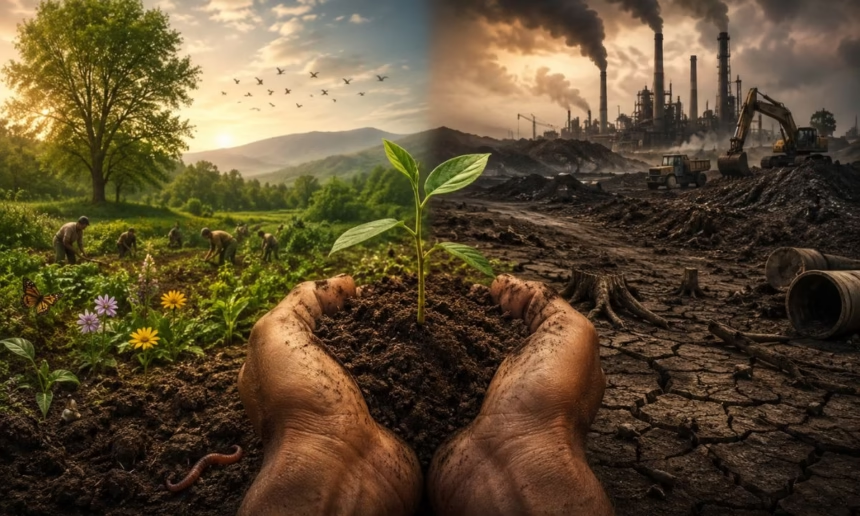
It takes a thousand years to build just a few centimetres of topsoil. Yet, in a single generation of intensive chemical farming, deforestation, and urban expansion, India has managed to undo what nature spent millennia creating.
The National Academy of Agricultural Sciences (NAAS) estimates that nearly 30% of India’s total geographical area is undergoing land degradation. The economic loss due to land degradation and soil erosion is estimated at 2.5% of GDP annually – over ₹6 lakh crore every year.
What is being lost
Healthy soil is not dirt. It is a living ecosystem – billions of bacteria, fungi, earthworms, and insects – all working together to cycle nutrients, store water, and support plant life. One teaspoon of healthy soil contains up to a billion bacteria.
India’s soils are losing this life. The Indian Council of Agricultural Research (ICAR) reports that soil organic carbon – the primary measure of soil health – has declined to less than 0.5% in most agricultural regions, far below the ideal level of 1-1.5%.
“We are mining our soil, not farming it,” says soil scientist Dr. R. S. Paroda. “Each crop we take removes nutrients. If we don’t return them organically, the soil becomes a mere growing medium – dead, dependent on chemical crutches.”
The cost of chemical dependency
India is the world’s second-largest consumer of chemical fertilizers. Yet, as noted in the first part of this series, nutrient use efficiency remains abysmally low – 30-45% for nitrogen, 15-25% for phosphorus.
The result is a vicious cycle: degraded soil requires more fertilizer to produce the same yield; more fertilizer further degrades soil biology; yields eventually plateau and decline; farmers apply even more chemicals.
Studies by ICAR show that continuous nitrogen-only application leads to declining yields and deterioration of soil properties. In contrast, balanced nutrient management including organic inputs can improve yields by 20-30% over nitrogen-only use.
The invisible crisis
Unlike air pollution or water contamination, soil degradation is invisible – until it is too late. Farmers do not see the microbes dying. They do not notice the slow compaction of soil that prevents root growth. They only see that their fertilizer bags are getting heavier and their harvests lighter.
“Soil degradation is the most underrated environmental crisis of our time,” says Dr. Rattan Lal, the first Indian to win the World Food Prize (2020) for his work on soil science. “It affects food security, water quality, climate change, and biodiversity – all at once.”
Government initiatives: A start
The government has launched several initiatives to address soil health:
Soil Health Card Scheme – Over 25.55 crore soil health cards have been distributed to farmers, providing plot-wise diagnostic reports on 12 key parameters. However, studies show that only about 30% of farmers actually use the cards to adjust their fertilizer application.
PM-PRANAM – The scheme incentivizes states to reduce chemical fertilizer use. In 2023-24, 14 states recorded a reduction of 15.14 lakh metric tonnes in chemical fertilizer consumption.
Natural farming push – The area under natural farming has expanded to over 12 lakh hectares, with 8 lakh farmers adopting zero-budget techniques. However, this remains a tiny fraction of India’s 140 million hectares of net sown area.
What needs to be done
Experts call for a multi-pronged approach:
Stop the loss first – Prevent further conversion of agricultural land for non-agricultural use. Protect prime farmland through zoning laws.
Rebuild organic carbon – Promote crop rotation, cover cropping, green manuring, and incorporation of crop residues. Every 1% increase in soil organic carbon can increase water-holding capacity by 20,000 litres per hectare.
Diversify cropping – The rice-wheat monoculture in North India has depleted soil organic carbon by 50-70% in some areas. Diversification with pulses, oilseeds, and millets can restore soil health while improving farmer incomes.
Incentivize soil restoration – Shift subsidies from fertilizers to soil health outcomes. Pay farmers for sequestering carbon, improving water infiltration, and reducing chemical inputs.
The time paradox
Soil formation is measured in centuries, even millennia. The United Nations Food and Agriculture Organization (FAO) states that it takes approximately 1,000 years to form 2-3 centimetres of topsoil. Yet, we lose an estimated 24 billion tonnes of fertile soil globally every year – roughly 3.4 tonnes for every person on the planet.
In India, the annual soil loss due to water erosion alone is estimated at 5.3 billion tonnes, according to ICAR’s National Bureau of Soil Survey and Land Use Planning. Much of this eroded soil ends up in reservoirs, reducing their storage capacity and causing flooding.
A generational choice
The soil crisis does not have a technological quick fix. No machine can rebuild a thousand years of biology. The restoration of soil health requires a fundamental shift in how we value land – not as a resource to be exploited, but as a living inheritance to be passed on.
“We have not inherited the earth from our ancestors. We have borrowed it from our children,” goes the old saying. When it comes to soil, the borrowing has turned into looting.
The next generation will not forgive us for what we have destroyed. But they will remember if we begin to restore it.